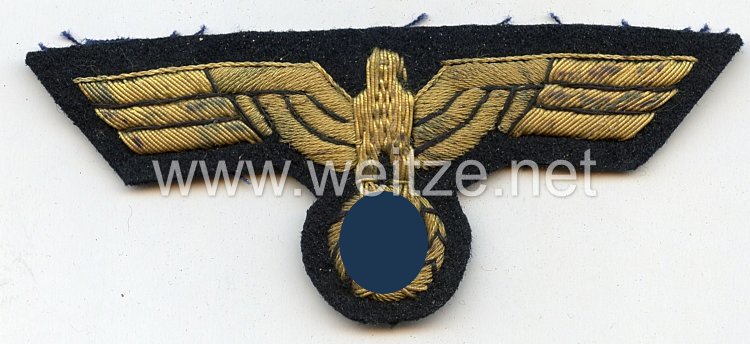
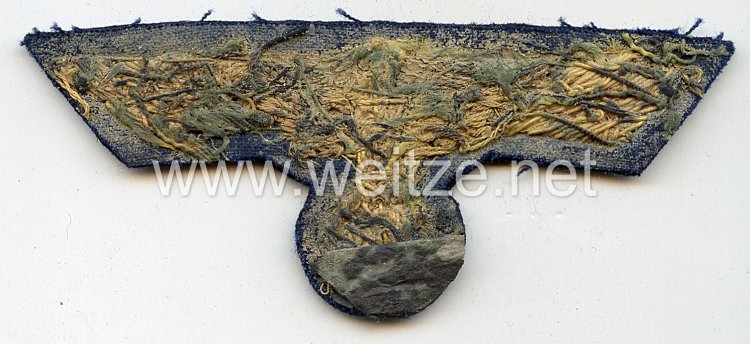
Kriegsmarine Breast Eagle for Naval Officers
The Kriegsmarine Breast Eagle for Naval Officers represents a significant example of military insignia and rank identification used by the German Kriegsmarine during World War II. This hand-embroidered version on dark blue base fabric embodies the traditional craftsmanship and strict uniform regulations of the National Socialist armed forces between 1935 and 1945.
The Kriegsmarine, officially established on June 1, 1935, replaced the Reichsmarine of the Weimar Republic and marked the beginning of the NS regime's massive rearmament policy under Admiral Erich Raeder and later Karl Dönitz. With the introduction of new uniform regulations, the national emblem in the form of the breast eagle was standardized for all branches of the Wehrmacht, with each service receiving specific variations.
The Kriegsmarine's breast eagle differed from those of the Army (Heer) and Air Force (Luftwaffe) in its particular design and manner of wear. For naval officers, the insignia was worn on the dark blue-black base fabric of the uniform tunic, which represented the characteristic navy color in accordance with maritime tradition. The variant described here, hand-embroidered with Cellon thread, represents the high-quality officer's version, which differed markedly from the machine-made or woven versions for enlisted personnel and non-commissioned officers.
Cellon, an artificial silk thread with metallic luster, was frequently used for officer insignia as it provided a more cost-effective alternative to genuine metal wire while still conveying a prestigious appearance. Hand embroidery required considerable craftsman skill and was often executed by specialized uniform tailoring shops and passementerie workshops. Well-known manufacturers of such insignia included companies like BEVO (Bandfabrik Ewald Vorsteher), although hand-embroidered examples were also produced by smaller local businesses.
The Kriegsmarine's uniform and insignia regulations were detailed in various service regulations. The breast eagle was worn on the right breast of the uniform tunic, above the pocket. The exact position was regulated and had to conform to specific spacing requirements. For officers, the quality of insignia was an expression of their status and position within the military hierarchy.
The eagle's design followed the National Socialist national emblem: a stylized eagle with spread wings, holding a swastika within an oak leaf wreath in its talons. This symbolism was standardized from 1935 onward for all military and state uses and was intended to represent the power and authority of the NS state. The right-facing eagle became the ubiquitous symbol of the Wehrmacht.
The described worn and stained condition of this example attests to its authentic use during the war years. Naval uniforms were particularly exposed to adverse conditions at sea – saltwater, humidity, and harsh working conditions aboard ship inevitably left their mark on uniforms and their insignia. Such wear patterns are typical of original pieces and distinguish them from later reproductions.
Following the end of World War II in May 1945, the Kriegsmarine was dissolved, and all its symbols and insignia were banned by the Allies. The wearing or public display of NS symbols remains legally prohibited in Germany and several other European countries to this day, except in the context of education, scholarship, and historical documentation.
From a military historical perspective, such objects are important testimonies to uniform history and the material culture of World War II. They document not only the craftsmanship and uniform regulations of the period but also serve as physical reminders of one of the darkest periods in German history. Museums and scholarly collections preserve such objects to research the history of this era and convey it to the public.
The collection and preservation of such military historical artifacts invariably raises ethical questions, particularly in connection with NS relics. Serious collectors and institutions emphasize the importance of historical context and the educational function of such objects while simultaneously rejecting any form of glorification or celebration.
Understanding these insignia within their proper historical framework allows researchers and the public to examine the organizational structures, regulations, and material culture of the Kriegsmarine. These objects serve as tangible links to the past, helping to ensure that the lessons of history are neither forgotten nor repeated.