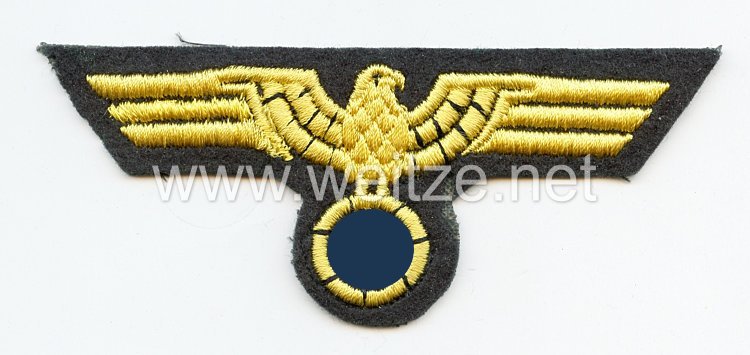
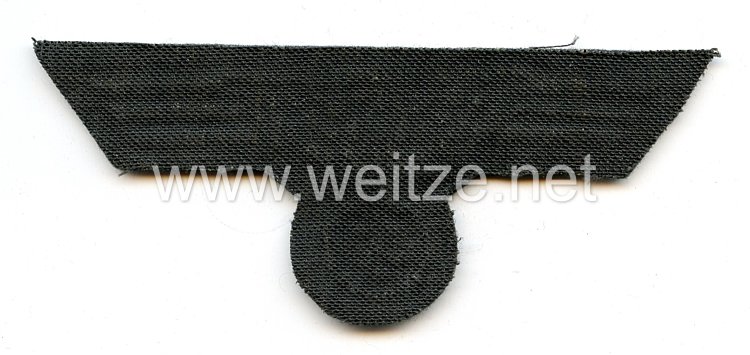
Kriegsmarine Breast Eagle for Enlisted Men Coastal Artillery and Land Units

machine-embroidered version on dark green wool, minor moth damage, condition 2.
447873
55,00

Kriegsmarine Breast Eagle for Enlisted Men Coastal Artillery and Land Units

The Kriegsmarine Breast Eagle for Enlisted Men of the Coastal Artillery represents a significant example of military insignia worn by the German Kriegsmarine during World War II. This machine-embroidered version on dark green fabric was specifically designed for and worn by members of the coastal artillery and land units of the Kriegsmarine.

The Kriegsmarine, as the naval force of the German Reich from 1935 to 1945, maintained various land-based units that received special uniforms. While traditional naval units aboard ships wore blue uniforms, green or field-gray uniforms were introduced for coastal artillery units and other land-based naval formations. This had practical reasons: coastal artillerymen and naval infantry operated in coastal fortifications and on land, where the dark blue naval uniform would have been too conspicuous.

The Kriegsmarine's uniform regulations from 1936 and subsequent amendments detailed the appearance and wearing of various insignia. The breast eagle was worn on the right breast and displayed the characteristic Reich eagle with outstretched wings, clutching a swastika in its talons - the official national emblem of Nazi Germany.

The machine-embroidered execution was typical for enlisted ranks. While officers often wore more elaborately crafted, hand-embroidered or metal breast eagles, enlisted men and non-commissioned officers typically received machine-made versions. These were more cost-effective to produce and could be manufactured in larger quantities, which was necessary given the massive expansion of the Kriegsmarine from 1935 onwards.

The dark green background is characteristic of the uniforms worn by coastal artillery and land units. The Kriegsmarine maintained extensive coastal fortifications, particularly after the beginning of the war against the Soviet Union and along the occupied coasts of Western Europe. These fortifications became part of the Atlantic Wall, an extensive defensive system stretching from Norway to the French-Spanish border. Tens of thousands of naval personnel served in these coastal batteries.

The Kriegsmarine's Coastal Artillery was equipped with various calibers, from medium 10.5-cm guns to heavy 40.5-cm cannons. These units played an important role in coastal defense and engaged enemy ships, but also supported land operations. Naval land units were additionally deployed as infantry, especially in the final years of the war, when the Kriegsmarine had to severely curtail its high-seas operations due to fuel shortages and Allied air attacks.

The production of such breast eagles was carried out by various manufacturers and suppliers throughout the German Reich. The textile industry was integrated into the war economy, and numerous companies produced military insignia, uniform parts, and equipment items. Quality could vary depending on the manufacturer and production period. Towards the end of the war, material shortages and deteriorating production conditions were often evident.

The breast eagle described here shows typical signs of use, including slight moth damage. This is characteristic of textile insignia from this period, which were worn and stored under often difficult conditions. Such traces attest to the authentic use and age of the object.

From a military-historical perspective, such breast eagles document the complex organizational structure of the Kriegsmarine and the various functions that naval units fulfilled during World War II. They commemorate the hundreds of thousands of men who served in the various branches of the Kriegsmarine, not only at sea but also in coastal defense installations, naval bases, and as land units.

Today, such objects are important historical witnesses that play a role in museums, collections, and in the scholarly study of 20th-century military history. They help to understand the material aspects of military organization and contribute to the documentation of this historical epoch.