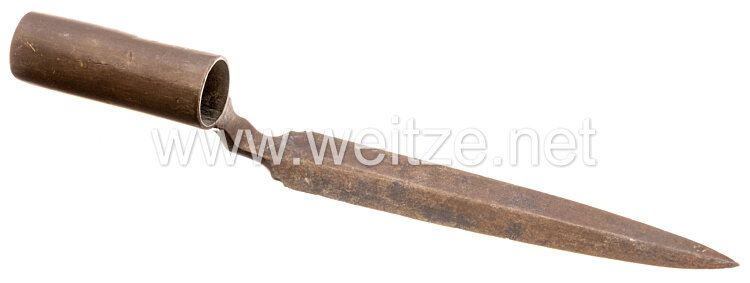
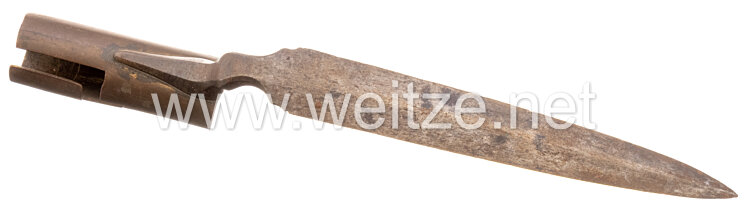
Italian Hunting Socket Bayonet
The Italian socket bayonet represents a significant component of the Italian army's military equipment, particularly in the context of infantry weapons development from the late 18th to the early 20th century. This specific variant with a brass socket and double-edged blade represents a classic type of edged weapon developed for various Italian rifle systems.
The socket construction characterizes one of the oldest attachment methods for bayonets. In this system, the hollow brass socket is slid over the rifle barrel and fixed by means of a slot and a stud on the barrel. This construction became established in European military affairs since the late 17th century and remained common until the late 19th century. Italy adopted this technology and adapted it to its own military requirements.
After Italian unification (1861), the new kingdom faced the challenge of standardizing its various regional armies. The Italian army equipped itself with different rifle types, including the Carcano rifle from 1891 onwards and earlier models such as the Vetterli rifle (from 1870). Corresponding bayonets were developed for these weapons, with both socket and later sleeve bayonets being used.
The described small variant suggests a special use. While standard bayonets often had blade lengths between 40 and 50 centimeters, there were shorter versions for special troop types or officers' weapons. Carbine versions for cavalrymen, artillerymen, or engineers often received shortened bayonets that were less cumbersome when riding or during technical work.
The double-edged design of the blade was typical for military thrusting weapons of this era. Unlike single-edged bayonets or saber bayonets, which also fulfilled cutting functions, the double-edged variant concentrated on the thrusting function. This construction corresponded to the military doctrine of the 19th century, which still attached considerable importance to bayonet combat.
The use of brass for the socket was widespread, as this material was corrosion-resistant, easily workable, and cost-effective. Brass could be easily cast and mechanically processed, which facilitated mass production. Additionally, the material prevented rusting onto the rifle barrel – an important practical aspect in field deployment.
Italy employed its socket bayonets in various military conflicts. The Italian-Austrian wars, the colonial campaigns in Africa (Ethiopia, Eritrea, Somalia), and later World War I saw the massive use of these weapons. Although the bayonet increasingly lost tactical significance in World War I, it remained a psychologically important element of infantry armament.
The hunting-style carry, as mentioned in the description, possibly refers to use by rifle troops (Italian: Alpini or Bersaglieri), who were considered elite units of the Italian army. These formations often received specially adapted equipment corresponding to their particular deployment profiles.
From a collector's perspective, Italian socket bayonets are sought-after militaria today. The condition “grade 2-” according to common rating scales indicates a worn but well-preserved specimen showing authentic signs of use but no significant damage. Such pieces document actual military use and therefore possess special historical value.
The development from socket to sleeve bayonet marked a technological change. While socket bayonets enclosed the barrel and did not affect readiness to fire, sleeve systems enabled a firmer connection and more versatile blade shapes. Italy made this transition like other European armies in the late 19th century but retained older socket variants partially in service for longer.
The historical significance of these bayonets extends beyond their military function. They represent an era when close combat still played a role in military thinking, and when standardization of military equipment became a crucial factor in building modern nation-states. Italian socket bayonets thus document both technological development and the political-military history of unified Italy.