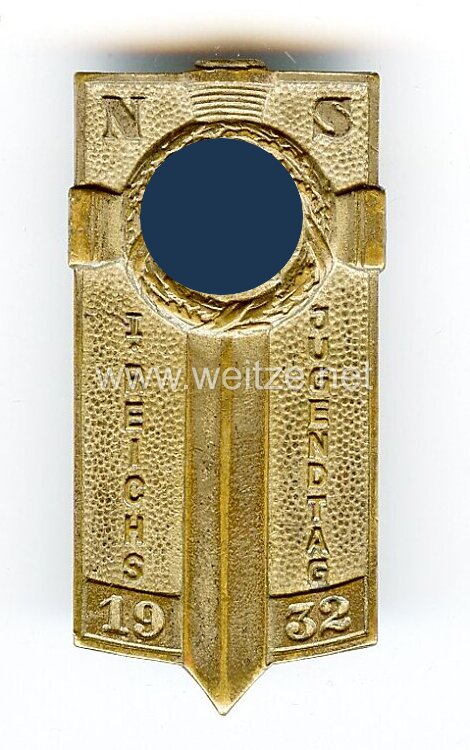
1st N.S. Reich Youth Day 1932 in Potsdam Visitor's Badge in Bronze

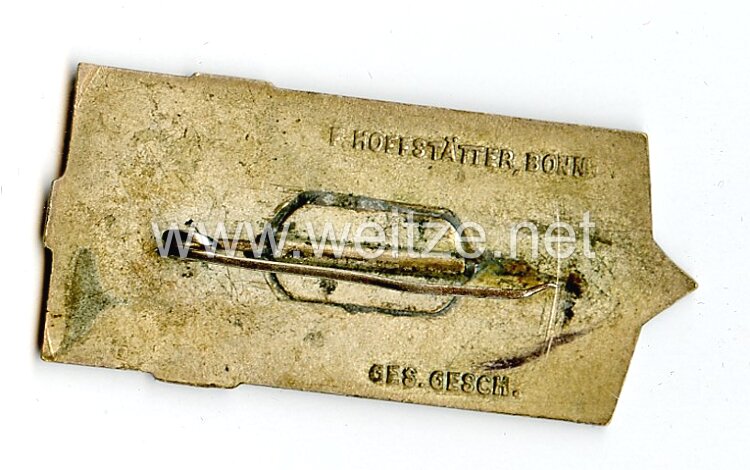
Non-ferrous metal construction. Pin catch broken off on reverse! Manufacturer: “F. Hoffstätter Bonn GES.GESCH.” 
452673
190,00

1st N.S. Reich Youth Day 1932 in Potsdam Visitor's Badge in Bronze

The Visitor's Badge for the 1st N.S. Reich Youth Day 1932 in Potsdam represents a significant historical document from the final phase of the Weimar Republic. This event took place on October 1-2, 1932 in the Prussian garrison city of Potsdam and marked an important milestone in National Socialist youth policy shortly before the seizure of power.

The Hitler Youth (HJ), founded in 1926 as the youth organization of the NSDAP, used this major event as a demonstration of its growing significance. The Reich Youth Day in Potsdam was a massive propaganda event that brought together over 70,000 young people from across Germany. The choice of Potsdam as the venue was symbolically significant: the city represented Prussian tradition and military values that the National Socialists sought to instrumentalize for their ideology.

This badge was manufactured in bronze (non-ferrous metal) and bears the maker's mark “F. Hoffstätter Bonn GES.GESCH.” The Hoffstätter company of Bonn was among the established manufacturers of orders, decorations, and badges in the Weimar Republic and later in the Third Reich. Such badges were produced in various versions - for participants, visitors, and functionaries - and served both as admission authorization and as souvenirs.

The production of visitor badges in different metals was customary: besides bronze, there were also versions in silver and possibly other materials that identified different participant categories. The reverse pin construction enabled wearing on the lapel or uniform. The condition described here with a broken pin catch is not unusual for objects of this age and testifies to material fatigue after more than 90 years.

The historical context of 1932 is of particular significance: Germany was in a deep political and economic crisis. The Weimar Republic was experiencing its final year, characterized by political instability, mass unemployment, and increasing political extremism. The NSDAP had achieved its best result in the Reichstag elections in July 1932 with 37.3% and had become the strongest force. The Reich Youth Day in Potsdam served the party to demonstrate its mass base and particularly to mobilize youth for its goals.

Under the leadership of Baldur von Schirach, who had been Reich Youth Leader of the NSDAP since 1931, the HJ was systematically expanded. The Potsdam Reich Youth Day was part of this strategy and was intended to display the unity and discipline of National Socialist youth. The event included marches, sporting competitions, ideological training, and mass rallies.

From a collection-historical perspective, such badges are today important study objects for research into NS propaganda and youth policy. They document the mobilization strategies of the NSDAP before 1933 and show how the party attempted to create an emotional bond with its followers, especially youth, through symbolic mass events and corresponding mementos.

The manufacturer's mark “GES.GESCH.” (legally protected) indicates legal protection of the design, which was common for official party badges to prevent counterfeiting. The quality of the non-ferrous metal production corresponds to the standards of the early 1930s, when the badge industry in Germany was highly developed.

Today, such objects serve in museums and scientific collections as material witnesses to a dark epoch of German history. They are important for historical education and help to understand the mechanisms of totalitarian propaganda and mass manipulation. The pedagogical value lies in the critical examination of the methods by which a democratic society was undermined and a dictatorship established.

The Reich Youth Day of 1932 was one of the last major NSDAP events before Hitler's appointment as Reich Chancellor on January 30, 1933. Within months of this event, the National Socialists would dismantle the democratic institutions of the Weimar Republic and establish their totalitarian regime. The badges and symbols from this transitional period therefore represent particularly important historical evidence of how the NSDAP prepared for power and mobilized its followers.

r