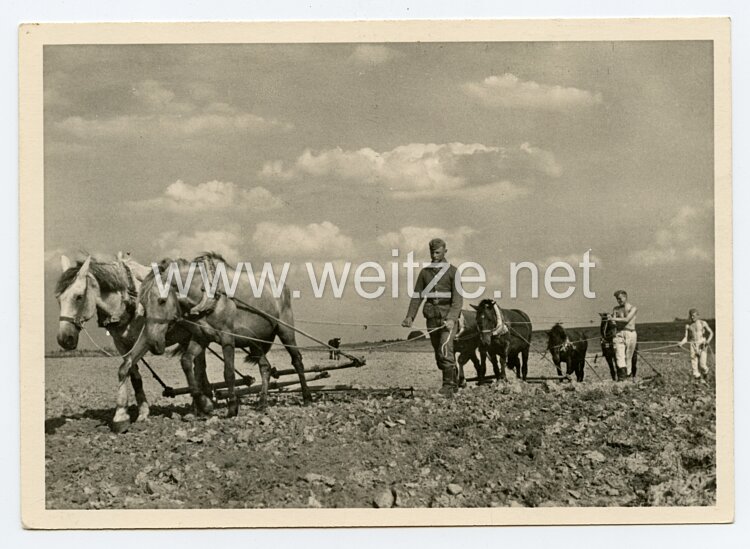
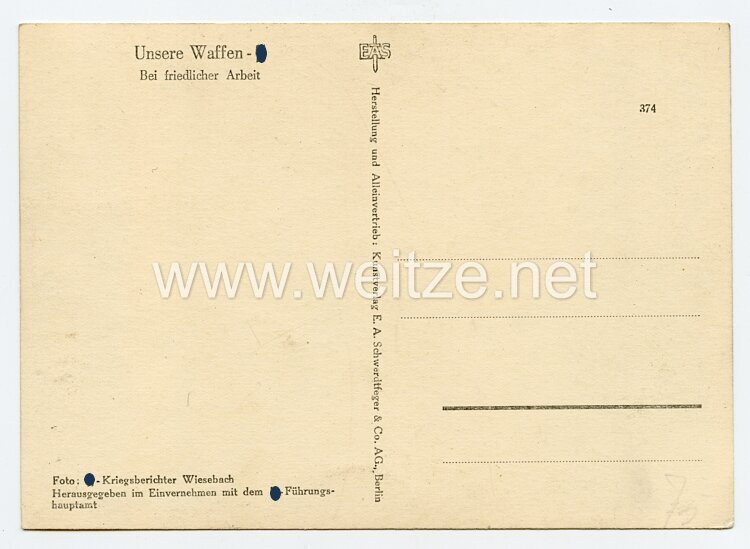
Waffen-SS - Propaganda Postcard - "Our Waffen-SS" - During Peaceful Work
This propaganda postcard from the series “Unsere Waffen-SS” (Our Waffen-SS) featuring the motif “Bei friedlicher Arbeit” (At Peaceful Work) represents a significant artifact of the Nazi propaganda machinery during World War II. Published by E.A. Schwerdtfeger Verlag in agreement with the SS-Führungshauptamt (SS Main Leadership Office), this postcard embodies the systematic efforts of the Nazi regime to present the Waffen-SS positively to the German public.
The SS-Führungshauptamt was established in August 1940 under the leadership of SS-Obergruppenführer Hans Jüttner and was responsible for the organization, training, and replacement system of the Waffen-SS. One of its important tasks consisted of controlling and coordinating propaganda material concerning the military formations of the SS. The fact that this postcard series was published “in agreement” with this central authority underscores the official nature and strategic importance of this propaganda.
E.A. Schwerdtfeger Verlag in Berlin was one of several publishers that worked closely with Nazi organizations and produced specialized propaganda material. Such publishers often received exclusive access to official photographs while simultaneously being subject to strict censorship and content guidelines from party and SS offices.
The motif “At Peaceful Work” is particularly characteristic of the Waffen-SS propaganda strategy during 1940-1943. While this formation primarily served military and later also criminal functions, propaganda attempted to paint a more versatile and humane picture. Such representations were intended to serve several purposes: first, to facilitate recruitment of new volunteers; second, to increase acceptance among the population; and third, to create a counter-image to purely military aspects.
The postcard series “Unsere Waffen-SS” comprised various motifs depicting different aspects of SS life. Besides combat scenes and military exercises, images were deliberately chosen showing SS members engaged in civilian activities, at leisure, or performing “constructive” work. This strategy corresponded to the National Socialist propaganda doctrine that sought to present elite formations as versatile “political soldiers.”
Postcards were an important propaganda medium in the Third Reich. They were inexpensive to produce, widely distributed, and reached broad segments of the population through postal traffic. Especially during the war, when millions of German soldiers were stationed at various fronts and lively postal communication existed between front and home, postcards played a significant role in maintaining morale and spreading political messages.
The condition grade 2 (according to the standard collector scale of 1-6, where 1 is the best condition) indicates a well-preserved specimen with only minor signs of wear. The fact that the card is unmailed, meaning never used postally, is of equal interest to collectors and historians. Unmailed postcards were often kept as collectibles or never used because their propagandistic purpose became obsolete with the war's end.
From today's historical perspective, such objects are important sources for researching Nazi propaganda and the self-representation of criminal organizations. The Waffen-SS was classified as a criminal organization by the International Military Tribunal at Nuremberg after World War II. Its members were involved in numerous war crimes and crimes against humanity, including massacres of civilians and prisoners of war, as well as participation in the Holocaust.
The discrepancy between the propagandistic portrayal of “peaceful work” and the historical reality of crimes makes such objects poignant testimonies to the manipulation techniques of totalitarian regimes. They document how systematically attempts were made to create a false image and conceal the true nature of this organization.
For academic research, such propaganda postcards are valuable primary sources that provide insight into the visual language, self-representation, and recruitment strategies of the Waffen-SS. They help understand how the Nazi regime attempted to create acceptance for its organizations and how propaganda functioned in everyday life.