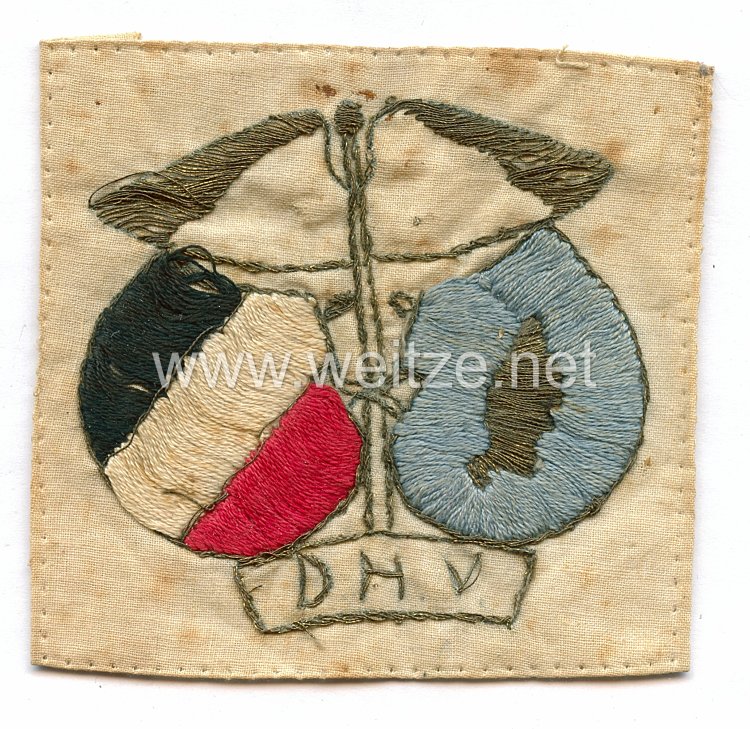
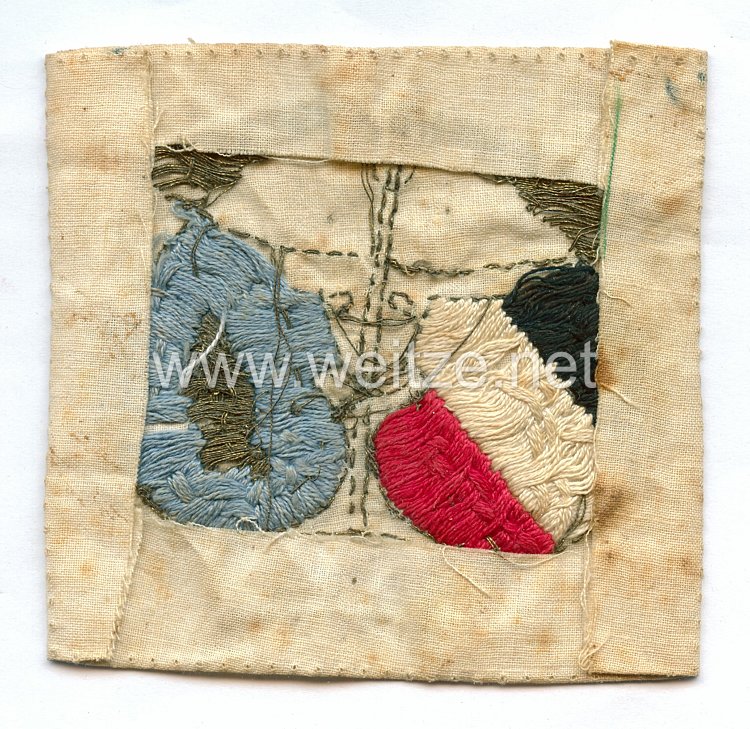
Cloth Insignia DHV "Deutschnationaler Handlungsgehilfen Verband" pre-1933

This is a cloth version, hand-embroidered, 9.5 x 9 cm, condition 2-3
328372
50,00

Cloth Insignia DHV "Deutschnationaler Handlungsgehilfen Verband" pre-1933

The cloth badge of the Deutschnationaler Handlungsgehilfen-Verband (DHV) represents a fascinating testimony to German social and organizational history during the Weimar Republic. This hand-embroidered specimen measuring 9.5 x 9 cm represents one of the most significant employee organizations of the interwar period.

The German National Union of Commercial Employees was founded in 1893 in Hamburg and developed into one of the most influential professional organizations for commercial clerks in the German Reich. The term “Handlungsgehilfe” was the contemporary designation for commercial employees working in trade and offices. From its inception, the association pursued an explicitly German nationalist and antisemitic orientation, which distinguished it from other employee unions.

During the Weimar Republic, the DHV reached its peak with over 400,000 members in the early 1930s. The organization offered its members not only trade union representation but developed a comprehensive system of social services, training facilities, and leisure activities. The association operated its own educational institutions, rest homes, and published several journals.

The symbolism and badges of the DHV played an important role in the organization's self-representation. Cloth badges like the present one were worn by members at official occasions, meetings, and events. The hand-embroidered execution indicates high-quality craftsmanship, possibly for functionaries or long-standing members. Unlike simple printed or woven versions, embroidery required considerable artisanal effort.

The political orientation of the DHV was characterized by völkisch nationalism, anti-Marxism, and antisemitism. The association rejected the Weimar Republic and advocated for an authoritarian state. Its statutes explicitly excluded Jews from membership. This ideology made the DHV an important precursor to National Socialism, even though the organization itself initially had a complicated relationship with the NSDAP.

The dating “before 1933” is of considerable historical significance. With the Nazi seizure of power in January 1933, the coordination of all associations and organizations began. In May 1933, the DHV, along with other unions and associations, was dissolved and incorporated into the German Labor Front (DAF). Many DHV functionaries found positions in the new NS organization, but the independent existence of the association ended.

The present badge thus originates from the high phase of the DHV between its founding in 1893 and dissolution in 1933, probably from the 1920s or early 1930s. The indicated condition grade 2-3 suggests a well-preserved but used piece that was actually worn and not merely kept for collecting purposes.

For military-historical and contemporary historical research, such badges are important sources for understanding the organizational and everyday culture of the Weimar Republic. They document the significance of association membership and collective identity during a time of social upheaval. While the DHV was not a military organization, its paramilitary organizational structure, pronounced nationalism, and role in mobilizing the middle class for authoritarian ideologies make it an important subject of study for understanding the prehistory of National Socialism.

Collectors and researchers value such authentic cloth badges as testimonies of a historically significant but also problematic organization that exemplifies the anti-democratic currents in the German white-collar movement of the interwar period.