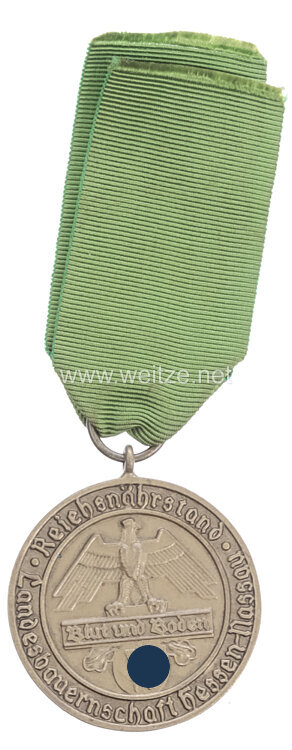
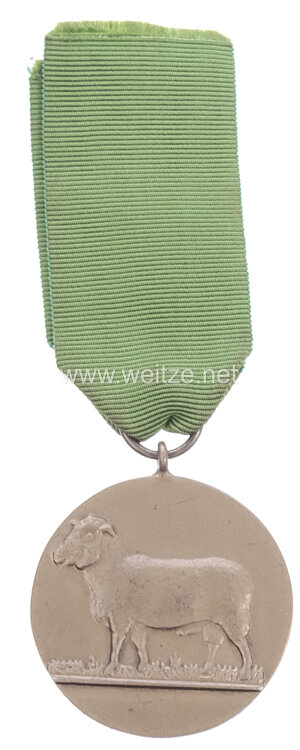
Reichsnährstand Landesbauernschaft Hessen-Nassau
The Bronze Medal of the Reichsnährstand Landesbauernschaft Hessen-Nassau for Merit in Sheep Breeding represents a significant chapter in National Socialist agricultural policy between 1933 and 1945. This decoration was part of a comprehensive system for controlling and promoting German agriculture under the Third Reich regime.
The Reichsnährstand (Reich Food Estate) was founded on September 13, 1933, through the Reichsnährstand Act and constituted the central organization of German agriculture and food economy. Under the leadership of Richard Walther Darré, who simultaneously served as Reich Minister of Food and Agriculture, this organization pursued the goal of coordinating all agricultural production and aligning it ideologically with the National Socialist “Blood and Soil” ideology.
The Landesbauernschaft Hessen-Nassau (Regional Farmers' Association Hessen-Nassau) formed a regional subdivision of the Reichsnährstand. The area of Hessen-Nassau was a Prussian province that had been formed in 1868 from the annexed territories of the Kingdom of Hanover, the Electorate of Hesse, the Duchy of Nassau, and the Free City of Frankfurt. Within the organizational structure of the Reichsnährstand, various regional farmers' associations existed, each responsible for specific geographic regions.
Sheep breeding held particular significance within the framework of National Socialist autarky policy. The regime strived for economic independence and self-sufficiency to avoid dependence on imports in case of war. Wool was a strategically important raw material for textile production, especially for military uniforms and equipment. The promotion of domestic sheep breeding was intended to reduce dependence on foreign wool.
The decoration system of the Reichsnährstand comprised various medals and badges of honor for different areas of agriculture. These decorations served multiple purposes: they were meant to increase productivity, recognize special achievements, and strengthen the ideological bond of the peasantry to the National Socialist system. The awarding of such medals was often accompanied by public ceremonies that were exploited for propaganda purposes.
Bronze as the material for this medal corresponds to common practice for decorations of the Third Reich. While higher decorations were frequently made in silver or with additional enamel work, bronze was the standard material for merit and achievement badges. The ribbon from which the medal was worn typically followed the official color guidelines of the Reichsnährstand or the respective regional farmers' association.
The organization of the Reichsnährstand was hierarchically and bureaucratically structured. It was organized according to the Führer principle into various levels: from the Reich Farmers' Leader through the Regional Farmers' Leaders down to the Local Farmers' Leaders. Each level had specific tasks in production planning, market regulation, and ideological training.
For sheep breeding, special breeding associations and control bodies existed within the Reichsnährstand. These supervised breed purity, conducted performance tests, and awarded decorations for breeding successes. The medal for merit in sheep breeding was presumably awarded to breeders who had distinguished themselves through special achievements in raising, improving wool quality, or increasing production numbers.
The ideological dimension of this decoration must not be underestimated. The National Socialist “Blood and Soil” ideology glorified the peasantry as the foundation of the German people. Farmers were designated as the “wellspring of the nation” and were supposed to occupy a privileged position in society. At the same time, however, they were comprehensively controlled by the Reichsnährstand and severely restricted in their economic freedom.
After 1945, the Reichsnährstand was dissolved by the Allies. All its symbols, decorations, and organizational structures were banned as part of the National Socialist system. Control Council Law No. 2 of October 10, 1945, ordered the complete dissolution of the NSDAP and all its subdivisions, which included the Reichsnährstand.
Today, such medals are historical documents that bear witness to the total penetration of all spheres of life by the National Socialist regime. They serve as reminders of how even peaceful agricultural activities such as sheep breeding were instrumentalized for military and ideological purposes. The condition grade 2 indicates a well-preserved collector's item that is significant for historical research and museum documentation.