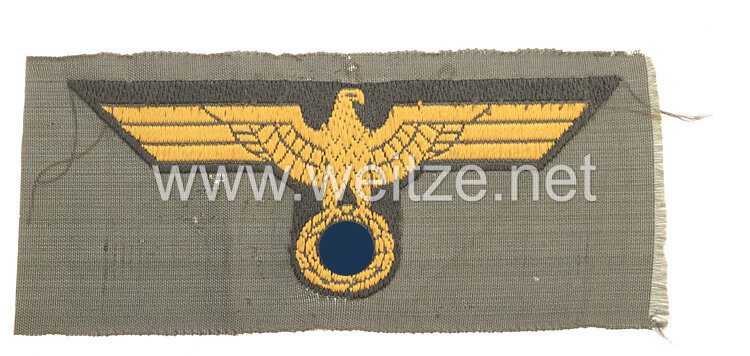
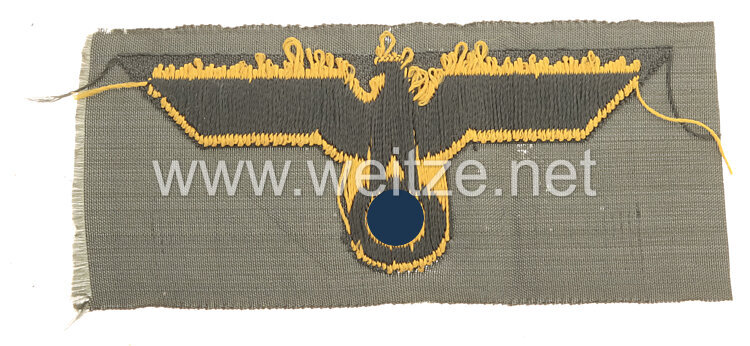
Kriegsmarine Side Cap Eagle for Enlisted Men Coastal Artillery
The Kriegsmarine Cap Eagle for Enlisted Personnel of the Coastal Artillery represents a characteristic insignia of the German Navy during World War II. This particular example in Bevo-woven execution displays the typical national eagle in yellow on field-gray background, indicating membership in the coastal artillery.
The Coastal Artillery of the Kriegsmarine formed an essential component of German coastal defense and was responsible for protecting strategically important harbors, sea routes, and coastal sections. These units were stationed throughout the German sphere of influence, from the Atlantic coasts of France and Norway to the Baltic Sea and the Black Sea. Their duties included repelling enemy naval forces, protecting friendly naval formations, and securing maritime supply routes.
The Bevo weaving technique was a specialized manufacturing method developed by the company Bandfabrik Ewald Vorsteher (BeVo) from Wuppertal. This technique enabled the mechanical production of insignia with fine details and sharp contours. In contrast to embroidered or handmade variants, Bevo insignia could be produced more cost-effectively and in larger quantities, which was of great importance during the war. Nevertheless, the quality of these woven works was remarkably high, and the insignia were characterized by their durability and attention to detail.
The cap eagle was worn on the Schiffchen (side cap), the characteristic obliquely-worn cap of naval enlisted personnel. The color scheme of yellow on field-gray was specifically prescribed for the coastal artillery. While regular naval units at sea wore the eagle in yellow on dark blue background, the coastal artillery units used the field-gray background due to their proximity to army units and their land-based role.
The wearing regulations of the Kriegsmarine were precisely defined. The eagle displayed the national emblem of the German Reich with its head facing right and spread wings, holding the swastika in an oak wreath in its talons. This symbolism was introduced from 1935 after the official re-establishment of the Wehrmacht and replaced the earlier Imperial eagles of the Weimar Republic.
The organization of the coastal artillery was subordinate to the Kriegsmarine and was divided into various Marine Artillery Battalions (Marineartillerieabteilungen or MAA). These units possessed different calibers of guns, from medium 10.5 cm cannons to heavy 28 cm and 40.6 cm guns in fortified positions. Particularly well-known were the massive coastal fortifications of the Atlantic Wall, where thousands of soldiers of the coastal artillery served.
Enlisted personnel wore such insignia as part of their regular service uniform. The condition grade 2 of this example indicates good to very good preservation, which is remarkable for textile militaria from this period. Many of these insignia were worn intensively during the war and today show significant signs of use.
After the war's end in 1945, all national emblems with National Socialist symbols were prohibited, and wearing such insignia was made punishable. Today these objects possess exclusively historical collector value and serve historical documentation purposes. They are important testimonies of military history and help in researching the organization, structure, and material culture of the German armed forces during World War II.
The authentication of such insignia requires expertise, as there are numerous post-war reproductions. Genuine Bevo insignia exhibit characteristic features such as the specific weaving technique, material composition, and typical signs of aging. The quality of workmanship and exact conformity with historical regulations are important criteria for judging originality.
For historians and collectors, such pieces provide valuable insights into the detailed organization and visual culture of the Kriegsmarine. They document the careful differentiation between various branches and units through color schemes and designs, reflecting the military's emphasis on hierarchy and identification during this period.