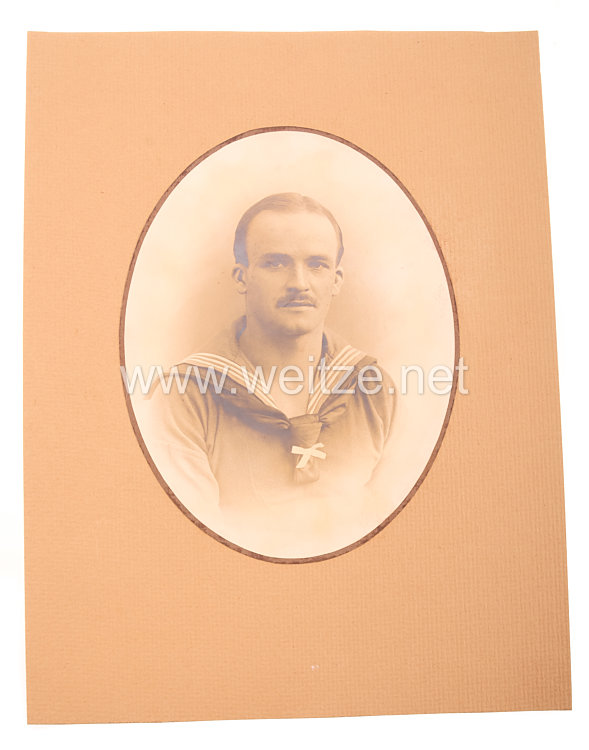
Imperial German Navy Large Portrait Photograph of a Sailor

Mounted on rigid cardboard, dimensions approx. 29.4 x 38.5 cm. Condition 2.


429572
30,00

Imperial German Navy Large Portrait Photograph of a Sailor

Imperial German Navy Portrait Photography: Documentation of Maritime Identity in Wilhelmine Germany

This large-format portrait photograph of a sailor from the Imperial German Navy (Kaiserliche Marine) represents a significant testimony to the photographic documentation practices of German naval forces between 1871 and 1918. Measuring approximately 29.4 x 38.5 cm and mounted on sturdy cardboard, this format corresponds to the then-customary standards for representative military portraits, which served both documentary and personal purposes.

The Imperial Navy as an Institution

The Kaiserliche Marine, founded in 1871 following German unification, underwent dramatic expansion under Kaiser Wilhelm II from 1888 onwards. The Tirpitz Plan, named after Grand Admiral Alfred von Tirpitz, aimed to develop Germany into the world's second-largest naval power after Great Britain. This ambitious naval armament program led to massive personnel growth: while only about 15,000 men served in the navy in 1871, this number had grown to over 80,000 naval personnel by 1914.

Photographic Practices and Military Portraits

The development of photography in the late 19th century enabled, for the first time, mass visual documentation of military personnel. Large-format portraits on cardboard, known as cabinet cards or even larger formats, were produced in specialized studio ateliers at naval bases such as Kiel, Wilhelmshaven, Cuxhaven, and Stralsund. These photographs served multiple purposes: they were mementos for families, documents of service time, and expressions of pride in belonging to the prestigious Imperial Navy.

Uniforms and Visual Identity

The uniform of the Imperial Navy followed strict regulatory specifications laid down in the Marine Clothing Regulations (Marinebekleidungsordnung). Sailors wore the characteristic dark blue sailor's blouse with its distinctive naval collar, the sailor's neckerchief, and the sailor's cap with a cap ribbon displaying the name of the ship or unit. This uniformity created an unmistakable visual identity that was documented in portrait photographs and contributed to popularizing the navy in German society.

Social Significance of Military Service

Service in the Imperial Navy was considered honorable and prestigious. Unlike army service, which encompassed all social classes through universal conscription, naval service required special skills and was considered more technically demanding. Sailors frequently needed to be literate and possess technical abilities. This gave the navy a special status within Wilhelmine military affairs.

Photographic Studios in Naval Cities

Specialized photographic studios focusing on military portraits became established in the major naval bases. Well-known studios such as Haase & Co. in Kiel or Louis Koch in Wilhelmshaven produced thousands of such portraits. Photographers had standardized backdrops and props to optimally showcase the uniforms and military character. Mounting on sturdy cardboard ensured the durability of these valuable keepsakes.

Historical Context and Contemporary Witness

Such portrait photographs are important historical sources today. They document not only the uniforms and external appearance of naval personnel but also social-historical aspects: the self-perception of military members, the significance of the military in Imperial German society, and the visual culture of the Wilhelmine era. Photography as a medium enabled, for the first time, broad visual transmission of military identity across all social classes.

Collector Value and Historical Significance

Today, such large-format naval portraits are equally valued by collectors and museums. They are authentic witnesses to a bygone era and offer insights into the life-world of naval soldiers in the German Empire. The quality of the images, condition, and size influence their historical and collector value. Large formats like the present example were more elaborate to produce and rarer than smaller cabinet cards, which underscores their special significance.