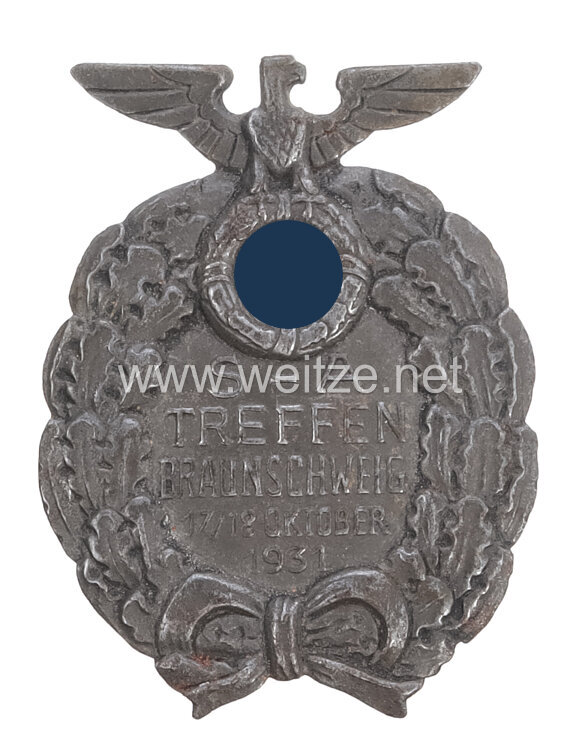
SA Rally Braunschweig October 17-18, 1931, 1st Pattern
The SA Rally in Braunschweig on October 17-18, 1931, represented one of the most significant mass gatherings of the Sturmabteilung (SA) during the final phase of the Weimar Republic. This event impressively demonstrated the growing power of the National Socialist movement and became a turning point in German history shortly before the seizure of power in 1933.
The SA, officially founded as the paramilitary combat organization of the NSDAP, had developed by 1931 into a mass organization with several hundred thousand members. The Braunschweig rally was deliberately organized in this Lower Saxon city because Braunschweig was at that time governed by a coalition involving the NSDAP – one of the first states in the German Reich with National Socialist government participation.
An estimated 100,000 to 120,000 SA men streamed into the city for the rally, making it one of the organization's largest marches before 1933. The event included parades, roll calls, and rallies at which Adolf Hitler personally delivered a speech. The gathering served multiple purposes: it was intended to demonstrate the SA's strength and discipline, impress potential supporters, and simultaneously intimidate political opponents.
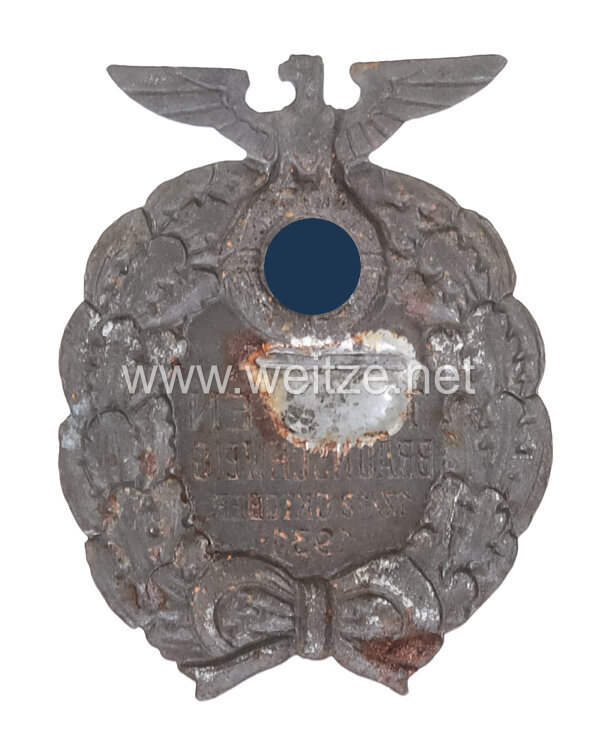
To commemorate this significant event, a badge was created and produced in various versions. The described specimen belongs to the first model of these commemorative badges. These early versions were typically manufactured from sheet iron and produced using hollow embossing – a cost-effective process that enabled mass production. The hollow embossing created a relief-like protruding design on the front, while the reverse was correspondingly recessed.
The design of such SA badges followed certain iconographic patterns of the National Socialist movement. They typically displayed SA symbolism, swastikas, the date and location of the event, and often stylized representations of SA men or Germanic-völkisch motifs. These badges were not merely souvenirs but also expressions of the wearers' belonging and pride in their participation in this event.
Production occurred in several variants, with the first model differing from later versions in details. Various manufacturers produced these badges, leading to variations in quality and exact execution. The badges were fitted on the reverse with a simple pin construction that enabled attachment to uniforms or civilian clothing.
The Braunschweig rally and its badges must be understood in the context of the political radicalization of the early 1930s. The Great Depression had hit Germany hard, unemployment had risen dramatically, and the democratic institutions of the Weimar Republic were increasingly losing legitimacy. In this climate of uncertainty and desperation, extremist movements gained followers.
The SA played a central role in the NSDAP's strategy of creating, through street presence, intimidation of political opponents, and spectacular mass events like the Braunschweig rally, a climate in which the party appeared as the only force capable of restoring order. The massive marches were intended simultaneously to demonstrate strength and create the impression that the National Socialist movement was an unstoppable historical force.
From a military-historical perspective, such badges are important documents. They testify to the organizational structure, visual propaganda, and commemorative culture of the SA. For collectors and historians, they offer insights into the material culture of the National Socialist movement before the seizure of power. At the same time, they remain problematic objects that recall one of the darkest periods in German history.
After 1945, many such badges were destroyed or defaced in accordance with denazification regulations. The possession and display of Nazi memorabilia were strictly regulated in Germany. Today, such objects may only be collected and displayed for purposes of historical research, civic education, or similar purposes.
The preserved specimen shows typical signs of wear, and the absence of the pin suggests long storage or deliberate rendering harmless. Such states of preservation are frequently encountered in objects of this type and reflect the turbulent history of these artifacts – from their original use through concealment in the postwar period to today's scientific-museum examination.
The Braunschweig rally of October 1931 remains a significant historical marker in the rise of National Socialism. The badges produced to commemorate it serve as tangible reminders of how mass mobilization, visual symbolism, and commemoration culture were instrumentalized by the Nazi movement. They stand as material witnesses to a period when democratic institutions failed and extremism triumphed, offering important lessons for understanding how authoritarian movements consolidate power through spectacle and symbolism.