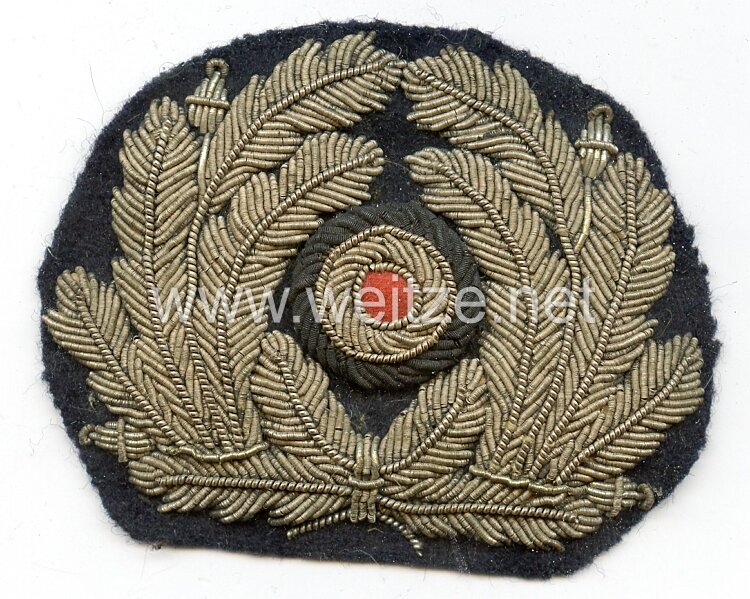
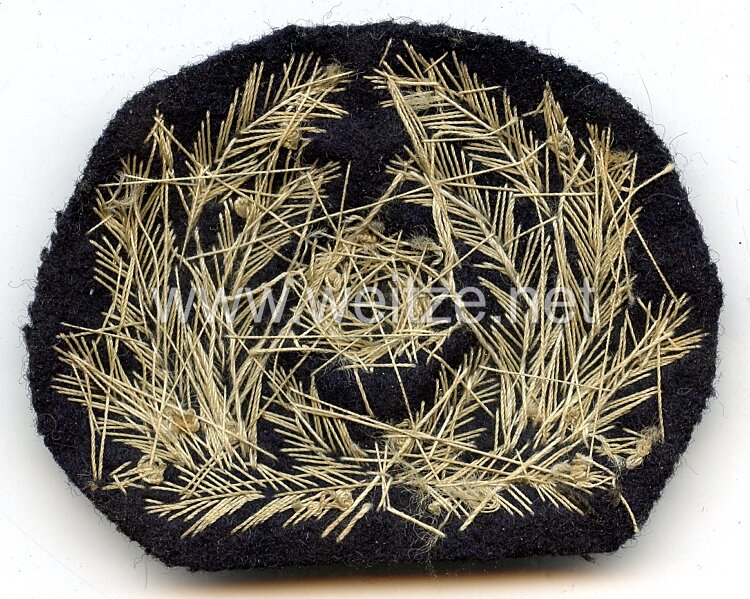
Kriegsmarine Visor Cap Oak Leaf Wreath for Naval Officials

Metal thread hand-embroidered construction with metal cockade. Worn condition, condition grade 2-3.
463070
140,00

Kriegsmarine Visor Cap Oak Leaf Wreath for Naval Officials

The Kriegsmarine Visor Cap Oak Leaf Wreath for Naval Officials represents a significant rank insignia of the German Navy during World War II. This hand-embroidered emblem made of metal thread embodies the strict hierarchy and ceremonial traditions of the German naval forces between 1935 and 1945.

The Kriegsmarine, officially established on June 1, 1935, as the successor to the Reichsmarine, developed a complex system of uniform regulations and rank insignia. The oak leaf wreath on the visor cap served as a visual identifier for various ranks and service groups within the Navy. For Marine Officials (Marinebeamte) – civil servants in naval service such as administrative officers, paymasters, engineers, and technical personnel – special uniform regulations applied that distinguished them from military naval officers.

The production of such oak leaf wreaths followed precise specifications outlined in the Dress Regulations for the Kriegsmarine. The hand-embroidered execution with metal thread demonstrates the high craftsmanship quality that German military effects manufacturers achieved during that period. The embroidery was typically executed on dark blue cloth and consisted of stylized oak leaves and acorns arranged in a wreath pattern. The use of metal thread – usually silver or gold-plated – gave the insignia its characteristic shine and durability.

The metal cockade combined with this oak leaf wreath represented the national emblem: the black-white-red cockade of the Third Reich, frequently combined with the Wehrmacht's national eagle. This cockade was mounted centrally above the visor and was mandatory for all Wehrmacht personnel.

Naval officials formed an important pillar of the Kriegsmarine. They were responsible for administrative, technical, and economic tasks and contributed significantly to the fleet's operational capability. Their uniforms resembled those of naval officers but featured specific distinguishing characteristics. The visor cap (Schirmmütze) was the standard headgear for officers and officials and was worn with all service uniforms.

The quality of execution varied depending on the manufacturer and production period. Early war years often showed higher craftsmanship standards, while later productions were sometimes simplified due to wartime conditions. The hand-embroidered variant with metal thread described here corresponds to the higher-quality executions typically worn by officers and senior officials.

Collecting such militaria requires extensive knowledge, as the market contains numerous post-war reproductions. Authentic pieces are characterized by specific materials, manufacturing techniques, and aging characteristics. Condition assessment follows a grading scale, with condition 2-3 indicating a worn piece with normal signs of use – typical for uniform components actually used in service.

After the war ended in 1945, the Kriegsmarine was dissolved, and wearing its uniforms and insignia was prohibited. Many of these objects were destroyed, lost, or ended up in private collections as war trophies. Today they serve as witnesses to a historical era and are used for scientific research and museum documentation.

The historical significance of such objects lies in their function as material remnants of a complex military system. They document not only military hierarchies and organizational structures but also craft traditions, production standards, and the material culture of the Third Reich. For historical science, they are valuable primary sources that, in conjunction with written documents, enable a more complete picture of the past.