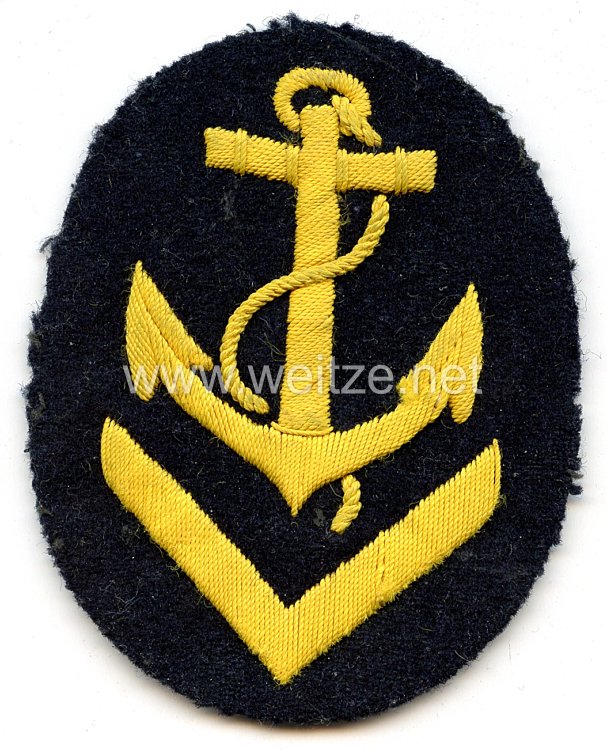
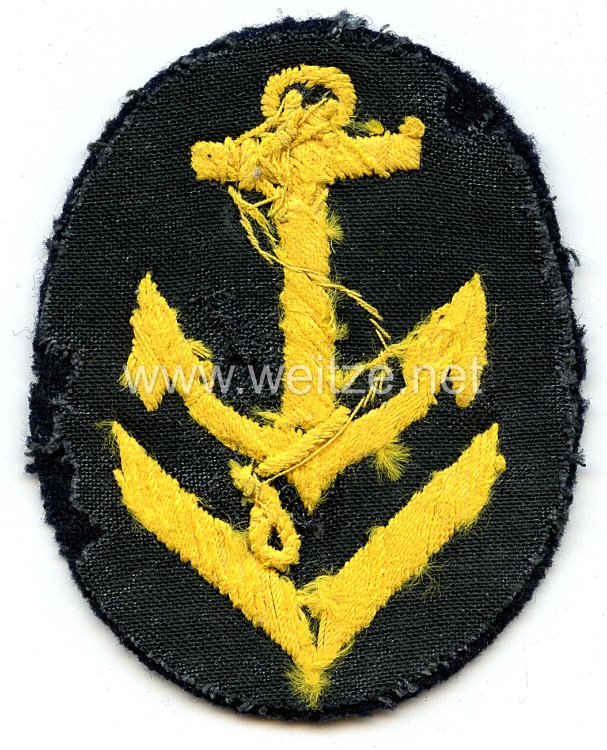
Kriegsmarine Sleeve Insignia Career Path Badge Bootsmannsmaat

hand-embroidered, for the blue jumper, condition 2.
442870
60,00

Kriegsmarine Sleeve Insignia Career Path Badge Bootsmannsmaat

The Kriegsmarine sleeve badge for a Bootsmannsmaat (Boatswain's Mate) represents a significant artifact of the complex rank structure and visual hierarchy of the German Navy during World War II. This hand-embroidered career insignia for the blue tunic embodies the traditions and organizational principles of the Kriegsmarine, which existed as the official naval force of Nazi Germany from 1935 to 1945.

The Kriegsmarine was officially established on May 21, 1935, after the Nazi regime had cast off the military restrictions of the Treaty of Versailles. Commander-in-Chief Grand Admiral Erich Raeder and later Karl Dönitz developed a comprehensive system of rank insignia and career identification badges that made the various specializations and ranks within the navy clearly recognizable.

The rank of Bootsmannsmaat belonged to the group of non-commissioned officers without sword knot (Portepee) and represented an important step in the seaman's career path. A Maat ranked higher than an ordinary seaman but had not yet advanced to the group of Portepee non-commissioned officers. The Boatswains formed a specific specialty group within the Kriegsmarine responsible for ship maneuvering, anchor work, rope handling, and general seamanship duties.

The career badge served to identify professional specialization and was worn on the left upper arm of the blue service tunic. The blue tunic was part of the working and shipboard uniform for enlisted men and non-commissioned officers. The Kriegsmarine strictly distinguished between different uniform types: parade uniforms for ceremonial occasions, service uniforms for daily shore duty, and shipboard uniforms for service at sea.

The hand-embroidered execution of this badge indicates a higher-quality manufacture. During the war years, sleeve badges were produced in both hand-embroidered and machine-woven or machine-embroidered forms. Hand-embroidered badges were often of higher quality and were frequently privately purchased, while machine-woven examples were typically issued through official channels. The use of aluminum or silver threads on a dark blue cloth background was characteristic of these badges.

The design of career badges followed precise regulations laid down in the Dress Regulations for the Kriegsmarine. These regulations were updated several times, particularly in 1935, 1937, and 1939, to reflect the growing complexity of the naval organization. For Boatswains, the career badge typically displayed an anchor or a combination of maritime symbols that illustrated the seamanship specialization.

The social structure of the Kriegsmarine was strongly hierarchical. Advancement from seaman to Maat required several years of service, successful completion of training courses, and demonstration of seamanship skills. The Boatswains formed the backbone of practical ship operations and were responsible for training younger crew members in seamanship skills.

The wearing of these badges was precisely regulated. The career badge was placed on the left upper arm, while rank insignia were worn on both sleeves. This visual coding made it possible to recognize a sailor's rank and specialization at first glance – an important aspect of military organization, especially in combat situations or with mixed crews.

After the collapse of the Third Reich in May 1945, the Kriegsmarine was dissolved. Its traditions, insignia, and organizational structures were only selectively adopted by the later-established Bundesmarine (Federal German Navy), with all Nazi symbols being consistently excluded. Today, such sleeve badges are important objects of study for military historians and are preserved in museums and private collections as testimonies of naval history.

The preservation in condition 2 – according to common collector grading – indicates a well-preserved specimen with minor signs of wear, which is remarkable for a textile object from this era.

r