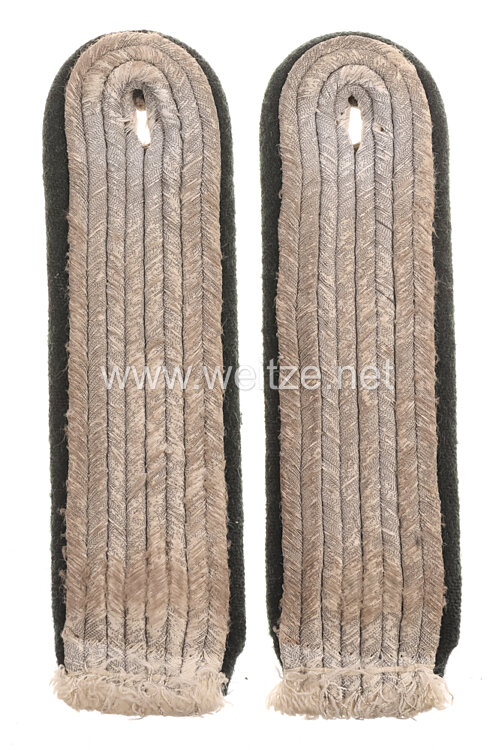
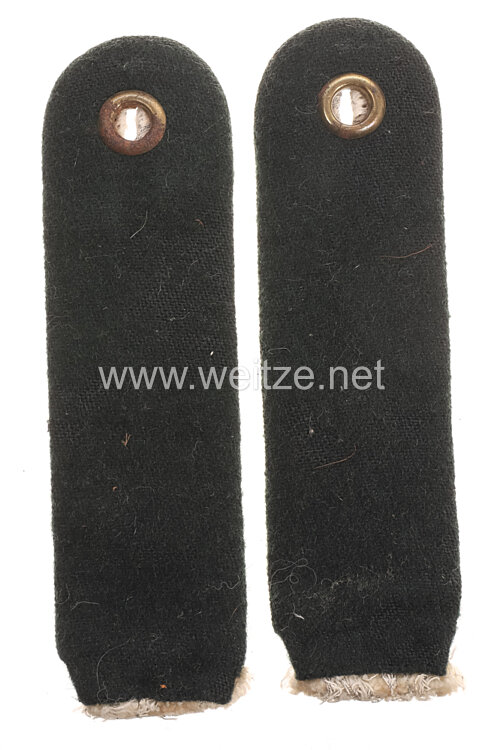
Kriegsmarine Pair of Shoulder Boards for a Lieutenant of the Land Units
The described shoulder boards for a Lieutenant of the Kriegsmarine Land Units represent a fascinating chapter of German naval history during World War II. These rank insignia were part of the field-gray uniform and demonstrate the close integration between naval and ground forces during this period.
The Kriegsmarine, the official designation of the German Navy from 1935 to 1945, developed a complex system of uniforms and rank insignia during its existence. While naval officers traditionally wore dark blue uniforms, field-gray uniforms were also introduced for certain purposes. This necessity arose particularly from the diverse operational areas of Kriegsmarine personnel, who served not only at sea but also in land units.
The Land Units of the Kriegsmarine comprised various formations, including naval artillery units, anti-aircraft divisions, coastal defense units, and the famous marine battalions. These troops frequently operated in coastal regions or were deployed to reinforce land operations. The field-gray uniforming of these units served practical camouflage purposes in land deployment and differed significantly from the traditional navy blue attire.
The present shoulder boards are manufactured in the sewn-in design, which meant permanent attachment to the uniform. This distinguished them from the removable variants used on other uniform types. A Lieutenant's shoulder boards (corresponding to the lowest officer rank) typically displayed a star as rank insignia on the characteristic background.
The manufacture of such shoulder boards followed precise military service regulations and uniform specifications. For the field-gray version, navy-specific elements were combined with the basic color typical for ground forces. The field-gray color was adopted after 1935 for certain naval uniforms as well, particularly as the Wehrmacht was created as a unified structure of the German armed forces.
The rank of Leutnant zur See (as it was correctly designated in the Kriegsmarine) corresponded to the Army's Leutnant and was the entry rank for officers after successfully completing their training. Training to become a naval officer was demanding and included both theoretical and practical components on training ships and in naval schools.
The use of shoulder boards as rank insignia had a long history in German military tradition, dating back to the 18th century. They enabled quick visual identification of a soldier's or officer's rank and were therefore of considerable practical importance for military hierarchy and command structure.
In the context of the Kriegsmarine, land units were particularly significant during coastal defense operations. Naval batteries along European coasts, from Norway to southern France, were frequently commanded by Kriegsmarine officers. These officers often wore the field-gray uniform during their land service duties to blend with the environment and maintain uniformity with other ground forces.
The preservation of such historical uniform items is of great importance for understanding military history. The indicated “condition 2-” suggests good preservation with minimal signs of wear, which is remarkable for textiles from this period. Many uniform items were destroyed after the war's end or lost through wear and tear.
Today, such shoulder boards are important study objects for military historians and collectors. They provide insights into organizational structure, manufacturing techniques, and material aspects of the Kriegsmarine. The examination of originals helps identify reproductions and contributes to the authentication of historical uniforms.
The existence of pairs of such shoulder boards is historically correct, as they were worn symmetrically on both shoulders. Manufacturing as a pair ensured that both pieces matched in color, size, and design, which was essential for the uniform's consistent appearance.
These artifacts serve as tangible connections to a significant period in military history, offering researchers and enthusiasts alike valuable information about the structure, organization, and daily realities of the Kriegsmarine's land forces during World War II.