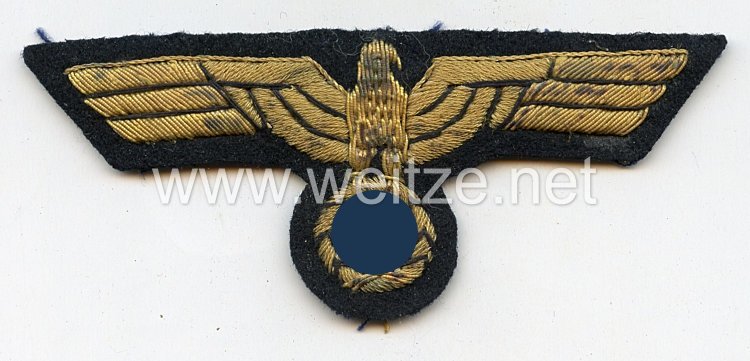
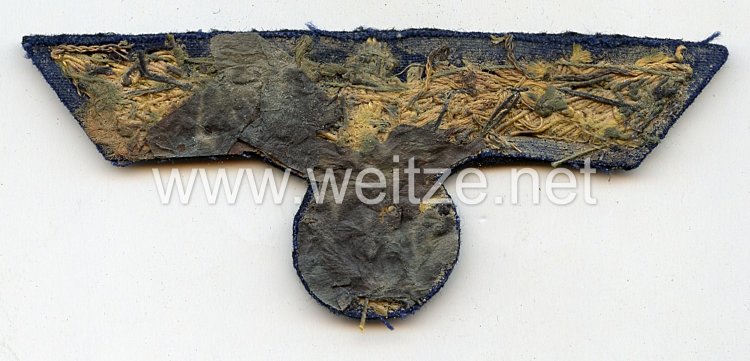
Kriegsmarine Breast Eagle for Naval Officers
The Breast Eagle for Naval Officers of the Kriegsmarine represents a significant example of military insignia of the German Reich during the period from 1935 to 1945. These hand-embroidered emblems were worn on the uniform jackets of Kriegsmarine officers and served as important rank insignia and symbols of military authority.
The Kriegsmarine was officially founded on June 1, 1935, after the German Reich unilaterally renounced the provisions of the Treaty of Versailles. With the Anglo-German Naval Agreement of June 18, 1935, Germany obtained the right to build a war fleet that could amount to 35 percent of the Royal Navy's tonnage. Under the leadership of Grand Admiral Erich Raeder and later Karl Dönitz, the Kriegsmarine developed into a significant naval force.
The breast eagle for naval officers was worn on the right breast side of the uniform jacket according to the uniform regulations of the Kriegsmarine. The present example shows the characteristic execution in hand-embroidered cellon thread on a dark blue cloth background. This technique was typical for officers' clothing and differed significantly from the machine-made or woven variants used for enlisted men and non-commissioned officers.
Hand embroidery with cellon thread was an elaborate process that required special craftsman skills. Cellon was an artificial silk thread that had a silvery sheen and represented an alternative to genuine silver wire. The use of this material made sense for both economic and practical reasons, as cellon thread was lighter and more flexible than metal wire and was better suited for hand embroidery.
The design of the breast eagle followed the National Socialist sovereignty symbols and showed a stylized eagle with outstretched wings holding a swastika in its talons. For the Kriegsmarine, the dark blue background was characteristic and distinguished naval officers from other Wehrmacht branches. Army officers wore their breast eagles on field-grey backgrounds, while Luftwaffe officers used light blue or grey backgrounds.
The manner of wearing the breast eagle was precisely regulated in the dress regulations of the Kriegsmarine. The eagle was attached to the right breast side above the breast pocket and had to be precisely positioned. Officers were required to wear the breast eagle on various uniform variants, including the full dress uniform, service dress, and parade uniforms.
The procurement of such breast eagles usually took place through private manufacturers and military outfitters. Well-known companies such as BEVO (Bandfabrik Ewald Vorsteher), various embroidery workshops, and specialized military effects manufacturers produced these emblems. Officers had to procure their uniforms and insignia themselves, which led to a certain variety in execution quality.
The condition of the present example with signs of wear and stains is typical for worn uniform insignia. These traces testify to actual use during service and give the object historical authenticity. The wear could have been caused by various factors: salt water, sun exposure, perspiration, and mechanical stress during wearing.
After the end of World War II in May 1945, the wearing of all National Socialist symbols was prohibited by Control Council Law No. 1. The Kriegsmarine was dissolved, and its officers were disarmed and demobilized. Many uniform parts and insignia were destroyed, hidden, or passed into private ownership.
Today, such breast eagles of the Kriegsmarine are important military-historical collector's items that provide insight into the uniform studies and phalerist of the German Navy during the period from 1935 to 1945. They are kept in museums, archives, and private collections and serve historical research and documentation. The scientific handling of such objects requires a critical examination of the history of National Socialism and the role of the Wehrmacht in World War II.