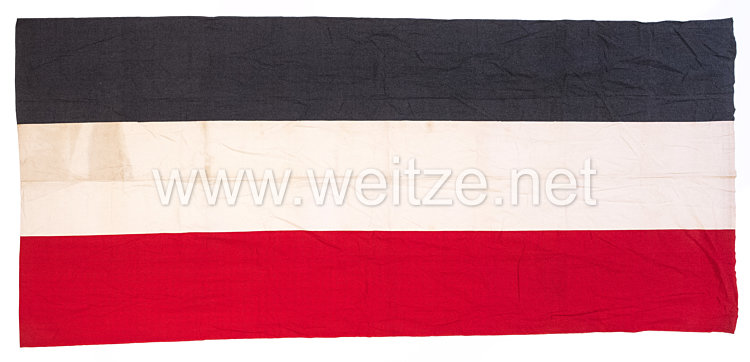
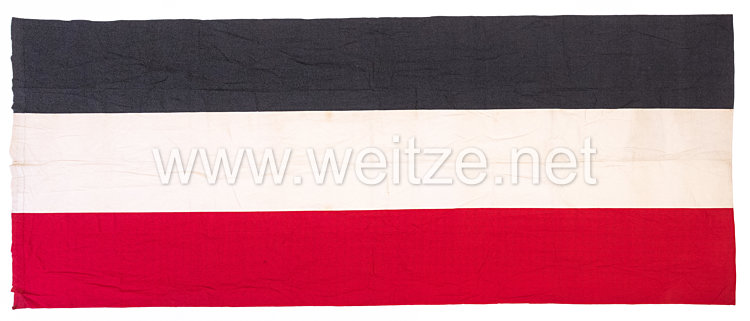
German Reich - National Flag (Patriotic Flag)
The National Flag of the German Reich in the colors black-white-red represents a significant symbol of German history between 1871 and 1945. These patriotic flags were not only official state symbols but were also used by the civilian population on various occasions to express national solidarity and loyalty to the Empire and later to the Weimar Republic and the Third Reich.
The color combination black-white-red was first adopted as the official Reich flag on January 1, 1871, with the founding of the German Empire. These colors symbolically united the traditions of Prussia (black-white) with the colors of the Hanseatic League (white-red). Emperor Wilhelm I and Chancellor Otto von Bismarck established this flag as a unifying national symbol for the newly united German states under Prussian leadership.
During the Imperial period (1871-1918), such flags in various sizes were widespread. The dimensions described here, approximately 1.50 x 3.50 meters, correspond to a typical size for patriotic flags that were hoisted on public buildings, schools, association halls, or during festive occasions. The manufacture from cotton was standard for such purposes, as this material was cost-effective, durable, and readily available for mass production.
After the end of World War I and the abdication of Kaiser Wilhelm II in November 1918, the newly founded Weimar Republic initially introduced the colors black-red-gold as the national flag. This led to considerable political controversy. Conservative, nationalist, and monarchist circles held fast to the imperial colors black-white-red and demonstratively used these flags as a symbol of their opposition to the democratic republic. The so-called flag dispute characterized the entire Weimar period and symbolized the deep division of German society.
A compromise was created in 1926 through a decree by Reich President Paul von Hindenburg, which stipulated that German diplomatic missions abroad should display both flags. Merchant shipping was allowed to continue using the black-white-red flag with the republican colors in the upper corner. This regulation illustrates the continuing significance and emotional charge of this color combination.
With the Nazi seizure of power in 1933, the black-white-red flag was initially used alongside the swastika flag as the official Reich flag. On September 15, 1935, through the Nuremberg Laws, the swastika flag was declared the sole national flag, while the black-white-red colors continued to be used as symbols of the “old Reich colors.” Nazi propaganda utilized the historic Reich colors to suggest continuity with the Empire and appeal to conservative circles.
Patriotic flags of this type were used on numerous occasions: Emperor's birthdays, Sedan Day celebrations commemorating the victory over France in 1870, fleet visits, military parades, and local folk festivals. During the Nazi era, they were used at mass events, marches, and for decorating buildings, often in combination with swastika flags.
The manufacturing technique of such flags was usually carried out in specialized flag factories. The stripes were sewn from dyed cotton, with careful attention to precise proportions. Higher-quality specimens featured double seams and reinforced corners. Attachment typically occurred via a side hoisting pole or through eyelets on the mast.
The condition of such historical flags is often affected by weather influences, UV radiation, and mechanical stress. Staining and minor damage are typical for flags that were actually used outdoors and show authentic signs of use. This distinguishes them from purely decorative or parade flags that were preserved.
After 1945, the use of the black-white-red flag was not banned in either German state, unlike Nazi symbols. Nevertheless, it is viewed critically due to its use during the Nazi period and its appropriation by right-wing extremist groups. Historically, however, it remains an important testimony to German history and political symbolism between 1871 and 1945, reflecting the continuities and ruptures of this era.