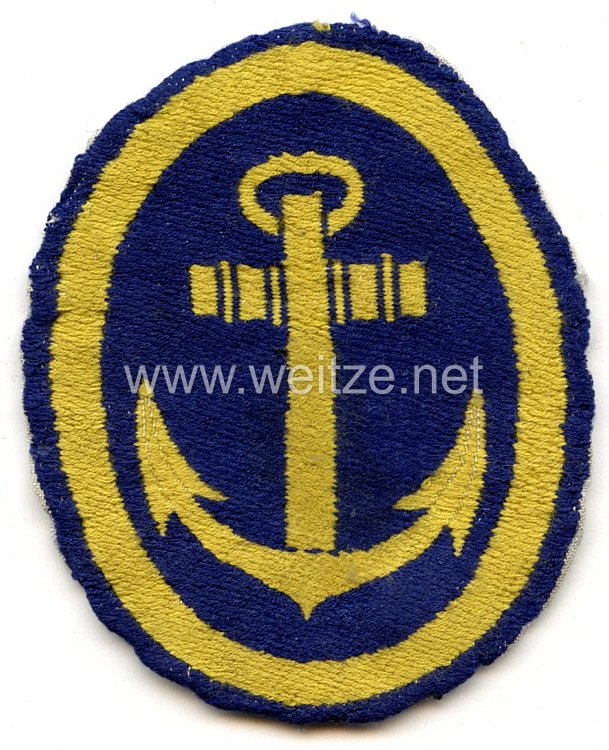
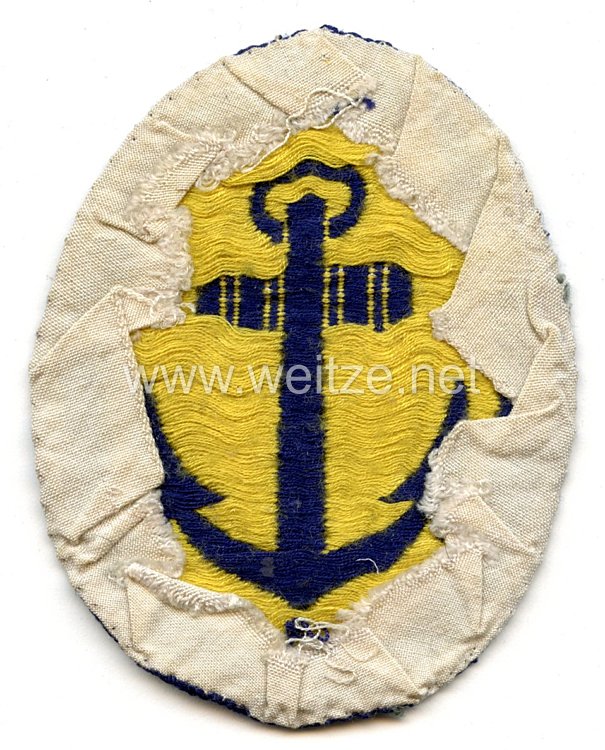
Kriegsmarine Sports Uniform Insignia for Officers

Woven construction with gold border around the perimeter. Lightly worn, condition 2.
440268
30,00

Kriegsmarine Sports Uniform Insignia for Officers

Kriegsmarine Sports Uniform Badge for Officers – A Historical Overview

The Kriegsmarine Sports Uniform Badge for Officers represents a fascinating example of the military uniform regulations of the Third Reich. These special badges were created for the sports clothing of naval officers and reflect the strict hierarchy and uniform regulations that permeated all aspects of military life.

The Kriegsmarine, the official designation of the German naval force from 1935 to 1945, developed a comprehensive system of uniforms and badges. Following Germany's rearmament and the introduction of general conscription on March 16, 1935, the Reichsmarine was renamed Kriegsmarine. This transition brought with it a modernization and standardization of uniform regulations.

The woven version of these badges was one of several manufacturing techniques used during World War II. Woven badges offered several advantages: they were lighter, more flexible, and often more cost-effective for mass production than embroidered or metal variants. The surrounding gold border indicated the officer quality of the wearer and distinguished these badges from those of enlisted ranks.

Sports clothing in the Kriegsmarine was not only intended for physical exercise but constituted an important component of military training. The National Socialist leadership placed great emphasis on physical fitness and athletic activity as part of military preparation. The Heeresdienstvorschrift (Army Service Regulation) and corresponding naval service regulations precisely stipulated which uniform and badge components were to be worn on which occasions.

Special regulations applied to officers regarding their service clothing. Even during athletic activities, they had to make their rank and affiliation with the Kriegsmarine recognizable through appropriate badges. These badges were typically worn on sports clothing, such as training suits or sports shirts, and usually displayed maritime symbols such as anchors, eagles, or other navy-specific emblems.

The manufacture of such badges was carried out by various private manufacturers authorized by the Kriegsmarine. Companies such as BeVo (Bandfabrik Ewald Vorsteher) in Wuppertal were known for their high-quality woven badges. Quality control was strict, and only approved manufacturers were permitted to produce official uniform items.

The gold border in this version was achieved through the use of gold-colored rayon thread or metallized thread. During the war, especially in the later years, material shortages often led to quality deterioration. Genuine gold thread was increasingly replaced by cheaper materials.

The use of these badges extended throughout the entire period of the Kriegsmarine from 1935 to 1945. During this time, the German Navy underwent significant changes, from the initial successes with U-boat operations to the devastating losses in the later war years. However, uniform regulations remained largely consistent until the end of the war.

After the war ended in 1945, the Kriegsmarine was dissolved, and all its symbols and badges were banned by the Allies. Many of these uniform items were destroyed or disappeared into private collections. Today, well-preserved specimens like the described badge are sought-after collector's items that possess important historical value for understanding the military culture of that time.

The preservation of such historical objects is important for scientific research and historical memory. They serve as material witnesses to a dark period of German history and help historians understand the structures, hierarchies, and daily life in the armed forces of the Third Reich.