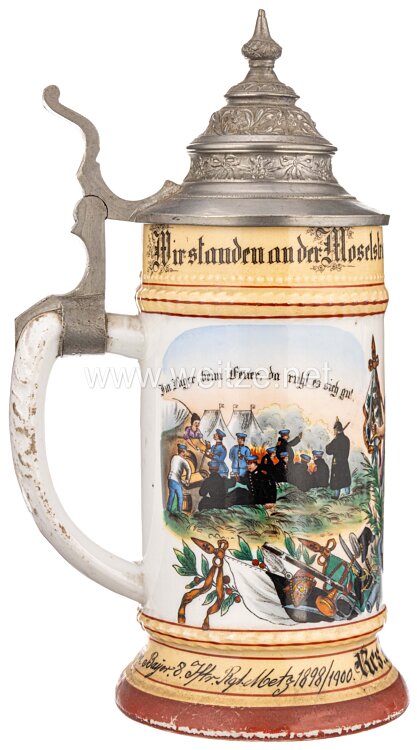
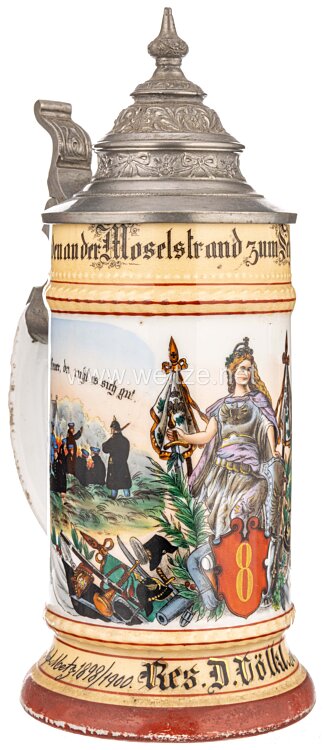
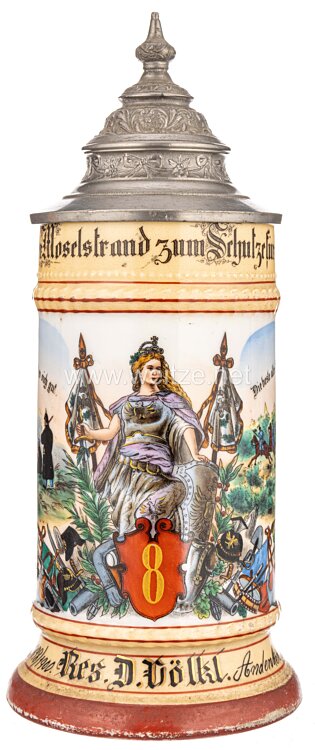
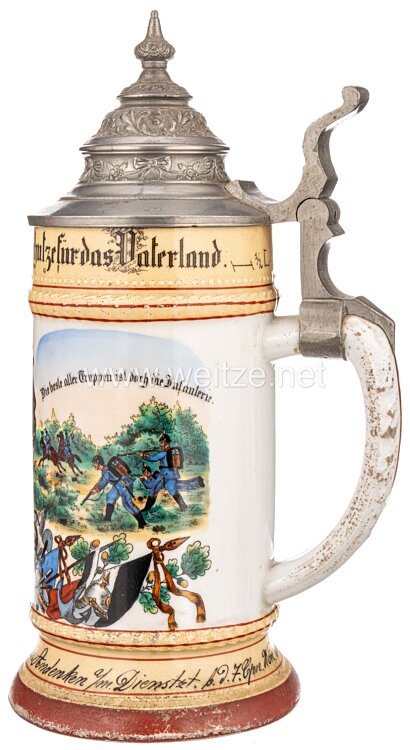
Bavarian Reservist Stein for Reservist “D. Völkl” of the 8th Infantry Regiment Grand Duke Friedrich II of Baden

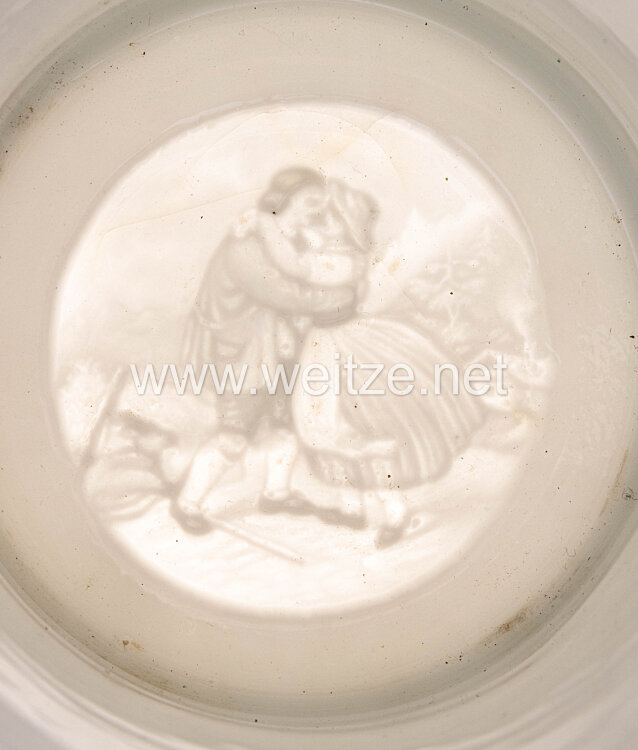
Stationed at Metz 1900. 0.5-liter porcelain stein with polychrome decoration, with base lithophane and pewter lid. Minor wear in places. Condition 2.
458968
300,00

Bavarian Reservist Stein for Reservist “D. Völkl” of the 8th Infantry Regiment Grand Duke Friedrich II of Baden

The Bavarian reservist stein represents a fascinating testimony to military everyday culture in the German Empire. This particular stein was made for reservist D. Völkl, who completed his military service with the 8th Infantry Regiment “Grand Duke Friedrich II of Baden” in Metz in the year 1900.

The tradition of reservist steins developed in the last third of the 19th century and reached its peak between 1890 and 1914. Following the introduction of universal conscription through the military reforms of 1814 and its consolidation in the North German Confederation in 1867 and the German Empire in 1871, virtually every able-bodied man served two to three years in the army. The transition from active service to the reserves became a significant life milestone that many soldiers wanted to commemorate with a personalized memento.

The 8th Infantry Regiment was a Bavarian line regiment that bore the honorary name of the Baden Grand Duke Friedrich II. This naming reflects the complex dynastic connections within the German Empire. The regiment was garrisoned in Metz, a strategically important fortress city in Reichsland Elsaß-Lothringen (Imperial Territory of Alsace-Lorraine), which had been ceded to Germany after the Franco-Prussian War of 1870-71.

After 1871, Metz developed into one of the strongest fortresses in the German Empire. The city housed numerous garrisons from various German states, including Bavarian units. The presence of Bavarian troops in this formerly French city underscores the empire-wide organization of the armed forces, even though the south German states maintained their own contingents with independent administration.

This stein is a typical example of porcelain reservist steins that were particularly popular in Bavaria and other southern German regions. With a capacity of 0.5 liters, it corresponds to the standard size of these mementos. The colored illustrations typically depicted military scenes, regimental insignia, garrison views, or symbols of soldier life. The lithophane base image inside the stein, which became visible only when the stein was emptied, often contained humorous or sentimental motifs—from images of sweethearts to jovial drinking verses.

The pewter lid was both functional and decorative. A figure or military emblem often adorned the lid's thumblift. The pewter mounting was considered a mark of quality and made the stein a valuable possession.

Such steins were manufactured by specialized workshops, particularly in Thuringia and Bavaria. Manufactories in Mettlach, the Westerwald, and other centers of ceramic production created these mementos according to customer specifications. Soldiers could select designs from pattern books and have them personalized. In addition to the name, the service period, garrison location, regimental designation, and sometimes the names of comrades were immortalized.

The social context of this tradition is remarkable. Military service was considered an honorable duty and a rite of passage into adulthood. The reserve period marked the return to civilian life, with the veteran proudly bearing his new status as a reservist capable of military service. The steins were displayed at reservist meetings, in taverns, and on special occasions, serving as conversation starters about military experiences.

The year 1900 marks a phase of relative stability in the German Empire under Kaiser Wilhelm II. The army was in peacetime, focusing on training and modernization. The Metz garrison played a central role in defense planning against France, which hoped for revenge for the defeat of 1870-71.

The artistic quality of these steins varied considerably. High-quality examples like the present one show detailed, multicolored decoration with precise execution. The craftsmanship encompassed various techniques: underglaze painting, overglaze painting, and transfer printing. The motifs were stylistically influenced by the Gründerzeit (Founder's Period) and Historicism.

After World War I, this tradition largely ended. The political and social upheavals, the abolition of the monarchy, and the drastic reduction of armed forces through the Treaty of Versailles made such military mementos obsolete. Today, reservist steins are sought-after collectibles that provide insight into the military culture, social history, and craftsmanship of the Imperial era.

The described condition with occasional wear is typical for a utilitarian object over 120 years old and hardly diminishes its historical value. Such steins document an era in which military and society were closely intertwined and military service represented a formative period of life.