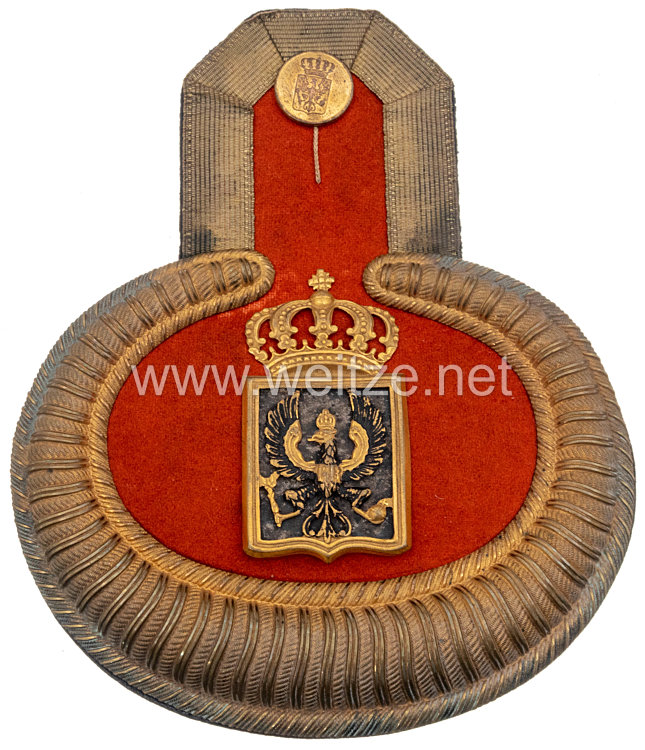
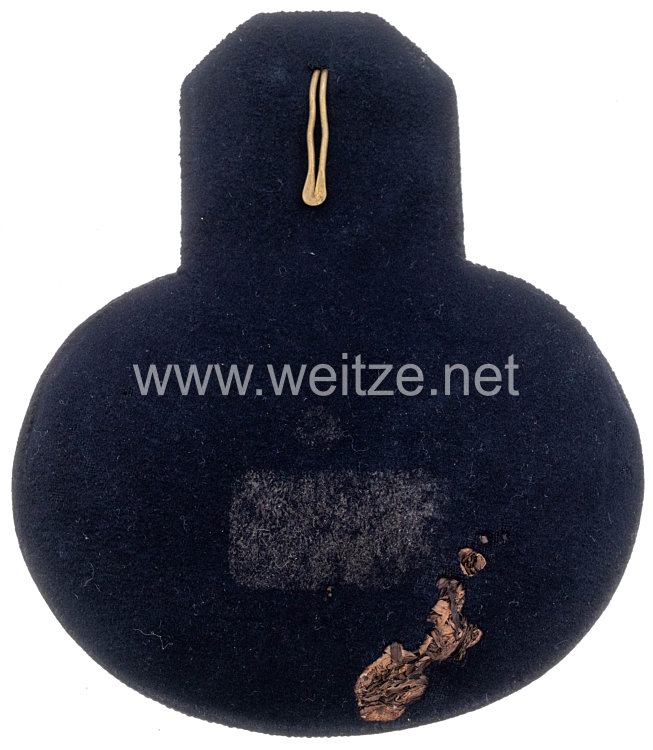
Prussian Postal Service Single Epaulette for a Postal Official
This Prussian postal epaulette from the mid-19th century represents a fascinating testament to Prussian administrative history, from an era when postal officials wore military-style uniforms and served the state with quasi-military status.
In the Kingdom of Prussia, the postal service had been a state institution of paramount importance since the 18th century. The Prussian postal administration developed into one of the most efficient in Europe and played a crucial role in communication within the expansive Prussian territories. Around 1850, the period when this epaulette was created, Prussia was undergoing significant modernization and expansion.
The uniforming of postal officials strictly followed military models. This was by no means unusual, as in the 19th century, civil servants, particularly those in uniform, enjoyed high social standing. The uniform symbolized authority, reliability, and a direct connection to the royal house. Postal officials were not merely simple employees but representatives of royal power and the Prussian state.
The epaulette – a badge worn on the shoulder – originated in military tradition and served to identify rank and function. In the Prussian postal service, epaulettes were worn according to established regulations that indicated the wearer's rank and position. A single epaulette, such as the specimen described here, was typically worn on the right shoulder, while higher ranks adorned both shoulders with epaulettes.
The construction of such epaulettes followed a standardized pattern: a cloth base, usually in Prussian colors, formed the foundation. Metallic elements – often made of gilded brass or other alloys – were applied to this. The fringes, characteristic of epaulettes, consisted of metal threads or bullion wire. For postal officials, the decorations were generally simpler than military epaulettes, yet they followed the same aesthetic principle.
The period around 1850 was particularly significant for the Prussian postal system. After the revolutionary unrest of 1848/49, the kingdom stabilized again, and infrastructure was systematically expanded. The postal system experienced enormous growth due to increasing industrialization and expanding trade. The introduction of the postage stamp in Prussia occurred in 1850, revolutionizing and modernizing the postal service.
The social position of a postal official was respectable. The profession required education, reliability, and often knowledge of multiple languages and bookkeeping. Postal officials enjoyed pension entitlements and were considered secure existences. The uniform with its rank insignia emphasized this status and distinguished the postal official from ordinary citizens.
The mentioned moth damage to the cloth base is not unusual for objects of this type. Wool and other natural textiles were the standard materials of the 19th century and are particularly susceptible to insect damage. This underscores the authentic age of the piece and its materiality. Such damage is often a sign of authenticity to collectors, provided the object is otherwise well preserved.
The Prussian postal system later became part of the North German Federal Post (1868) and eventually the Imperial Post (1871). The uniform traditions and rank insignia were partially adopted and further developed. Epaulettes remained part of the uniform until the early 20th century but were increasingly replaced by more modern shoulder boards.
For collectors and historians, such epaulettes are valuable sources. They document not only uniform history but also the social history of civil service, the development of state institutions, and the self-representation of the Prussian state. Every detail – from the quality of workmanship to the types of materials used – provides insight into the period of its creation.
The preservation of such objects is of cultural-historical significance. They recall a time when civil servants wore their uniforms with pride and the postal system represented one of the most modern achievements of the 19th century. The described specimen is thus not merely a militaria-like collector's item but an authentic witness to Prussian administrative history and state representation.