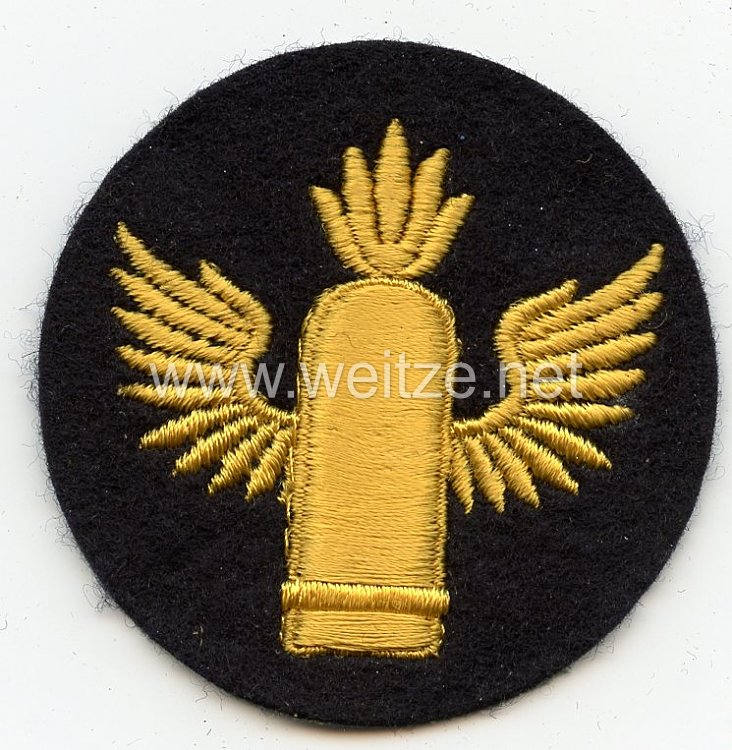
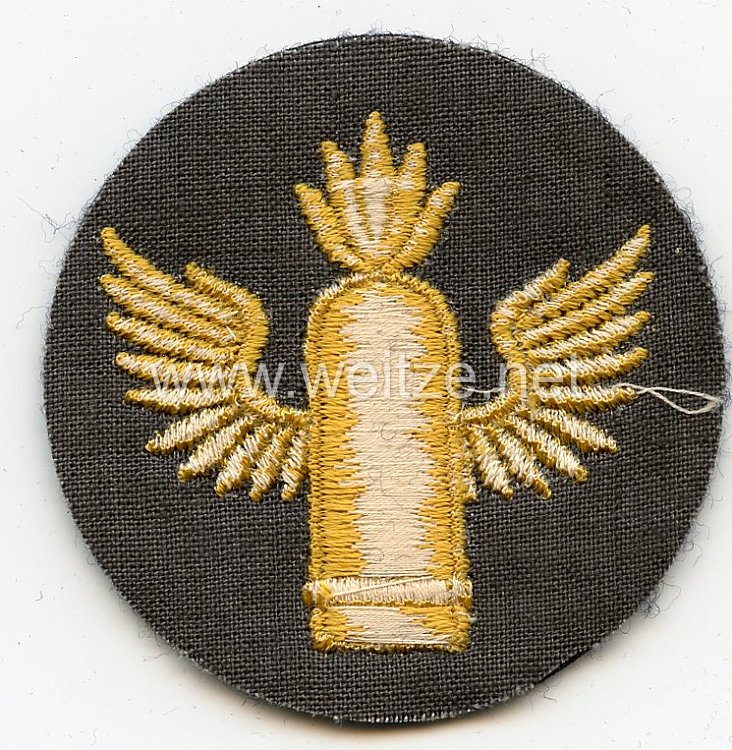
Kriegsmarine Enlisted Ranks Sleeve Insignia Naval Artillery Career Path
The Kriegsmarine sleeve insignia for enlisted personnel of the naval artillery career path represents a significant example of the complex system of career and specialization badges used by the German Kriegsmarine between 1935 and 1945. These badges served not only to identify a sailor's professional specialization but also reflected the highly organized structure of the National Socialist German Navy.
Following the reestablishment of the German Kriegsmarine in 1935, which constituted a direct violation of the provisions of the Treaty of Versailles, a comprehensive system of uniform regulations and insignia was established. The Anzugsordnung für die Kriegsmarine (A.O.K. - Uniform Regulations for the Navy) regulated in detail the wearing of uniforms and badges. The present sleeve insignia was worn on the blue working and walking-out uniform, known as the Bordanzug (shipboard uniform).
The naval artillery career path (Marineartillerielaufbahn) was one of the most important specializations within the Kriegsmarine. Enlisted personnel in this career path were responsible for operating, maintaining, and deploying all artillery weapons aboard warships. This included both heavy naval guns for sea combat and anti-aircraft guns of various calibers. The training was demanding and encompassed theoretical instruction in ballistics, fire control, and ammunition science, as well as practical exercises on the guns themselves.
The badge itself was machine-embroidered in yellow thread on a blue wool backing. This manufacturing method became standard from the late 1930s onward, as it enabled more cost-effective and faster production than hand-embroidered badges. The yellow color was characteristic of the naval artillery career path and distinguished it from other paths that used different colors: torpedo personnel wore red badges, while signals personnel used brown badges.
The sleeve insignia were worn on the left upper arm, approximately halfway between shoulder and elbow. They were an integral component of the uniform and had to be properly affixed according to regulations. For enlisted personnel and non-commissioned officers without the portepee (sword knot), these career badges were mandatory and had to be worn on all uniform variants, with the exception of certain working dress.
The production of these badges was carried out by various manufacturers throughout the German Reich. Both state workshops and private companies were contracted for production. Quality could vary depending on the manufacturer and time of production. Toward the end of the war, when material shortages prevailed, simplified versions with less elaborate embroidery were sometimes produced.
Wearing such badges had not only practical but also psychological significance. They fostered esprit de corps within the various career paths and contributed to the identity formation of naval personnel. Membership in the naval artillery was considered prestigious, as this branch played a central role in naval battles.
In the context of the Kriegsmarine between 1939 and 1945, artillery personnel were present on all ship types, from small fast attack craft to large battleships such as the Bismarck or Tirpitz. They were also responsible for deck guns on U-boats, although these became increasingly less important as the war progressed.
Following Germany's unconditional surrender in May 1945, the Kriegsmarine was dissolved, and all its symbols, uniforms, and insignia lost their official significance. Today, such sleeve insignia are important military-historical documents that provide insights into the organization, hierarchy, and daily life of the German Kriegsmarine. They are valued by museums, collectors, and researchers as objects of study and help to paint a more complete picture of this historical era.