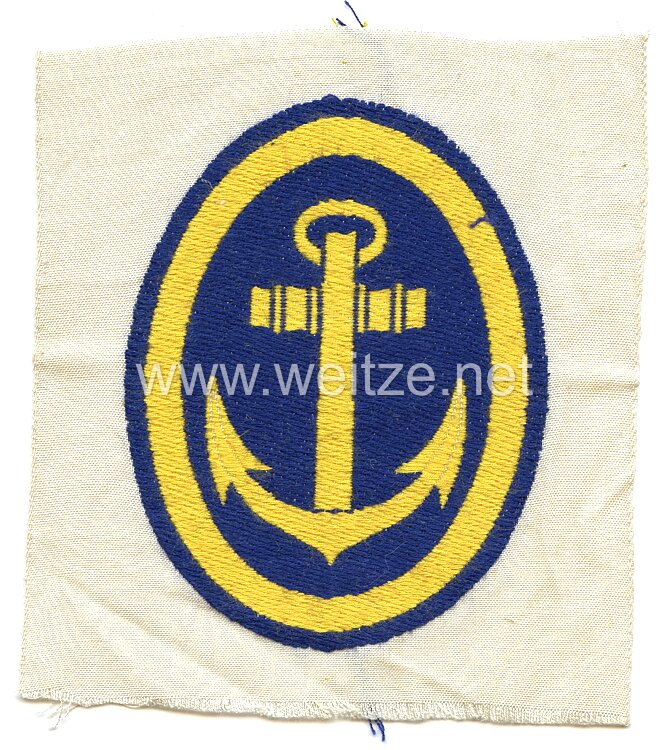
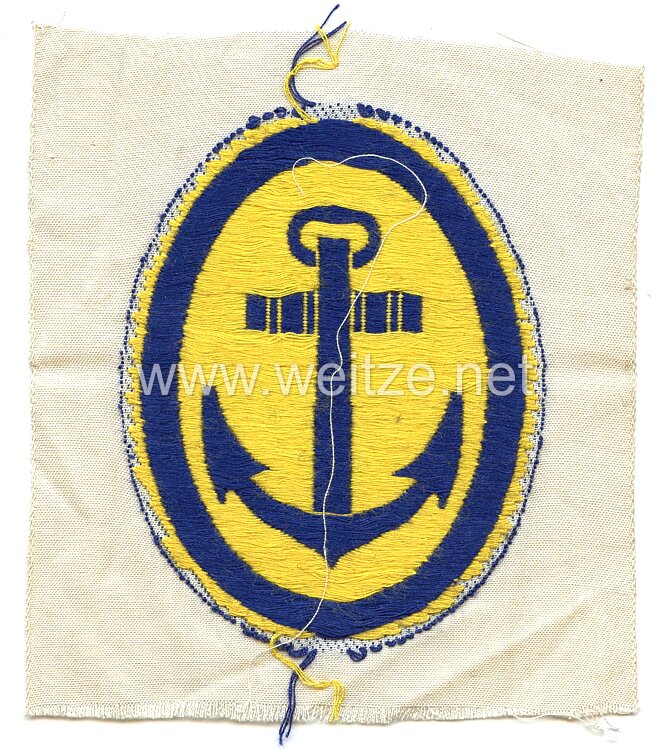
Kriegsmarine Sports Pants Badge for Officers

Woven execution. Unissued condition, condition grade 2.
462667
20,00

Kriegsmarine Sports Pants Badge for Officers

The Kriegsmarine Sports Shorts Badge for Officers represents a remarkable example of military dress regulations and rank insignia of the German Navy during World War II. This specialized form of rank identification was developed to maintain visible military hierarchy even during sporting activities and physical training.

The Kriegsmarine, the official designation of German naval forces from 1935 to 1945, maintained a complex system of uniforms and badges for various occasions and types of dress. Following Germany's rearmament under the Nazi regime and the official renaming of the Reichsmarine to Kriegsmarine in 1935, comprehensive new dress regulations were introduced that governed all aspects of military appearance.

The woven construction of this badge is characteristic of the practical approach to sports clothing within the Wehrmacht. Unlike the metal or embroidered badges of dress uniforms, woven badges were preferred for sportswear because they were lighter, more flexible, and more resistant to the stresses of athletic activities. These badges were typically sewn onto sports shorts (athletic shorts or training trousers) and allowed officers to display their rank even in civilian-style sportswear.

The importance of physical fitness in the German Kriegsmarine cannot be underestimated. Even in the pre-war period, the Navy placed great emphasis on the physical fitness of its crews. Regular sports exercises, swimming training, and physical conditioning were integral parts of military daily life both aboard ship and on shore. The service regulations of the Kriegsmarine contained detailed instructions on the type and extent of physical activity for all ranks.

For officers, there existed a particular obligation not only to remain physically fit themselves but also to serve as role models for the enlisted ranks. Officers' sportswear therefore deliberately differed from that of enlisted personnel through the wearing of special rank badges. This served to maintain military discipline and hierarchy even in more informal situations.

The weaving technique for these badges was carried out in various specialized textile factories that served as suppliers to the Wehrmacht. Manufacturing followed precise specifications regarding size, color, and design. Typically, these badges displayed rank insignia in simplified form, often as stripes or other geometric patterns that indicated the wearer's rank.

The unworn condition of this particular specimen offers a rare insight into the original quality and appearance of these military textiles. Many sports badges were used intensively and show corresponding signs of wear. An unworn piece preserves the original colors and structural integrity of the fabric.

In the broader context of Kriegsmarine uniform studies, sports badges belong to the lesser-known but nevertheless important aspects of military dress. While parade and service uniforms are well documented, there are fewer comprehensive records of everyday sportswear and its badges. This makes preserved specimens particularly valuable for understanding the complete spectrum of military clothing from this era.

The collection and preservation of such militaria today serves exclusively historical and scholarly purposes. It enables historians and researchers to reconstruct a more comprehensive picture of military daily life and better understand organizational structures. Such objects are witnesses to a dark period in German history and should always be viewed in the context of their time.

These badges also reflect the totalitarian nature of the Nazi military system, where rank and hierarchy permeated every aspect of life, including recreational activities. The attention to detail in creating specific insignia even for sports clothing demonstrates the regime's emphasis on maintaining strict military order and visible social stratification at all times.