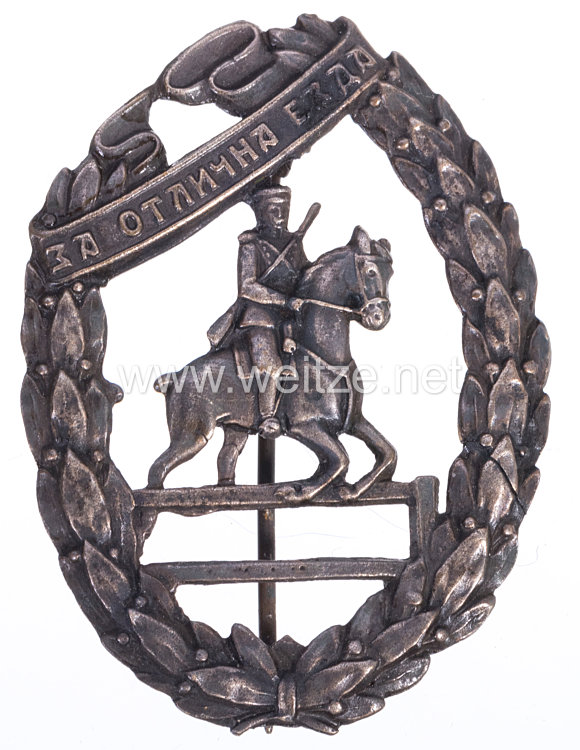
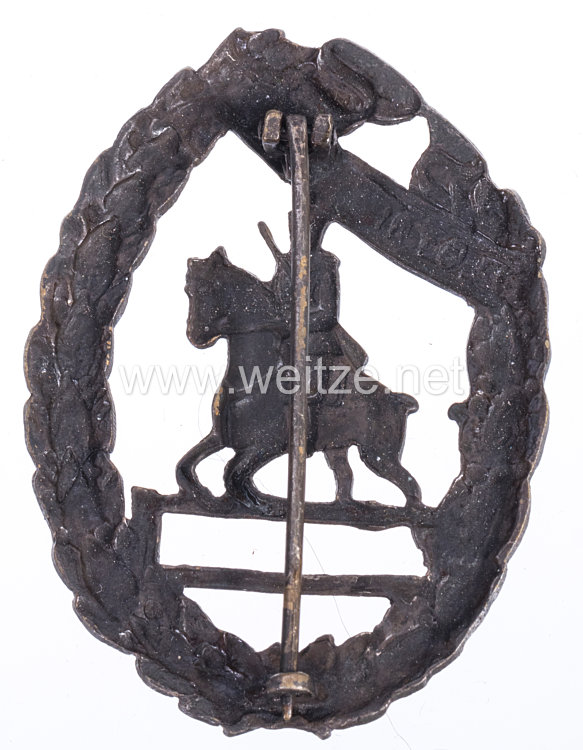
Bulgaria World War II Cavalry Distinguished Service Badge

Silver-plated base metal, pinback. Condition 2

356067
200,00

Bulgaria World War II Cavalry Distinguished Service Badge

The Bulgarian cavalry badge from World War II represents a fascinating testament to Bulgaria's military tradition during one of the most turbulent periods of the 20th century. This badge, crafted from silver-plated base metal with a pin fastening, belongs to a system of military awards that reflects the role and significance of cavalry in the Bulgarian armed forces during the war.

Historical Context: Bulgaria in World War II

Bulgaria joined the Tripartite Pact on March 1, 1941, officially becoming an ally of the Axis powers. Under the leadership of Tsar Boris III, the kingdom pursued a complex and often ambivalent policy. While Bulgarian troops participated in the occupation of parts of Yugoslavia and Greece, Bulgaria notably refused to send troops to the Eastern Front against the Soviet Union and largely preserved its Jewish population from deportation.

The Bulgarian Cavalry: Tradition and Modernization

The cavalry had a long and honorable tradition in Bulgarian military history, dating back to the time of the First Bulgarian Empire. During World War II, however, the Bulgarian cavalry found itself in a transitional phase between traditional mounted warfare and modern mechanized combat. The Bulgarian Army maintained several cavalry regiments that were employed for both reconnaissance and security duties.

Despite the increasing mechanization of warfare, cavalry retained its tactical significance in the mountainous regions of the Balkans. The terrain of Bulgaria and neighboring countries made mounted units indispensable for certain operations, particularly in areas difficult to access with motorized vehicles.

The Decoration System

The Bulgarian military possessed an elaborate system of orders, decorations, and badges that drew upon traditions dating partly from the period following liberation from Ottoman rule in 1878. During World War II, this system was expanded and adapted to accommodate the particular circumstances and requirements of the war.

Cavalry badges such as this one served multiple purposes: they identified affiliation with a particular branch of service, recognized special achievements or qualifications, and strengthened esprit de corps within cavalry units. Such badges were typically worn on the uniform and served as visible signs of military competence and honor.

Manufacture and Material

The use of silver-plated base metal in manufacturing this badge is characteristic of wartime production. Given the scarcity of precious metals during the war, recourse was frequently made to more economical materials that nevertheless maintained an appropriate representative character. The silver plating gave the badge a dignified appearance, while the use of base metal as the carrier material kept production costs low.

Pin fastening was the most common method of attaching such badges to uniforms. It allowed for easy attachment and removal, which was particularly important since decorations and badges had to be changed depending on the occasion and type of uniform.

The End of an Era

On September 9, 1944, Bulgaria declared war on Germany and switched sides after Soviet troops crossed the border. This dramatic turn marked the end of Bulgarian participation on the side of the Axis powers. After the war, Bulgaria became part of the Soviet sphere of influence, and the monarchy was abolished in 1946.

Military traditions, including the decoration system, were fundamentally restructured in the communist era. Many decorations and badges from the monarchical period were abolished or replaced with new Soviet-inspired symbols. The cavalry as an independent branch of service gradually lost significance and was eventually completely replaced by mechanized and armored units.

Collector Value and Historical Significance

Today, Bulgarian militaria from World War II are sought-after collector's items. They offer material access to the history of a country whose role in World War II is often less well known than that of the major belligerents. Such badges document not only military organization and hierarchy but also the artistic and craftsman traditions of the period.

The good condition of such pieces is remarkable considering they were manufactured nearly eight decades ago. They serve historians, collectors, and museums as important sources for understanding Bulgarian military history and the complex political situation of the Balkans during World War II.