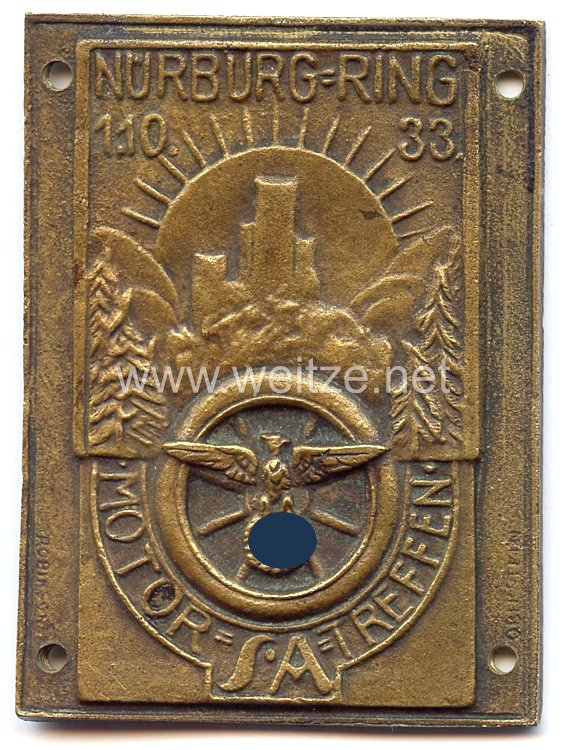
SA / NSKK - Non-Wearable Participant Plaque - “Motor-SA-Treffen Nürburg-Ring 1.10.1933”

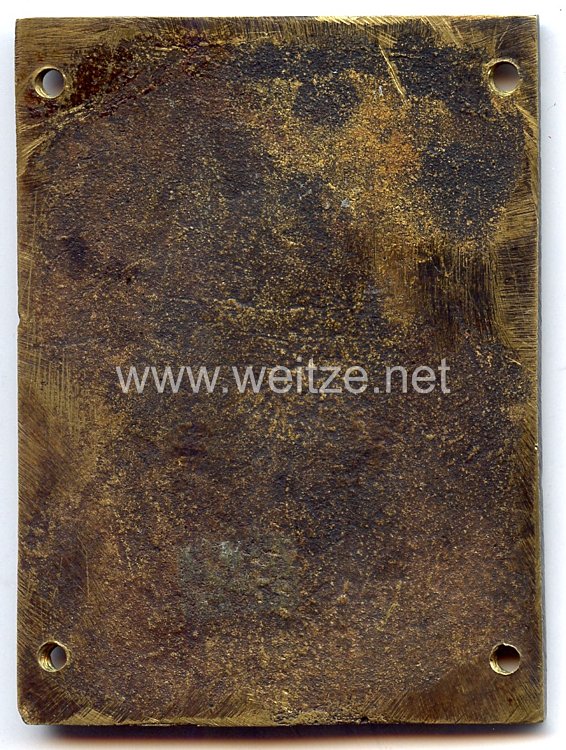
Brass, 57 x 77 mm, with 4 holes, maker: Robinson Oberstein, condition 2.
337366
350,00

SA / NSKK - Non-Wearable Participant Plaque - “Motor-SA-Treffen Nürburg-Ring 1.10.1933”

The SA/NSKK participant plaque from the Motor-SA meeting at the Nürburgring on October 1, 1933, represents a significant chapter in the history of National Socialist organizations and their motorsport activities in the early Third Reich. This non-wearable brass plaque, manufactured by Robinson Oberstein, documents an important propaganda event of the Sturmabteilung (SA) and the National Socialist Motor Corps (NSKK).

The NSKK was founded on April 1, 1930, as a motorized sub-organization of the SA and quickly developed into an independent formation of the NSDAP. After the seizure of power in 1933, the NSKK gained considerable importance as it assumed responsibility for the pre-military training of German drivers and served as a reserve for the later Wehrmacht. The first Corps Leader was SA-Gruppenführer Adolf Hühnlein, who led the NSKK until 1942.

The Nürburgring, opened in 1927 in the Eifel region, was already one of Europe's most challenging racing circuits before 1933. After the National Socialist seizure of power, the facility was increasingly used for propagandistic mass events. The Motor-SA meeting of October 1, 1933, took place during a decisive phase of Gleichschaltung (coordination), just months after Hitler's appointment as Reich Chancellor on January 30, 1933.

Such motorsport events served multiple purposes: they were meant to demonstrate the technical modernity of the new regime, propagate the connection between motorsport and military fitness, and mobilize the masses through spectacular events. The SA, under the leadership of Ernst Röhm, was at the height of its power in 1933 with several million members, before being stripped of power during the “Röhm Affair” in June 1934.

The present plaque with its four drill holes was designed as a non-wearable commemorative piece, presumably intended for mounting on vehicles or for display. The dimensions of 57 x 77 mm and the brass construction were typical for such badges of the early Nazi period. The manufacturer Robinson Oberstein from Idar-Oberstein was located in a region traditionally known for its metalworking and jewelry production.

The early 1930s were characterized by a flood of such participant and commemorative badges at National Socialist events. These objects served to bind participants to the movement and created a sense of belonging to historical events. For collectors and historians today, they are important testimonies to Nazi propaganda and organizational history.

After 1933, the NSKK developed an extensive system of motorsport events, competitions, and training programs. The organization was structured into Motor Staffeln, Motor Stürme, and Motor Standarten and wore characteristic brown uniforms with specific insignia. By 1939, the NSKK had grown to approximately 500,000 members.

The importance of motorsport in the Nazi state is also evident in the massive promotion of German automobile racing by the regime. The “Silver Arrows” of Mercedes-Benz and Auto Union dominated international racing series from the mid-1930s, financed by state subsidies. The Nürburgring became the stage for these successes and for mass events like the meeting documented here.

From a military-historical perspective, this plaque documents the early phase of militarization of German society after 1933. The NSKK contributed significantly to the training of drivers who would later serve in the Wehrmacht. The connection between sport, technology, and pre-military training was a central element of Nazi ideology.

Today, such objects are important sources for researching Nazi history, everyday culture in the Third Reich, and the propaganda mechanisms of totalitarian systems. They remind us of a time when even leisure activities and sports were instrumentalized for political and military purposes.

r