Prussia Gardes du Corps Belt for Gala Guard Uniform

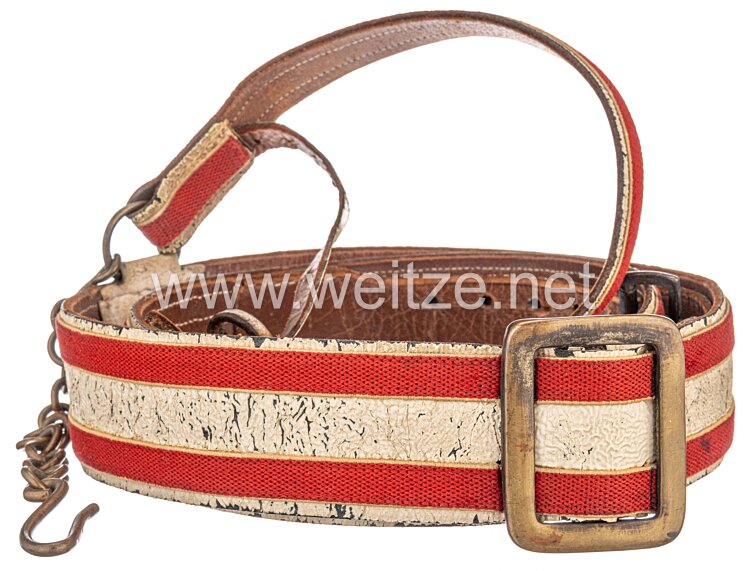
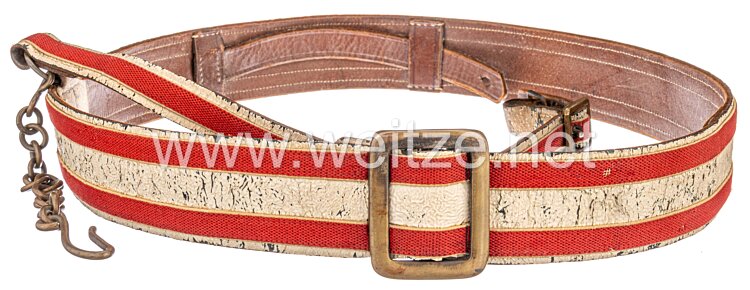
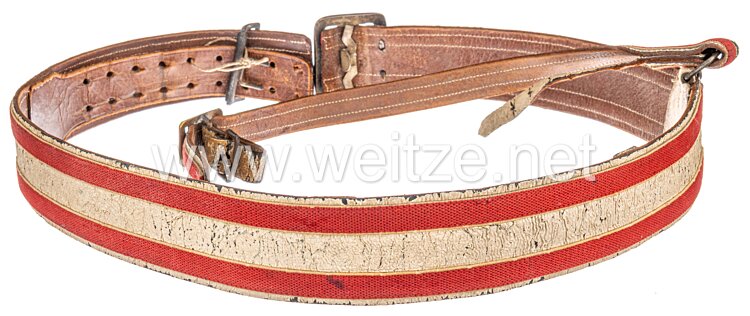
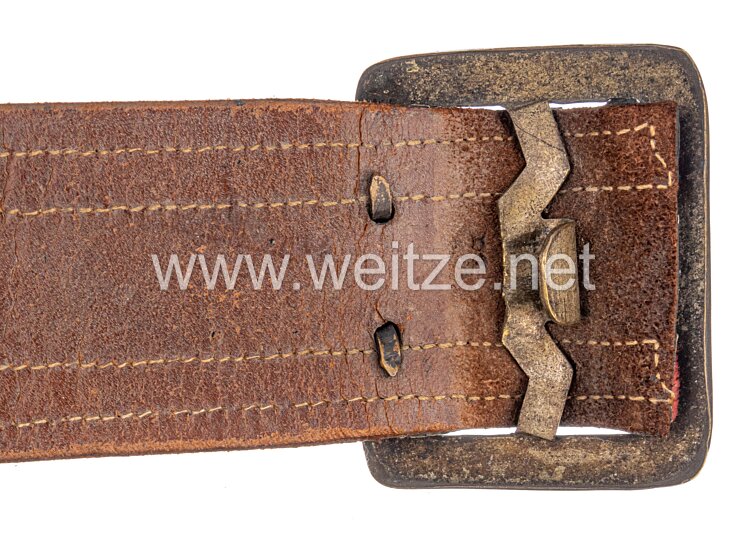
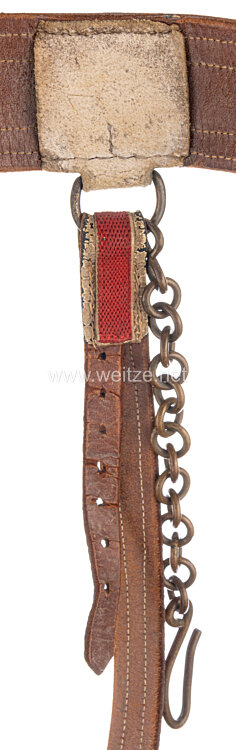
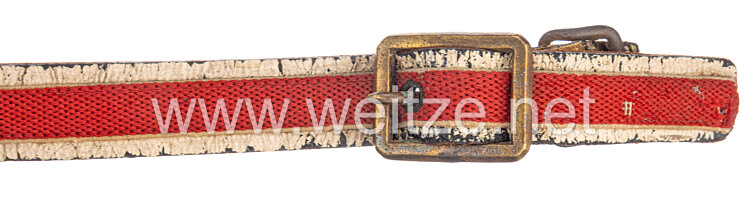
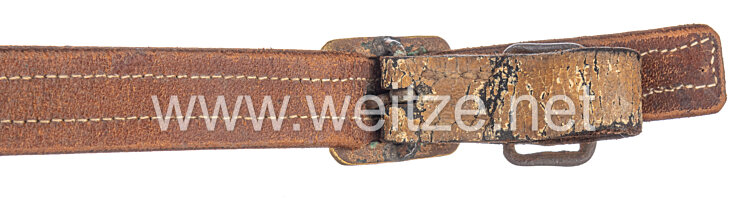
Circa 1900. Leather belt with brass fittings, the exterior whitened and bordered all around with two red-white braids, complete with drag strap and brass chain. Condition 2.

Extremely rare and offered for the first time in our catalog!

For grand court festivities, members of the Gardes du Corps Regiment who were detailed as honor guards wore a special uniform, the so-called gala guard uniform. Initially, only the supravest was distinctive. From 1883 onwards, a special bandolier with cartridge box and this special belt for the gala guard uniform were additionally introduced.
459966

Prussia Gardes du Corps Belt for Gala Guard Uniform

The Koppel zum Galawachtanzug (belt for gala guard uniform) represents one of the rarest and most prestigious pieces of equipment from the Prussian Guard Cavalry. This special belt was introduced in 1883 as part of the distinctive equipment for the Galawachtanzug and worn exclusively by members of the Regiment der Gardes du Corps when they were detailed as honor guards at great court festivals.

The Regiment der Gardes du Corps occupies a unique position in Prussian military history. Established by cabinet order of June 23, 1740 by King Friedrich II of Prussia, it was founded as a training squadron with Guard character. The historical lineage extends further back: since 1542 the Electors of Brandenburg maintained a mounted household troop with the Trabant Guard on foot, joined by mounted troops in 1571. From 1692 to 1713 under Friedrich I a Garde du Corps existed, but it was dissolved under Friedrich Wilhelm I. Friedrich II created the regiment not only as the personal bodyguard for the King but also as a model unit for the Prussian cavalry, which required fundamental restructuring after failing at the Battle of Mollwitz on April 10, 1741.

The regiment was expanded to three squadrons in 1756 and numbered as the 13th Cuirassier Regiment (K 13). In 1753, Potsdam was assigned as the new garrison. The Gardes du Corps was assigned first rank in the Army list, making it the most distinguished unit of the royal Prussian cavalry. This outstanding position was manifested ceremonially: at the New Year's reception of the Kaiser and King, officers of the GdC were presented to the throne immediately after those of the First Guard Regiment on Foot and thus before the princes and ambassadors.

The social composition of the regiment was extraordinarily elite. In 1913, apart from five doctors and veterinarians, there was not a single non-noble officer in the Gardes du Corps. Of 34 officer positions, 20 were held by princes and counts, giving the regiment a peak proportion of high and ancient nobility.

The Galawachtanzug, to which this belt belonged, developed gradually. Initially only the Supraveste was distinctive – a red sleeveless vest worn over the Koller, embroidered with the star of the Order of the Black Eagle on front and back. From 1883, the equipment was enhanced by a special bandolier with cartridge box and the special belt for the Galawachtanzug. These cartridge box and bandolier prescribed since 1883 belonged exclusively to the Galawachtanzug of the Regiment der Gardes du Corps.

The belt itself consists of a leather belt with brass fittings, its outer side whitened and trimmed all around with two red-white borders. It is complete with the sword drag strap and brass chain – a heavy whitened belt with red cloth trim and large silver angle-edged buckle.

The era of this magnificent equipment ended with the modernization of the Prussian Army. Already ordered by cabinet order of February 14, 1907 and gradually introduced from 1909/10, the colorful uniform was replaced for the first time by the field-gray field service uniform (M 1910) at the Kaiser maneuvers of 1913. The bandolier and cartridge box were no longer worn with this new uniform, suggesting that the Galawachtanzug and its special equipment fell out of use by World War I.

The regiment existed until after World War I. The tradition was continued in the Reichswehr by decree of the Chief of Army Command, General der Infanterie Hans von Seeckt, dated August 24, 1921, by the 1st Squadron of the 4th (Prussian) Cavalry Regiment in Potsdam. Most recently in the Bundeswehr, Panzerbataillon 24 in Braunschweig carried on this tradition until its dissolution.