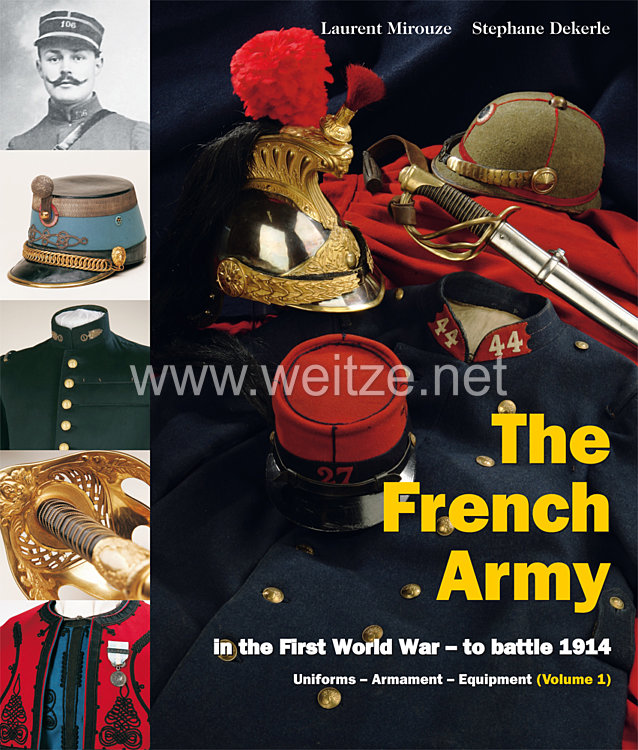
Laurent Mirouze, Stéphane Dekerle : The French Army in the First World War – to battle 1914
Verlag Militaria. 528 pages, approx. 1000 photographs and illustrations, bound in linen with a protective cover. Format: 29.5 x 26.0 cm.
With more than 500 original artefacts this illustrated book shows for the first time the appearance of the French army at the outbreak of the First World War, i.e. at the time of mobilization in August 1914. Approx. 1,000 photographs on 528 pages give the reader a vivid picture of the different headgear, uniforms and items of clothing and equipment including cavalry equipment (saddlery). The originals illustrated in the book derive from the Musée de l'Armée in Paris and Salon-de-Provence (L'Empérie) and are supplemented by major public and private collections. The majority of the artefacts are shown to the public for the first time. All of this presents a well structured and authentic picture of the French army at the beginning of the war and during the initial fighting in the Battle of the Marne. With more than 300 carefully selected black and white and ten contemporary, original colour photographs ('autochromes') the reader is given a realistic impression of the appearance of the French army in the 'Belle Epoque'. The book shows the reader the colourfulness of the French army at the beginning of the war in Europe, supplemented by the traditions of African and Arab units and influences on uniforms. The orientally inspired clothing of 'L'Armée d'Afrique', the uniforms of the Foreign Legion and colonial troops and elegant officers' clothing mirror both the fashions of the time and the prestige of wearing uniform. The complete equipment of a colonial soldier before 1914 - from his képi to his knife - in almost mint quality, each individual item stamped with the personal registration number of the soldier, gives these objects a human and emotional dimension. The large number of artefacts available makes it possible to produce a second volume covering the period from the end of 1914 until 1918. It will present the extraordinary development of uniforms during the war and especially the introduction of the horizon-blue dress which was so typical of the French soldier during the Battle of Verdun. This volume will also contain the personal uniforms and items of equipment of famous personalities and officers up to the rank of field marshal.
For deliveries to non-European countries, increased shipping costs may apply. We ask for a consultation. Pour les livraisons dans des pays non européens, des frais d'expédition plus élevés peuvent s'appliquer. Nous demandons une consultation.
With more than 500 original artefacts this illustrated book shows for the first time the appearance of the French army at the outbreak of the First World War, i.e. at the time of mobilization in August 1914. Approx. 1,000 photographs on 528 pages give the reader a vivid picture of the different headgear, uniforms and items of clothing and equipment including cavalry equipment (saddlery). The originals illustrated in the book derive from the Musée de l'Armée in Paris and Salon-de-Provence (L'Empérie) and are supplemented by major public and private collections. The majority of the artefacts are shown to the public for the first time. All of this presents a well structured and authentic picture of the French army at the beginning of the war and during the initial fighting in the Battle of the Marne. With more than 300 carefully selected black and white and ten contemporary, original colour photographs ('autochromes') the reader is given a realistic impression of the appearance of the French army in the 'Belle Epoque'. The book shows the reader the colourfulness of the French army at the beginning of the war in Europe, supplemented by the traditions of African and Arab units and influences on uniforms. The orientally inspired clothing of 'L'Armée d'Afrique', the uniforms of the Foreign Legion and colonial troops and elegant officers' clothing mirror both the fashions of the time and the prestige of wearing uniform. The complete equipment of a colonial soldier before 1914 - from his képi to his knife - in almost mint quality, each individual item stamped with the personal registration number of the soldier, gives these objects a human and emotional dimension. The large number of artefacts available makes it possible to produce a second volume covering the period from the end of 1914 until 1918. It will present the extraordinary development of uniforms during the war and especially the introduction of the horizon-blue dress which was so typical of the French soldier during the Battle of Verdun. This volume will also contain the personal uniforms and items of equipment of famous personalities and officers up to the rank of field marshal.
For deliveries to non-European countries, increased shipping costs may apply. We ask for a consultation. Pour les livraisons dans des pays non européens, des frais d'expédition plus élevés peuvent s'appliquer. Nous demandons une consultation.