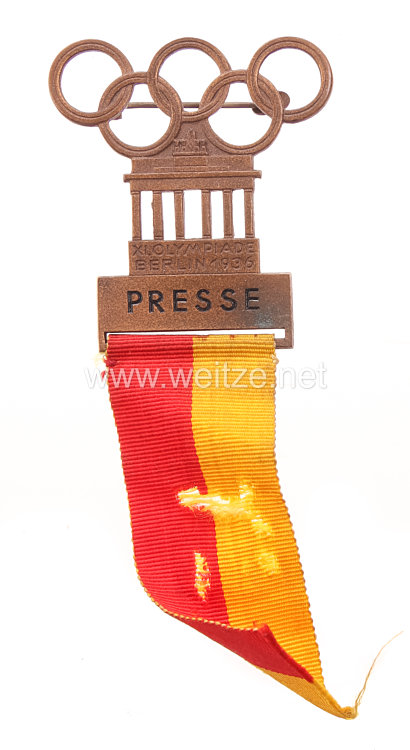
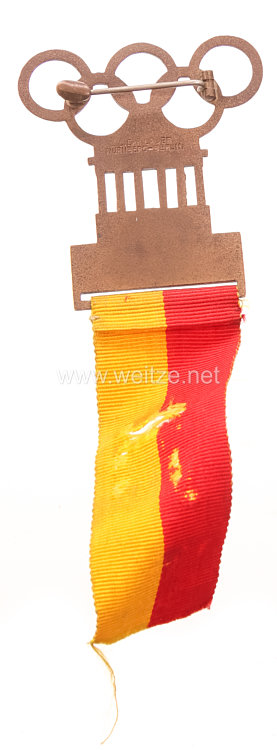
XI. Olympic Games 1936 Berlin - Official Participant Badge for a Member of the Press
The official press badge of the XI Olympic Games 1936 in Berlin represents a significant chapter in Olympic history and simultaneously a complex legacy of the Nazi propaganda machine. These badges were issued to accredited press representatives who were to report on the Summer Games held from August 1 to 16, 1936.
The XI Summer Olympic Games were the first Games to take place in Nazi Germany, after Berlin had been selected as the host city by the International Olympic Committee (IOC) in 1931 – before the Nazi seizure of power in 1933. The NS regime quickly recognized the propagandistic potential of this major event and used the Games to present Germany as a modern, peace-loving nation, concealing the racist and militaristic nature of the regime.
This badge was manufactured by the renowned firm L. Chr. Lauer of Nuremberg-Berlin, one of the leading manufacturers of orders, decorations, and badges in the German Reich. The Lauer company, founded in the 19th century, had earned an excellent reputation in the production of high-quality metallic awards and was frequently commissioned to produce official state and sporting badges.
The badge itself is made of tombac, a copper-zinc alloy that was frequently used for manufacturing orders and badges due to its gold-like color and corrosion resistance. The designation “Presse” (Press) on the badge clearly identified the wearer as a member of the accredited press. The attached red-and-yellow ribbon corresponds to the Olympic colors and was part of the official design.
The 1936 Olympic Games were a media event of unprecedented scale. Over 3,000 journalists from around the world traveled to Berlin to cover the Games. This was the first Olympiad to be televised, albeit only locally in Berlin and surrounding areas. The Reich Broadcasting Corporation transmitted the events to 28 countries. The Nazi leadership invested enormous sums to convey a positive image of Germany.
The press badges were part of a sophisticated accreditation system that regulated various access levels and authorizations. Journalists wearing such badges were granted access to competition venues, press conferences, and special press areas. Control and administration of press accreditation lay with the organizing committee under the leadership of Carl Diem and Theodor Lewald, though the Reich Ministry of Public Enlightenment and Propaganda under Joseph Goebbels exercised considerable influence.
The Games themselves featured high-caliber athletic competition. 49 nations participated, more than ever before. The African-American athlete Jesse Owens became the star of the Games by winning four gold medals, symbolically refuting Nazi racial ideology. While Germany won the most medals, the athletic successes of athletes of diverse backgrounds testified to the universality of the Olympic spirit.
From a historical perspective, the 1936 Olympic Games are highly controversial today. While they showcased outstanding athletic performances and introduced technical innovations such as the Olympic flame and torch relay, they served directly as Nazi propaganda. Many contemporary observers, particularly from abroad, were deceived by the staged façade of tolerance and modernity.
The press coverage was largely positive, partly due to skillful staging, but also partly due to the political naivety or appeasement attitude of many Western media outlets. Anti-Semitic signs were temporarily removed, and the regime made efforts to show a civilized face. Few journalists recognized or reported on the true nature of the Nazi regime.
Today, such press badges are important historical artifacts that document both the history of sports and the history of political propaganda. They serve as reminders of a time when a criminal regime instrumentalized sports for its purposes. Collectors and historians value these objects as historical documents that help us understand the past and learn from it.
The firm L. Chr. Lauer produced numerous official badges and awards during the Nazi era. After 1945, the company continued its activities and produced orders and decorations for the Federal Republic of Germany. The craftsmanship quality of Lauer products makes them sought after by collectors to this day, although the historical context must always be critically reflected upon.
The 1936 Olympics marked a pivotal moment when international sport intersected with totalitarian politics. The press badges, worn by journalists who witnessed and documented these Games, stand as tangible links to this complex historical moment, reminding us of the power of propaganda and the importance of critical journalism in democratic societies.