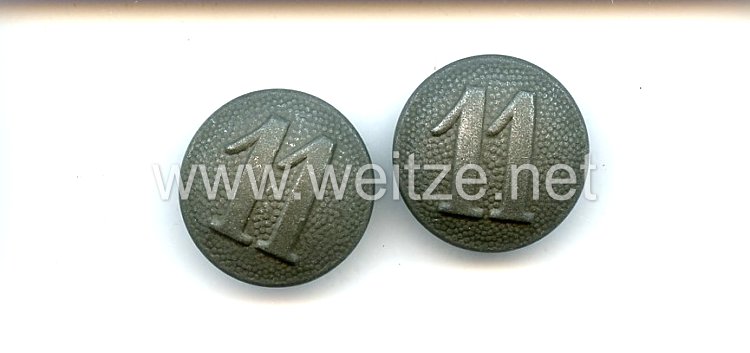
Hitler Youth (HJ) 2 Gefolgschaft Shoulder Buttons No. 11
The present Gefolgschaft shoulder buttons No. 11 of the Hitler Youth (HJ) represent a characteristic element of the uniform technical design of this National Socialist youth organization. These shoulder strap buttons served to identify organizational affiliation within the complex structure of the HJ and were an integral component of uniform regulations.
The Hitler Youth was founded in 1926 and developed after the National Socialist seizure of power in 1933 into the state-controlled unified youth organization of the German Reich. With the Law concerning the Hitler Youth of December 1, 1936, the HJ was declared the state youth organization, and membership became effectively obligatory. The organization was divided into various sub-units, with the Gefolgschaft (following) representing a central organizational unit.
A Gefolgschaft typically comprised 150 to 200 members aged 14 to 18 years and corresponded roughly to a company in military terminology. It was led by a Gefolgschaftsführer (following leader) and subdivided into several Scharen (troops). The numbering of Gefolgschaften occurred within the superior organizational units, the Stämme and Banne. The number 11 present here thus identified a specific Gefolgschaft within its superior unit.
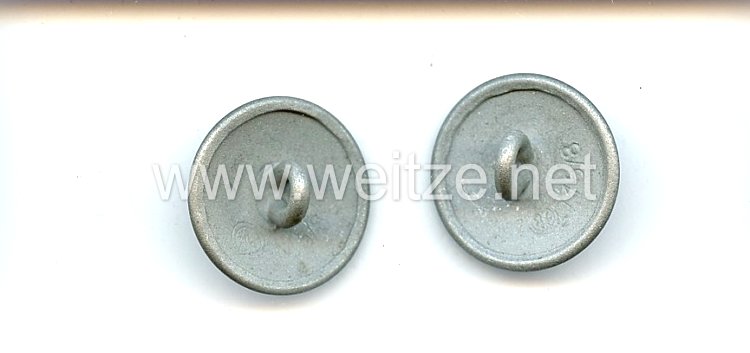
The shoulder buttons were attached to the shoulder straps of HJ uniforms and were manufactured from metal. They bore the respective unit number and thus enabled immediate identification of the wearer's organizational affiliation. The reverse RZM marking is of particular significance: The Reichszeugmeisterei (RZM) was the central procurement and inspection office of the NSDAP, which from 1929 oversaw quality control and licensing of uniform parts and equipment items.
The RZM assigned manufacturer numbers to authorized producers, thereby guaranteeing compliance with prescribed standards. This system was intended to ensure uniformity and prevent unauthorized production. The marking with RZM stamp and manufacturer number documents the official authorization and production of these shoulder buttons according to organizational regulations. Various companies were commissioned with manufacturing such uniform components, whereby the specific manufacturer number permits conclusions about production location and period.
The uniforming of the Hitler Youth followed detailed regulations set forth in the Uniform Regulations of the HJ. These rulebooks precisely described material, color, form, and manner of wearing all uniform parts. The shoulder straps with their numbering were mandatory components of service dress and had to be worn at official occasions, roll calls, and duty performances.
Uniforming served several purposes: it created a feeling of belonging and equality, emphasized the paramilitary orientation of the organization, and enabled quick identification of rank and unit. The HJ uniform deliberately oriented itself on military models and was intended to accustom youth early to military structures and discipline. This corresponded to the ideological objective of the organization to educate youth in the National Socialist sense and prepare them for their future role as soldiers and party members.
Collectibles such as these shoulder buttons are today subjects of historical research and museum documentation. They serve as material witnesses of a dark chapter in German history and provide insights into the organizational structure and uniforming practice of the National Socialist youth organization. The indicated condition 2 suggests, according to common collector evaluation, a well-preserved condition with minor signs of use.
The scholarly examination of such objects occurs in the context of research into National Socialism and its organizations. Critical contextualization is always required, which identifies these objects as relics of a criminal system responsible for unimaginable suffering and millions of deaths. Engagement with such material remnants serves historical education and warning for future generations.