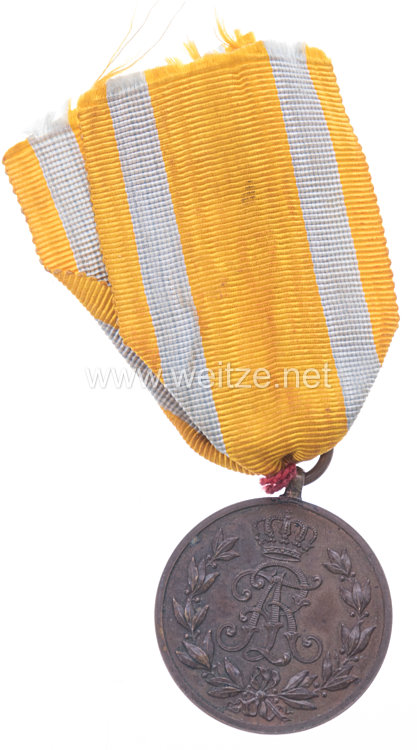
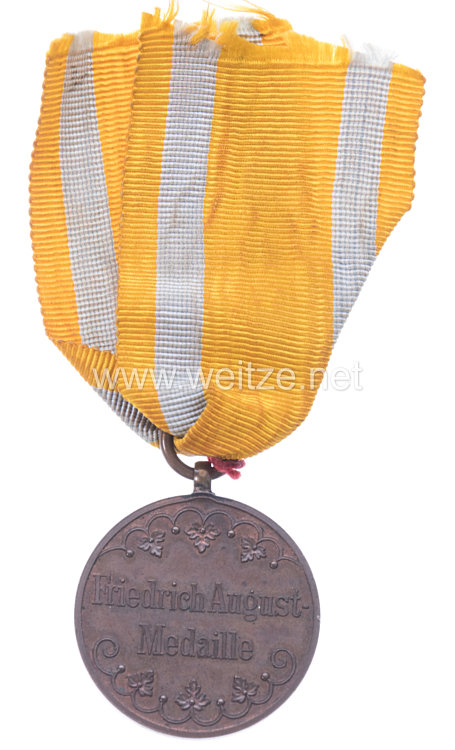
Kingdom of Saxony Friedrich-August Medal in Bronze
The Friedrich August Medal of the Kingdom of Saxony represents a significant decoration in the history of Saxon military and civil honors. This medal was instituted in honor of King Friedrich August I of Saxony (1750-1827), who ruled from 1806 to 1827 and was a central figure in Saxon history during the Napoleonic era.
The Kingdom of Saxony was one of the most important German states in the 19th century and played a significant role in Central European politics. Friedrich August I, initially known as Elector Friedrich August III, elevated Saxony to the status of a kingdom in 1806 during the Napoleonic Wars. His reign was marked by the turbulent years of Napoleonic domination, the Wars of Liberation, and the subsequent reorganization of Europe at the Congress of Vienna.
The Friedrich August Medal in Bronze belongs to the system of Saxon decorations for bravery and merit that developed throughout the 19th century. Bronze was traditionally the grade awarded to non-commissioned officers and enlisted men, while higher ranks typically received silver or gold medals. This tiered system reflected the strict hierarchy of military and social life in the Kingdom of Saxony.
The medal was typically worn on a characteristic green and white ribbon, the state colors of Saxony. The original ribbon is an important authenticity feature for collectors and historians, as it clearly establishes the attribution to the Saxon order family. The medal typically displays the portrait or initials of King Friedrich August on the obverse, surrounded by appropriate inscriptions and decorations in the neoclassical style of the period.
Such medals were awarded for various merits, including military valor, long and faithful service, or special achievements in civilian life. In the military context, they were frequently awarded to soldiers who distinguished themselves in the numerous conflicts of the early 19th century, particularly during the Napoleonic Wars (1803-1815) and the Wars of Liberation (1813-1815).
Saxon troops initially fought as Napoleon's allies, which placed the kingdom in a difficult position. After the Battle of Leipzig in October 1813, which took place on Saxon soil, Saxony changed sides and joined the coalition against Napoleon. These events had profound effects on the Saxon order system and the awarding of decorations.
The craftsmanship quality of Saxon medals was highly regarded throughout the German territories. They were manufactured in specialized workshops in Dresden and other Saxon cities, known for their precision and artistic design. The bronze was carefully cast and struck, with particular attention paid to the details of the representation and the legibility of inscriptions.
After the Congress of Vienna in 1815, Saxony had to cede approximately 60% of its territory to Prussia but retained its status as a kingdom. The order system and associated decorations, however, remained in place and continued to develop. The Friedrich August Medal remained an important decoration in the Saxon system until the end of the monarchy in 1918.
For collectors and historians, the condition of such a medal is of great importance. The indicated “Condition 2” suggests, according to common numismatic and militaria collecting grading scales, a very well-preserved example that may show signs of use but is complete and well-maintained in its substance.
The Friedrich August Medal is today a sought-after collector's item, valued not only for its material worth but above all for its historical significance. It represents an important epoch of German and European history and commemorates the men who wore it and the events for which it was awarded. In museums and collections worldwide, such medals document the rich order tradition of the Kingdom of Saxony and its rulers.