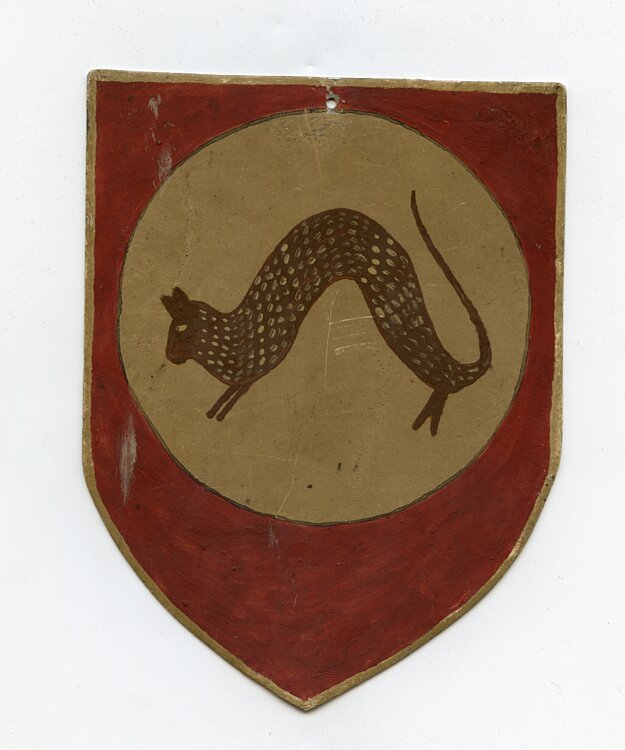
Luftwaffe: Squadron Crest of Jagdgeschwader 8./51
The squadron emblem of the 8th Staffel of Jagdgeschwader 51 (8./JG 51) represents a fascinating chapter in German Luftwaffe history during World War II. Such hand-painted emblems embody not only military tradition but also the esprit de corps and identity of the Wehrmacht's flying units.
Jagdgeschwader 51, also known as “Mölders” after the legendary fighter pilot Werner Mölders, was established on April 1, 1937, in Bad Aibling. It developed into one of the most successful fighter wings of the Luftwaffe, fighting on nearly all fronts of World War II. The unit achieved over 10,000 aerial victories, making it one of the most successful fighter units in aerial warfare history.
The 8th Staffel was part of the III. Gruppe of the Geschwader. According to the Luftwaffe's organizational structure, a Jagdgeschwader typically consisted of three to four Gruppen, with each Gruppe comprising three to four Staffeln. The 8th Staffel was thus the second squadron of the III. Gruppe (III./JG 51). Each Staffel normally included approximately 12 to 16 aircraft.
Squadron emblems and their significance played an important role in the Luftwaffe for morale and cohesion. These emblems were frequently painted on the fuselages of fighter aircraft and served as identification marks. The design of these emblems was often created by talented artists within the squadron or by specialized painters. Traditional symbols, mythological figures, animals, or humorous motifs were used that reflected the character or history of the respective unit.
Such metal shields with hand-painted squadron emblems were used for various purposes. They decorated headquarters buildings, accommodation quarters, mess halls, or were created as awards and commemorative pieces. The craftsmanship quality of these objects varied considerably, from simple field work to professionally executed artworks. The fact that this specimen is described as “very beautifully hand-painted” indicates careful artistic execution.
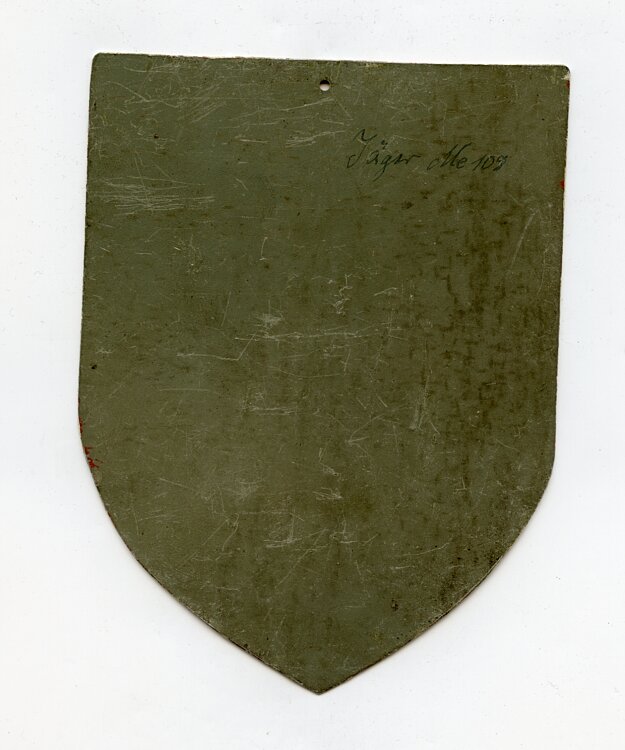
The dimensions of 16 cm in height correspond to typical sizes for such emblems that served as wall decorations or for official purposes. The existing drill hole indicates that the shield was intended for mounting on a wall or other support.
JG 51 participated in significant air battles, including the Battle of France (1940), the Battle of Britain (1940-1941), and particularly the Eastern Front campaign from 1941 onwards. On the Eastern Front, the Geschwader achieved its greatest successes against the Soviet Air Force. Many of the most successful German fighter pilots, including several Knight's Cross recipients, served in JG 51.
The material culture of the Luftwaffe encompassed a variety of objects that today are of significance as military-historical testimonies. In addition to official documents, equipment items, and uniforms, these include squadron emblems that document the personal and collective identity of the units. They provide insights into everyday culture, artistic practice, and morale building within military structures.
The authenticity and preservation of such historical objects is of great importance to collectors and historians. Signs of age and wear are not only inevitable but also markers of authenticity. They document historical use and the decades since the end of the war.
In military-historical research, such objects serve as primary sources that provide information beyond official files and documents. They enable the reconstruction of the history of individual units and make the experiences of the people who served in these formations more tangible.
Today, such emblems are found in museums, private collections, and archives worldwide. They are preserved as historical testimonies of a past era and contribute to the documentation and critical examination of World War II history.