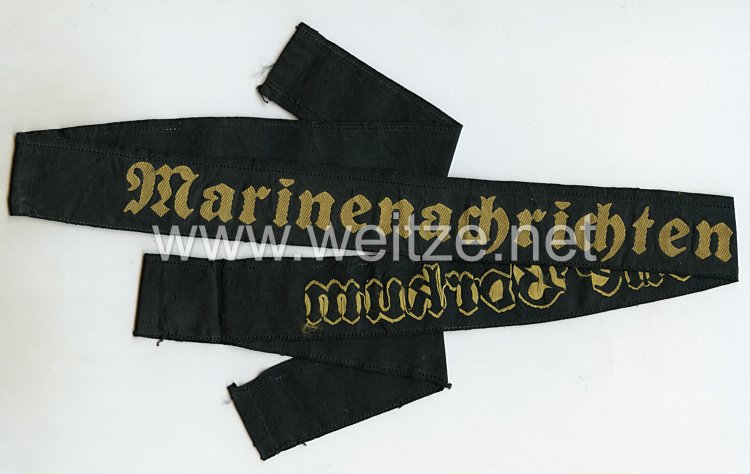
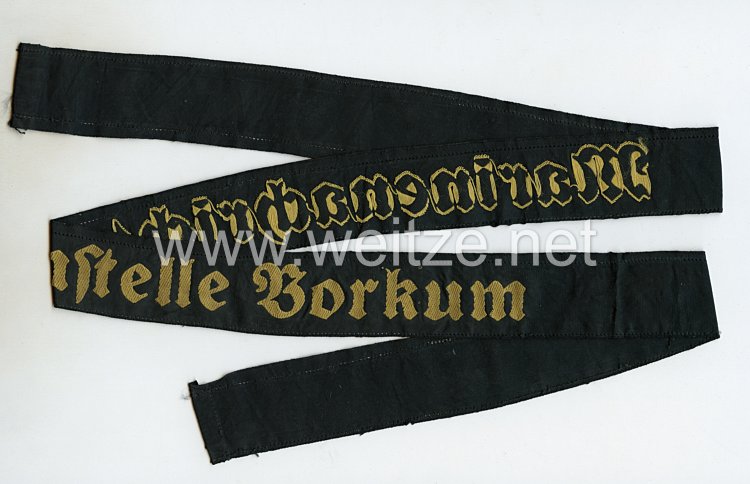
Kriegsmarine Cap Tally "Marinenachrichtenstelle Borkum"

 Cotton construction, 98 cm, seam traces along entire length, condition 3-
417364
60,00

Kriegsmarine Cap Tally "Marinenachrichtenstelle Borkum"

The Kriegsmarine cap tally "Marinenachrichtenstelle Borkum" represents a fascinating chapter in German naval history during World War II. These cap tallies, worn by sailors of the Kriegsmarine, served not only as practical components of the uniform but also as important identification markers indicating affiliation with specific units, ships, or service stations.

The Marinenachrichtenstelle Borkum (Naval Signals Station Borkum) was part of the Kriegsmarine's extensive communications and intelligence network. The island of Borkum, the westernmost of the East Frisian Islands in the North Sea, played a strategically significant role in German coastal defense. Due to its geographical location, the island was an important site for observation, communications, and intelligence services that were essential for monitoring maritime traffic and Allied activities in the North Sea.

This cap tally in cotton construction conforms to the Kriegsmarine's standard specifications for such equipment items. The use of cotton was typical for the manufacture of cap tallies, as the material was robust, cost-effective, and suitable for maritime service. With a length of 98 cm, this tally corresponds to the regular measurements that allowed the band to be placed around the cap and tied at the back of the head.

The Marinenachrichtenstellen (Naval Signals Stations) were specialized facilities within the Kriegsmarine responsible for collecting, processing, and forwarding information. These service stations played a central role in maritime communications and worked closely with other branches of the Wehrmacht. The signals stations dealt with various aspects of communication, including radio traffic, encryption, decryption, and coordination of intelligence about enemy movements.

During the war, Borkum Island was heavily fortified and formed part of the Atlantic Wall, the extensive coastal fortification system that Nazi Germany constructed along the European Atlantic and North Sea coasts. The strategic importance of the island led to the stationing of various military units, including Kriegsmarine personnel assigned to signals duties. The Naval Signals Station on Borkum would have been responsible for monitoring radio traffic, coordinating with other coastal installations, and providing intelligence for fleet operations.

The production and issue of cap tallies were subject to strict regulations within the Kriegsmarine. The inscription had to be precise and standardized, with specific font types and letter spacing maintained. The golden-yellow lettering on a black background was characteristic of Kriegsmarine cap tallies and distinguished them from the tallies of other navies. The present stitch marks along the entire length indicate that the tally was actually used and possibly attached to a sailor's cap, which underscores its authenticity as a period equipment item.

The Kriegsmarine's signals service was highly developed and played a crucial role in naval warfare operations. The decentralized signals stations along the coast formed a network that ensured timely transmission of information about convoys, U-boat movements, and Allied air raids. Personnel serving at such facilities required special training in radio technology, cryptography, and maritime communications.

After the war, the military installations on Borkum were taken over by Allied forces and later dissolved. Many of the fortifications and military structures were dismantled or repurposed. Today, cap tallies like this one are important historical artifacts that provide insight into the organization, structure, and daily reality of the Kriegsmarine. They are valuable collector's items for military historians and collectors who wish to document and preserve the naval history of World War II.

The study of such objects contributes to understanding military organization, logistics, and the everyday life of naval personnel during this period. Each cap tally tells a story about a specific unit, location, or ship and fits into the larger mosaic of Kriegsmarine history. These items serve as tangible links to the past, offering researchers and enthusiasts concrete evidence of the complex organizational structure of Germany's wartime navy.

r