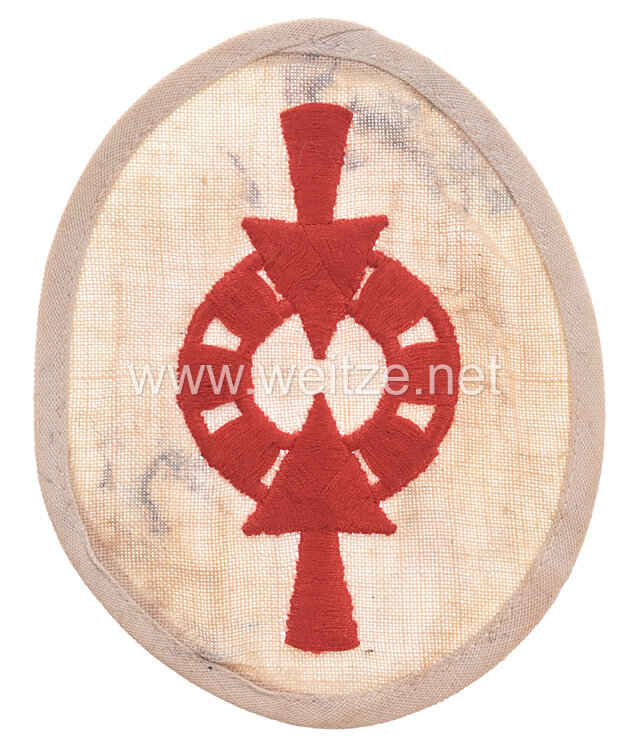
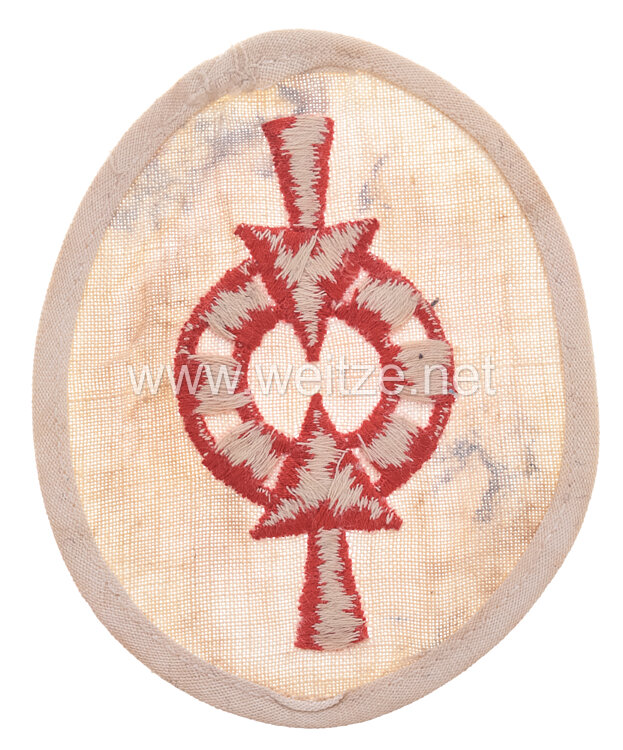
Kriegsmarine Sleeve Insignia Special Training Fire Control Petty Officer (Troop Training)

for the white tunic, condition 2.
466364
15,00

Kriegsmarine Sleeve Insignia Special Training Fire Control Petty Officer (Troop Training)

The Kriegsmarine Sleeve Badge for Special Training as Weapons Control Petty Officer represents an important aspect of the complex training and insignia system of the German Navy during World War II. These special sleeve badges served to identify qualified specialists in various technical fields and were a visible sign of special skills and training within the naval organization.

Historical Background

From the late 1930s, the Kriegsmarine introduced a comprehensive system of specialist badges to reflect the increasing technical complexity of modern naval warfare. With the development of advanced weapons systems, particularly fire control systems for artillery, specialized personnel were needed to operate and maintain these complex systems. The Waffenleitvormann (Weapons Control Petty Officer) was such a specialist, responsible for operating and monitoring fire control equipment.

Function and Significance

Fire control systems were crucial components of larger warships' armament. They included optical rangefinders, computing devices, and aiming systems that enabled precise targeting of enemy vessels and appropriate orientation of one's own artillery. Training as a Weapons Control Petty Officer required extensive technical knowledge in optics, mechanics, and ballistics, as well as practical experience in handling these sensitive devices.

Wear and Uniform

The described badge was designed for the white blouse, which was part of the Kriegsmarine's summer uniform. This white uniform variant was worn in warmer climates or during the summer months. Sleeve badges were typically attached to the left upper arm and were made of dark blue cloth with embroidered or woven motifs. The design usually consisted of a cogwheel or technical symbols indicating the wearer's specialized function.

Training System

The designation Truppenausbildung (troop training) indicates that this qualification was acquired within regular troop training, as opposed to special schools or civilian training facilities. Training usually took place aboard ship or at naval bases and included both theoretical instruction and practical exercises. After successfully completing the training and passing examinations, the naval serviceman received the right to wear the corresponding badge.

Manufacturing and Variants

Kriegsmarine sleeve badges were produced by various manufacturers, both military tailoring shops and private companies that manufactured uniform accessories. Quality varied depending on the manufacturer and production period. Early badges often showed higher craftsmanship with fine embroidery, while later wartime productions were simplified. Badges for white blouses differed in coloring from those for blue uniforms to ensure necessary contrast.

Collector Value and Preservation

Today, these sleeve badges are sought-after collectibles for militaria collectors specializing in the German Navy of World War II. The indicated Condition 2 corresponds in collector hierarchy to a very good to good state of preservation with minimal signs of wear. Such badges for the white uniform are often rarer than their counterparts for the blue uniform, as the white variant was worn less frequently and thus also produced in smaller quantities.

Historical Context

These sleeve badges are important testimonies to maritime warfare and the military organization of the Third Reich. They document the professionalization and specialization within the armed forces and show how important technical expertise had become for modern naval warfare. At the same time, they are material remnants of a dark period in German history and are today viewed in the context of historical research and documentation.

Technical Specialization in the Kriegsmarine

The Kriegsmarine's emphasis on technical training reflected the naval arms race of the interwar period and the rapid technological developments in naval warfare. Fire control systems had evolved from simple optical sights to sophisticated electro-mechanical computers that could calculate firing solutions while accounting for ship movement, target speed, wind, and other variables. The men who operated these systems required months of intensive training and represented a significant investment in human capital for the navy.