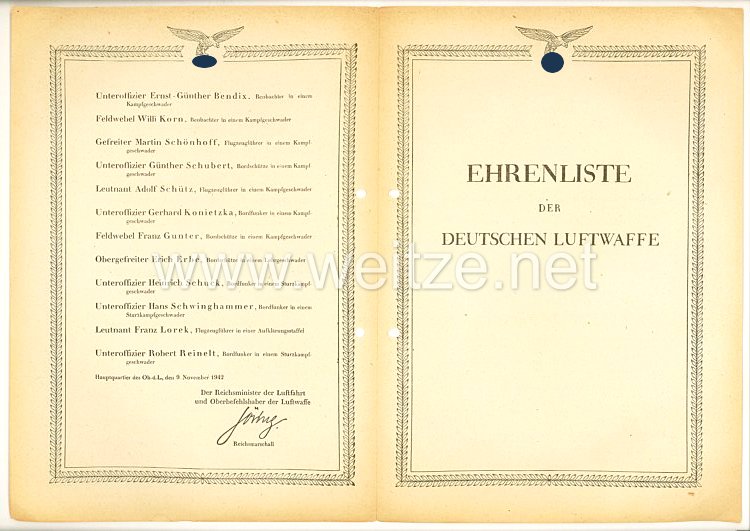
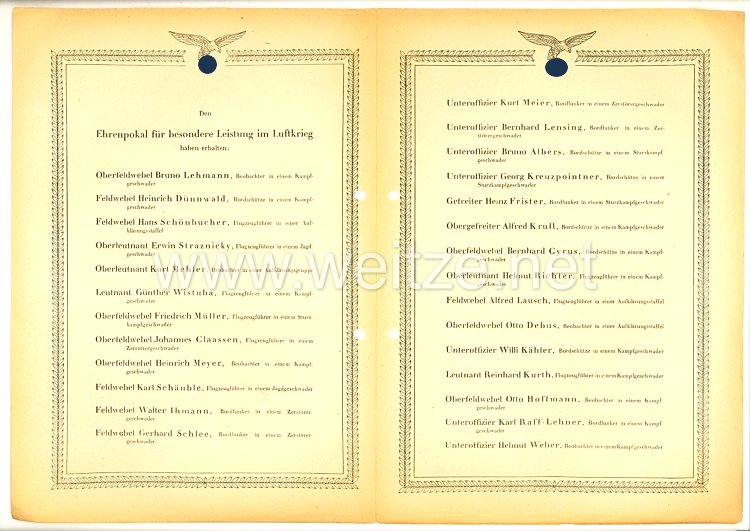
Honor Roll of the German Luftwaffe - Issue of November 9, 1942

DinA4 double sheet in used condition.
348864
100,00

Honor Roll of the German Luftwaffe - Issue of November 9, 1942

The Honor Roll of the German Luftwaffe (Ehrenliste der Deutschen Luftwaffe) represented a significant official document of Nazi military propaganda during World War II. This particular edition from November 9, 1942 dates from a critical phase of the war, when the Wehrmacht was fighting simultaneously on multiple fronts and the Luftwaffe played a central role in German warfare.

These honor rolls were issued at regular intervals by the High Command of the Luftwaffe (Oberkommando der Luftwaffe, OKL) and served several purposes: they documented fallen members of the Luftwaffe, honored exceptional bravery and military achievements, and functioned as an instrument for maintaining morale both at the front and on the home front. The standardized DIN A4 double-sheet format enabled wide distribution in barracks, service posts, and for informing relatives.

The date of November 9, 1942 carries particular symbolic significance. November 9 was a prominent commemorative day in the Nazi calendar, marking the failed Beer Hall Putsch of 1923 in Munich. Memorial ceremonies were regularly held on this day to honor the “blood witnesses of the movement.” The publication of an honor roll on this specific date underscores the propagandistic linking of Nazi ideology with military commemoration.

In November 1942, German warfare found itself in an increasingly precarious situation. The Battle of Stalingrad was reaching its climax, with the 6th Army under General Paulus already encircled. In North Africa, the British had won at El Alamein, and American troops had landed in Morocco and Algeria. The Luftwaffe was heavily engaged on all fronts: over the Soviet Union, in the Mediterranean theater, and increasingly in the defense of the Reich against growing Allied bombing raids.

Honor rolls typically contained names, ranks, units, and often the circumstances of death of fallen soldiers. They followed strict formal guidelines and were written in a ceremonial, pathos-laden language that glorified the “hero's death for the Fatherland.” The documents were not only distributed internally but also published in excerpts in newspapers and sent to relatives.

The used condition of this specimen testifies to its actual use during wartime. Such documents were frequently posted on bulletin boards, laid out in common rooms, or kept in personal files. The traces of time and use make each of these documents an authentic witness to the military everyday culture of that era.

From today's historical-scientific perspective, these honor rolls are important sources for researching several aspects: they document biographical data, enable reconstruction of losses by individual units, show the development of the war situation, and illustrate the mechanisms of Nazi propaganda. At the same time, they must be read critically, as they were part of a system of glorification and ideological exaltation of war.

The Luftwaffe held a special position in the Nazi state. As the youngest branch of the armed forces, whose buildup was only publicly announced after 1935, it was considered modern and technologically advanced. Its commanders, such as Hermann Göring and later Robert Ritter von Greim, stood high in the Nazi hierarchy. The Luftwaffe was intensively used for propaganda purposes, with fighter aces like Werner Mölders and Adolf Galland being stylized as heroes.

For collectors and historians today, such documents represent material remnants of a dark era. Their value lies not in glorification but in their testimonial worth for history. They remind us of the reality of war, of lives lost, and of the propaganda machinery of a criminal regime. Responsible handling of such objects always requires critical historical contextualization and rejection of any glorification.