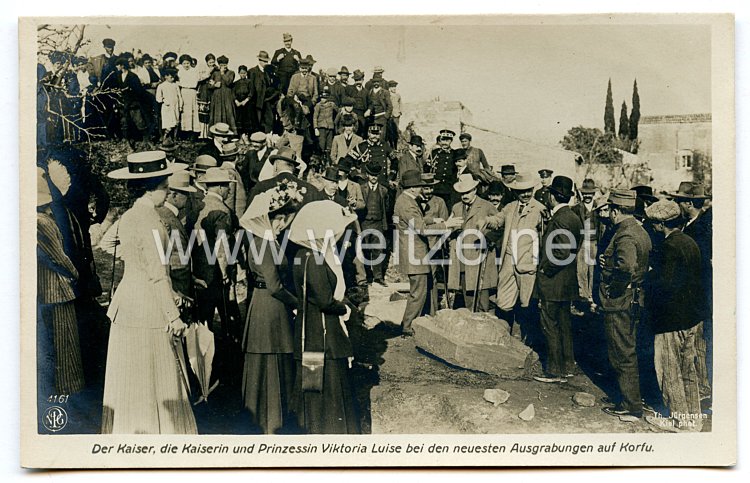
This postcard from the German Empire documents a remarkable moment in German monarchical history, showing Kaiser Wilhelm II, Empress Auguste Viktoria, and Princess Viktoria Luise at archaeological excavations on the Greek island of Corfu in 1911.
Kaiser Wilhelm II's connection to Corfu began in 1907 when the German Emperor acquired the Achilleion, the former vacation palace of Austrian Empress Elisabeth (“Sisi”). This magnificent palace, built in Pompeian style between 1889 and 1891 for the Austrian Empress, served Wilhelm II as a holiday residence until the outbreak of World War I. The palace was named after the Greek hero Achilles and reflected an enthusiasm for ancient Greek culture that Wilhelm II enthusiastically shared.
Kaiser Wilhelm II was not only a passionate traveler but also a significant patron of archaeology. His support for archaeological research was part of his broader cultural policy program designed to underscore the German Empire's position as a leading cultural nation. The Kaiser financed several major excavations in the Mediterranean region, including the work of Wilhelm Dörpfeld at Troy and Olympia, as well as the Pergamon excavations. On Corfu itself, he commissioned archaeological investigations to explore the island's ancient heritage.
The presence of Empress Auguste Viktoria and Princess Viktoria Luise, the only daughter of the imperial couple, at these excavations underscores the importance the imperial family placed on such cultural endeavors. Princess Viktoria Luise (1892-1980) was approximately 19 years old at this time and frequently accompanied her parents on their travels. Her later marriage to Ernst August of Brunswick in 1913 would become the last great celebration of European monarchies before World War I.
Postcards like this played an important role in representing the monarchy in Wilhelmine Germany. The mass production and distribution of postcards featuring motifs of the imperial family was part of a deliberate public relations effort designed to convey the image of a modern, culturally interested, and popularly accessible ruling house. Photography and postcard distribution were new media that Wilhelm II skillfully employed for his self-presentation.
The depiction of the Kaiser at archaeological excavations was particularly significant. It combined several aspects of Wilhelmine ideology: the connection to classical antiquity as a basis for legitimation, the promotion of science as an expression of German cultural achievement, and the portrayal of the Kaiser as an educated, broadly interested ruler. Greek antiquity was revered in the Empire as the cradle of European civilization, and German archaeology enjoyed international recognition.
The condition grade 2 of the postcard indicates a well-preserved card with slight signs of use, representing a considerable state of preservation for collectible items from this period. Such postcards were typically produced by specialized publishers and sold both as souvenirs and sent through the mail.
The years around 1911 mark the zenith of the Wilhelmine era. The German Empire had developed into a leading industrial and military power, and the Kaiser used his annual stay on Corfu to maintain diplomatic contacts while pursuing his cultural interests. The island offered him a retreat from the political daily routine in Berlin, although governmental affairs continued to be conducted even there.
After World War I, the Achilleion had to be ceded as part of reparations. The postcard thus documents an epoch that ended irrevocably with the outbreak of war in 1914. It is a valuable contemporary historical document providing insights into the self-representation of the monarchy, the leisure activities of the ruling house, and the cultural-political aspirations of the German Empire.