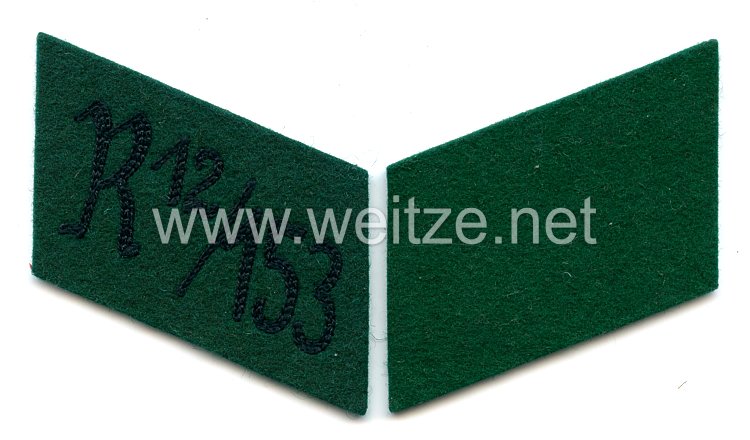
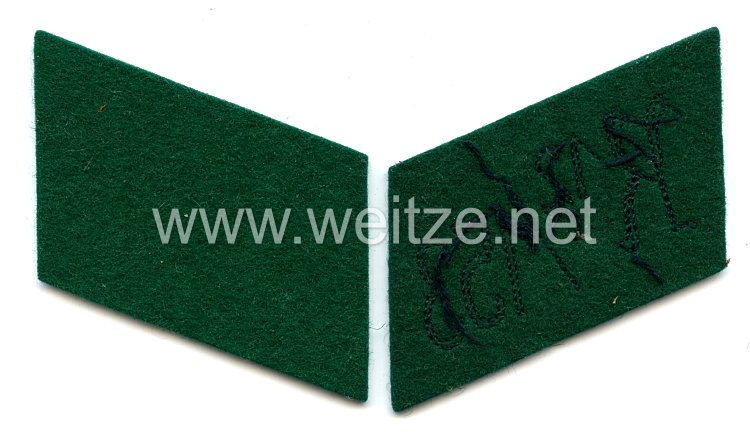
SA Pair of Collar Tabs for Enlisted Men SA-Gruppe Kurpfalz Reserve-Sturm 12 of Standarte 153
These SA collar patches for enlisted men represent a significant testimony to the organizational structure of the Sturmabteilung (SA) in the early phase of the National Socialist regime. These specific insignia belonged to Reserve-Sturm 12 of Standarte 153 within the SA-Gruppe Kurpfalz, a regional division responsible for the area between Freudenstadt and Mannheim.
The SA, originally founded in 1920/21 as a security force for the NSDAP, developed during the Weimar Republic years into a paramilitary mass organization. By the time of the seizure of power in 1933, its membership had grown to several hundred thousand. The SA-Gruppe Kurpfalz was one of the regional upper-level units into which the SA was divided according to geographical considerations. This group comprised several Standarten, including the relevant Standarte 153.
The organizational structure of the SA followed a military pattern: The smallest unit was the Trupp (squad), several squads formed a Sturm (storm troop), several storm troops formed a Standarte (regiment), and several regiments in turn formed a Gruppe (group). The term Reserve-Sturm indicates a unit that did not belong to the active core personnel but consisted of reservists or older members who were not designated for regular street combat and propaganda operations.
The collar patches were an essential component of the SA uniform and served to identify rank and affiliation. The specimens described here in steel green correspond to the typical coloring for SA enlisted men. The color coding of SA uniform parts followed a complex system: While the basic color of the SA uniform was brown, the collar patches identified the respective group through their color. Steel green was the characteristic color for certain SA groupings, although the exact assignment was changed several times over time.
The dating to around 1933 is of particular historical significance. This year marked a turning point in the history of the SA: After the National Socialists seized power in January 1933, the SA experienced a massive increase in membership. Many people joined for opportunistic reasons, leading to internal tensions. The production of uniform parts had to be significantly increased to meet demand.
The fact that these collar patches come from an old tailor's stock and are unworn makes them an authentic historical artifact. During the Nazi era, numerous tailoring shops and textile companies worked on producing uniform parts for the various organizations. Many of these businesses received orders directly from the service offices or produced items for inventory.
Standarte 153 was geographically located in the area between the Black Forest (Freudenstadt) and the Rhine plain (Mannheim). This region had a turbulent political history during the Weimar period with frequent violent clashes between different political camps. The SA played a central role as the NSDAP's fighting force.
After the seizure of power in 1933, the function of the SA changed. While it had previously acted primarily as a combat organization against political opponents, it now assumed quasi-police functions and was involved in establishing the first concentration camps. However, the peak of its power was short-lived: In the course of the so-called Röhm Affair or “Night of the Long Knives” from June 30 to July 2, 1934, the SA leadership was liquidated, and the organization largely lost its political significance to the SS.
Such collar patches were manufactured according to standardized regulations laid down in the SA service regulations and uniform orders. Production was subject to certain quality standards, with distinctions made between officially approved and privately procured pieces. The condition rating of 2 indicates very good preservation, which is not unusual for unworn pieces from tailor's stocks.
Today, such objects are important sources for historical research and museums. They document the organizational complexity and visual propaganda of the Nazi regime. At the same time, they raise questions about the local anchoring of National Socialism and the participation of broad sections of the population.