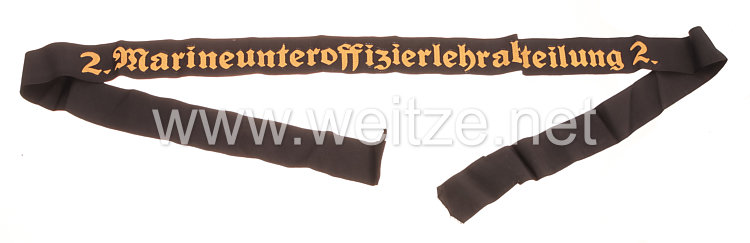
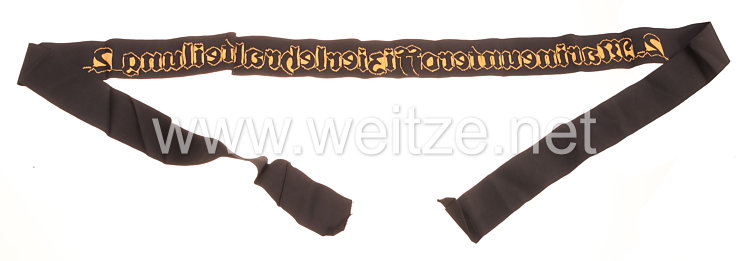
Kriegsmarine Cap Tally "2. Marineunteroffizierslehrabteilung"

worn condition, 114 cm long. Condition 2
444063
20,00

Kriegsmarine Cap Tally "2. Marineunteroffizierslehrabteilung"

This cap tally of the 2nd Naval NCO Training Department (2. Marineunteroffizierslehrabteilung) of the Kriegsmarine represents an authentic piece of German naval training history from the Second World War era. Measuring 114 centimeters in length, it conforms to the standardized dimensions for Kriegsmarine cap tallies and shows clear signs of wear, indicating actual service use.

The Kriegsmarine, officially established on June 1, 1935, as the successor to the Reichsmarine, developed a complex system of training institutions to facilitate the rapid expansion of German naval forces. The Naval NCO Training Departments played a central role in training the non-commissioned officer corps, which formed the backbone of operational units.

The 2nd Naval NCO Training Department was one of several specialized training units established following German naval rearmament. These training departments were responsible for the professional and military education of prospective non-commissioned officers, providing both theoretical knowledge and practical skills in various naval disciplines. Training encompassed navigation, seamanship, weapons instruction, leadership techniques, and other skills necessary for service aboard warships.

Cap tallies were an essential component of naval uniforms and served not merely decorative purposes but fulfilled important identification and traditional functions. They were worn on the service cap (also known as the side cap or Schiffchen) and indicated affiliation with a specific ship, unit, or institution. The tradition of cap tallies in the German Navy dates back to the 19th century and was continued through the Imperial Navy, Reichsmarine, and finally the Kriegsmarine.

The manufacture of cap tallies was subject to precise regulations set forth in Naval Clothing Regulations. They typically consisted of black silk ribbon or artificial silk with gold-colored lettering. The inscription was rendered in Latin letters and appeared on both ends of the ribbon, so that the tally ends hanging at the back of the head displayed the unit designation. For training units such as teaching departments, the inscription reflected the official designation of the unit.

The training structure of the Kriegsmarine was hierarchically organized and comprised various levels. After basic training, prospective non-commissioned officers underwent specialized courses in the Naval NCO Training Departments. The duration of training varied depending on specialization but could range from several months to over a year. Graduates were subsequently deployed to various Kriegsmarine units, from U-boats and surface vessels to coastal fortifications.

The condition of this cap tally with visible signs of wear documents its authentic use. The length of 114 centimeters was standard for Kriegsmarine cap tallies and allowed for proper attachment to the service cap with the characteristic hanging ends. The wear patterns are typical of objects worn during training or active service and exposed to weather conditions and daily use.

In the context of naval history, such cap tallies represent important material evidence. They document not only the organizational structure of the Kriegsmarine but also the individual affiliation of naval personnel with their training units. For maritime memorial culture and military-historical research, these objects are of considerable value, as they provide insights into the everyday reality and institutional organization of the German Navy during World War II.

The survival of such cap tallies is relatively rare today, as many were destroyed at war's end in 1945 or lost over the decades. Preserved examples, particularly those with clear provenance and recognizable signs of use, are therefore important collection objects for maritime museums and military-historical collections that document the history of the German Navy and preserve it for future generations.

r