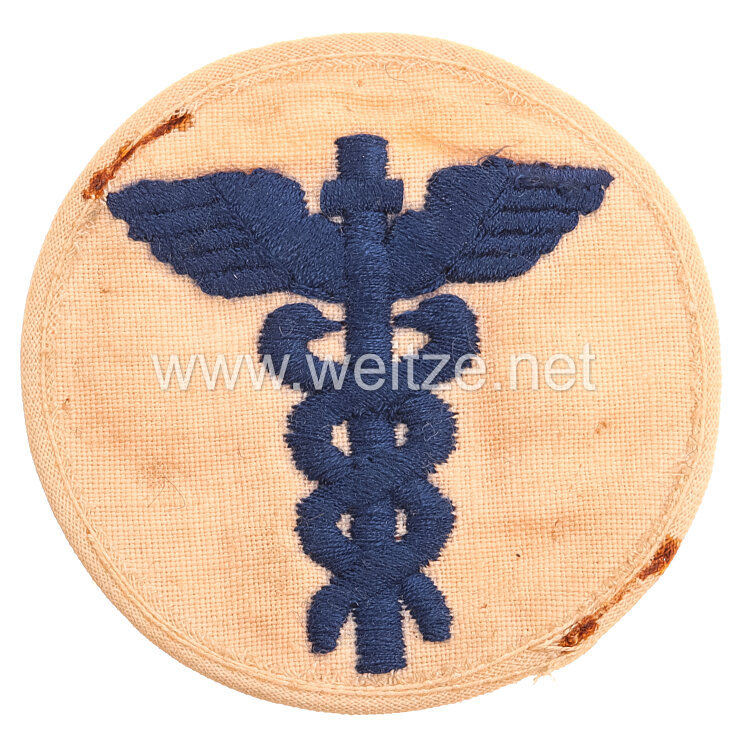
Kriegsmarine Enlisted Sleeve Insignia Administration, Steward, and Provisions Career Track
The Kriegsmarine sleeve badge for enlisted personnel of the Administrative, Supply Management, and Provisions career paths represents a characteristic example of the sophisticated rank insignia and career path system of the German Navy during World War II. These machine-embroidered badges served the immediate identification of career affiliation within the complex organizational structure of the Kriegsmarine.
The Kriegsmarine, officially established in 1935 following the repudiation of the Versailles Treaty restrictions, developed a comprehensive system for distinguishing various service branches and career paths. While sea officers and technical personnel were identified by different uniform features, the administrative and supply-technical areas also required their own distinctive markings. The administrative, supply management, and provisions career paths formed the logistical backbone of the Navy and were essential for proper supply, administration, and smooth operation of warships and shore installations.
This badge was manufactured for wear on the white summer blouse, which was part of the lighter summer uniform for enlisted personnel. The Kriegsmarine strictly distinguished between various uniform types: the dark blue working and winter uniform, the white summer uniform, and various dress uniforms. Each of these uniform variants required appropriately adapted badges, which explains the demand for different versions of the same insignia.
Machine embroidery became increasingly standard for uniform insignia of the Wehrmacht and Kriegsmarine from the 1930s onward. This manufacturing method enabled more cost-effective mass production while maintaining high quality and durability. Unlike hand-embroidered badges, which were often reserved for officers, machine-embroidered variants were primarily used for enlisted and non-commissioned officer ranks. The embroidery was typically executed on a dark blue cloth backing (for white uniforms) and displayed the specific symbols of the respective career path.
The Administrative career path comprised personnel entrusted with administrative duties, from personnel management to correspondence. The Supply Management career path was responsible for the management and distribution of materials, equipment, and goods, while the Provisions career path organized all food supply, menu planning, and meal preparation aboard ship and ashore. These areas were clearly separated in the hierarchically structured Kriegsmarine and made visible through corresponding career badges.
Sleeve badges were worn on the left upper arm according to the Kriegsmarine dress regulations. The exact position and method of attachment were detailed in the uniform regulations. Enlisted personnel wore their career badges below the shoulder seam, with the position varying depending on rank and additional badges. The system made it possible to recognize at first glance not only the rank but also the specialization of a naval serviceman.
The term “unworn” in the description indicates that this badge was never attached to a uniform or used in service. Such unworn pieces are particularly interesting from a collector's and historical perspective, as they preserve the original manufacturing condition. Many badges were produced during the war but never issued, either remaining in depots after the war's end or no longer needed due to the deteriorating military situation.
The production of uniform insignia was a significant industry during the war. Numerous textile manufacturers and specialized companies were engaged in production. Quality varied depending on the manufacturer and production year, with simplified variants or those made from substitute materials becoming more common toward the end of the war. The present piece in condition 2 (very good) indicates high-quality preservation.
After the end of World War II in May 1945, the Kriegsmarine was dissolved, and all its symbols, uniforms, and badges lost their official function. Many of these objects were destroyed, some taken by Allied soldiers as souvenirs, others remained in private collections. Today they serve as important historical artifacts providing insight into the organization, hierarchy, and daily life of the German Navy during this period.
The study of such badges contributes to understanding military social history and demonstrates how complex the administrative and logistical structure of a modern navy was. They remind us that behind the fighting units stood an extensive network of administrative and supply personnel, without whom military operations would not have been possible.