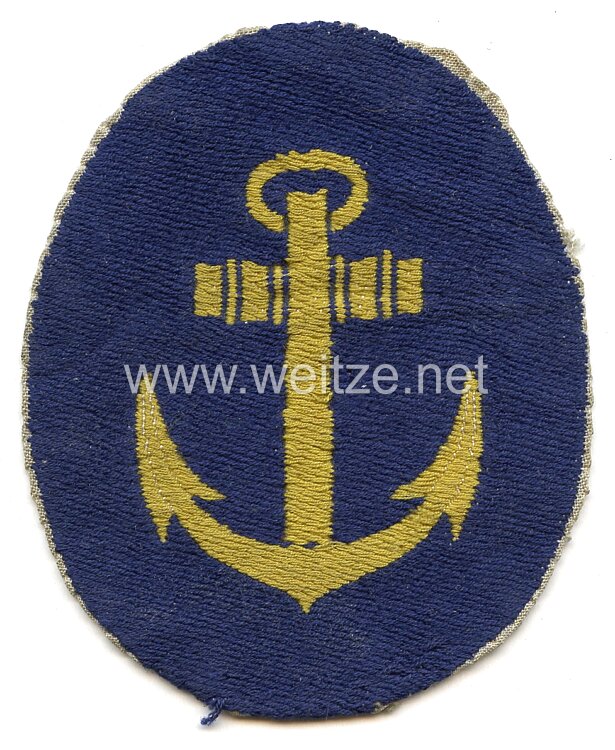
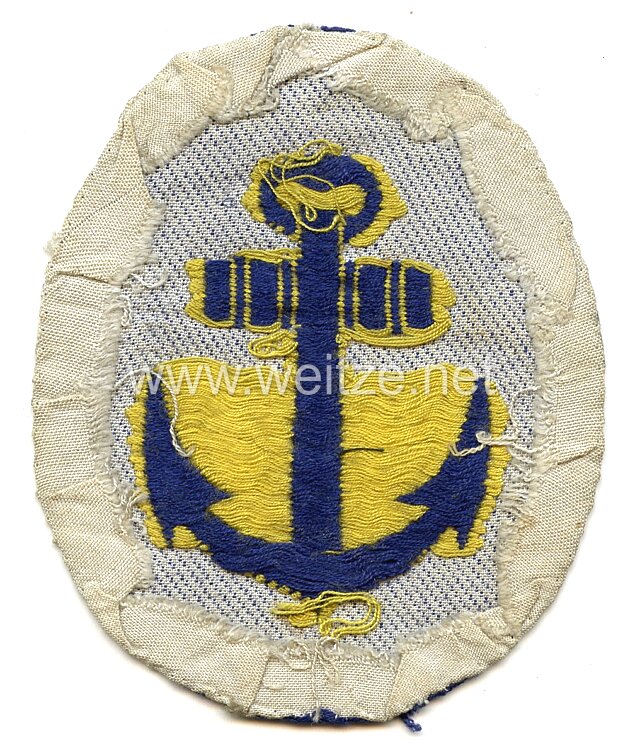
Kriegsmarine Sports Pants Badge for Petty Officers
The Kriegsmarine Sports Trousers Badge for Petty Officers represents a fascinating example of the military clothing regulations and rank insignia of the German Kriegsmarine during World War II. This particular badge in woven execution was worn on sports clothing and served to identify petty officer rank even outside the regular service uniform.
The Kriegsmarine, the official designation of the German Navy from 1935 to 1945, developed a complex system of rank insignia and uniform regulations. Following the reintroduction of general conscription by the National Socialist regime in 1935 and the associated massive expansion of the armed forces, detailed clothing regulations were issued that governed all aspects of military attire – including sports clothing.
Unlike the metal or embroidered badges of parade uniforms, the sports trousers badges were manufactured in woven execution. This manufacturing method was more practical for garments that needed to be washed regularly and were subject to physical stress. The woven construction enabled durable yet flexible attachment to the fabric of the sports trousers, typically made of cotton or a cotton blend.
The petty officers (Maat to Oberstabsbootsmann) formed the backbone of the Kriegsmarine and were responsible for training and leading the enlisted men as well as technically operating increasingly complex weapons systems. Their special position in the military hierarchy had to be recognizable even in sports clothing, as physical training was an essential component of military education.
Sports in the Kriegsmarine served multiple functions: it maintained the physical fitness of crews who had to serve under often extreme conditions at sea. Especially on U-boats and smaller vessels, physical capability was vital for survival. Furthermore, communal sports promoted esprit de corps and camaraderie within units. The Kriegsmarine maintained its own sports fields and training facilities at its bases from Kiel to Wilhelmshaven, from France to Norway.
The Kriegsmarine's clothing regulations were established in various publications and orders that were regularly updated. The Supreme Command of the Navy (Oberkommando der Marine - OKM) issued detailed descriptions for each uniform and equipment item, including the correct wearing method and placement of badges. These regulations ensured that military hierarchy remained recognizable even in more informal situations such as sports.
The woven execution of these badges was carried out in specialized textile companies that held contracts with the Wehrmacht. Quality could vary depending on the manufacturer and production period. Toward the end of the war, as material shortages increased, the quality of uniform parts and badges often decreased. Early war productions typically showed higher craftsmanship quality than later examples.
For collectors and military historians, such badges are of interest as they provide insight into everyday aspects of military life that are often less documented than combat operations or strategies. The sports trousers and their badges belong to the category of effects that reflect soldiers' daily lives.
The condition of such textile badges varies considerably. Through their use during athletic activities, they were exposed to perspiration, frequent washing, and mechanical wear. Well-preserved examples are therefore rarer than corresponding badges from parade uniforms. Classification as “Condition 2” indicates a worn but still well-preserved example showing typical signs of use but no major damage.
Today, such objects have primarily historical and museum value. They document the meticulous organization and hierarchy of the Kriegsmarine and serve as reminders of a time when even details such as sports clothing were strictly regulated. For scholarly research into the everyday history of World War II, such seemingly insignificant objects are of considerable value as they represent authentic testimonies of military daily life.