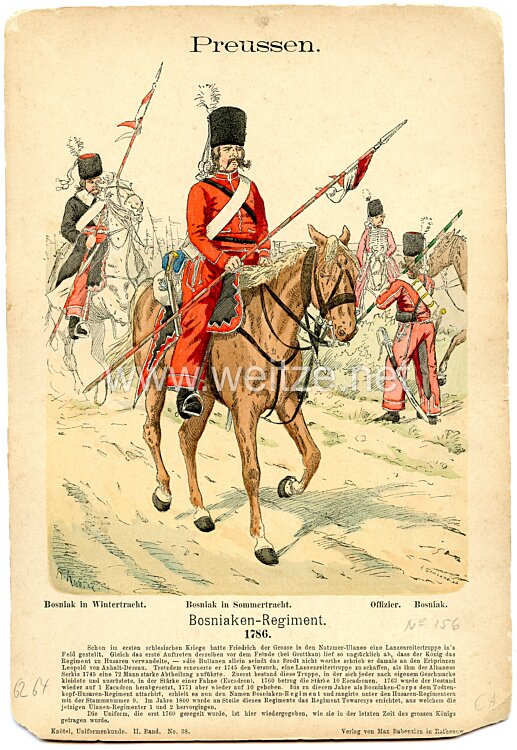
Knötel Uniform Plate “Bosniaken-Regiment” 1786
The Knötel uniform plate depicting the Bosniak Regiment from 1786 represents a significant military-historical document from the era of the Austrian Habsburg Monarchy. This uniform illustration belongs to the comprehensive work of the Knötel family, who were considered the most important documentarians of military uniform history across multiple generations.
Richard Knötel the Elder (1857-1914) established the tradition of systematic uniform illustrations, which was later continued by his son Herbert Knötel. The Knötel plates became the standard reference work for military historians and collectors, distinguished by their meticulous accuracy and artistic execution. These illustrations were based on intensive archival research, historical documents, and contemporary sources.
The Bosniak Regiment was a special formation within the Imperial Austrian Army. While these characteristic units were formally established after the Austrian occupation of Bosnia and Herzegovina in 1878, their roots reach further back. The term “Bosniaks” was already used in the 18th century for light cavalry units organized according to southeastern European models.
In 1786, the date of this uniform plate, the Habsburg Monarchy was under the rule of Emperor Joseph II (1780-1790), an enlightened absolutist who implemented comprehensive military reforms. The Austrian Army at this time was organized into various regiments, including exotic formations such as the Bosniaks, who were valued for their unconventional fighting methods and distinctive uniforms.
The uniform of the Bosniak regiments differed significantly from regular line units. It was characterized by Oriental influences and included distinctive elements such as the Dolman (a tight-fitting, braided jacket), the Schabraque (decorated saddle cloth), and often a fur or fur cap. This uniforming reflected the origin of these troops from the southeastern border regions of the Habsburg Empire.
The military significance of such light cavalry units lay in their mobility and reconnaissance capabilities. They were deployed for outpost duty, patrols, and rapid raids. Their combat tactics differed from those of heavy cavalry, which was designed for frontal attacks in closed formation.
Uniform plates like this served multiple purposes: they were reference documents for uniform manufacture, identification aids in the field, and administrative tools for military administration. Additionally, they had a representative character, demonstrating the diversity and splendor of the Imperial Army.
The indicated Condition 2 suggests good preservation, which is remarkable for objects from the 18th century or reproductions from the 19th/20th centuries. Paper-based military documents were subject to considerable risks from moisture, light, and mechanical damage.
In the context of military history, the Knötel plates document an important aspect of European uniform development. The late 18th century was a period of both standardization and differentiation in military uniforms. While line units became increasingly uniformly dressed, specialized units like the Bosniaks retained their distinctive uniforms, emphasizing their special role and tradition.
For collectors and military historians, Knötel plates represent invaluable sources. They enable accurate reconstruction of historical uniforms and contribute to understanding the military culture and organization of past epochs. The systematic documentation by the Knötel family created a visual archive that continues to serve as a reference today.
The Bosniak regiments remained in existence until the end of the Habsburg Monarchy in 1918 and participated in numerous campaigns, including the Turkish Wars, the Coalition Wars against revolutionary and Napoleonic France, and World War I. Their characteristic uniform became a symbol of the multi-ethnic composition of the Imperial and Royal Army.