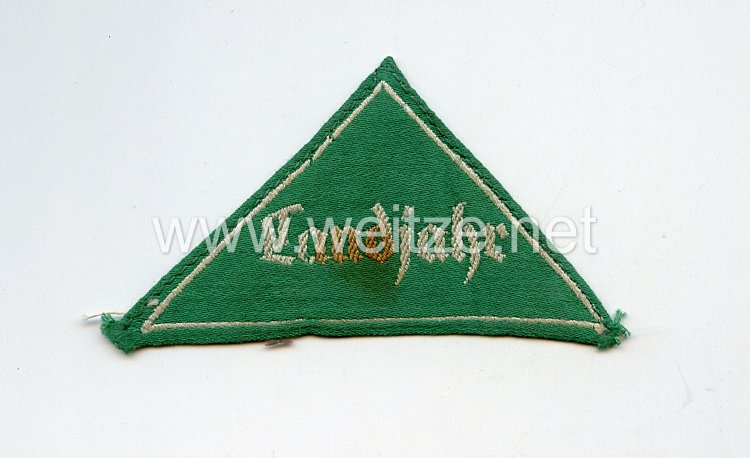
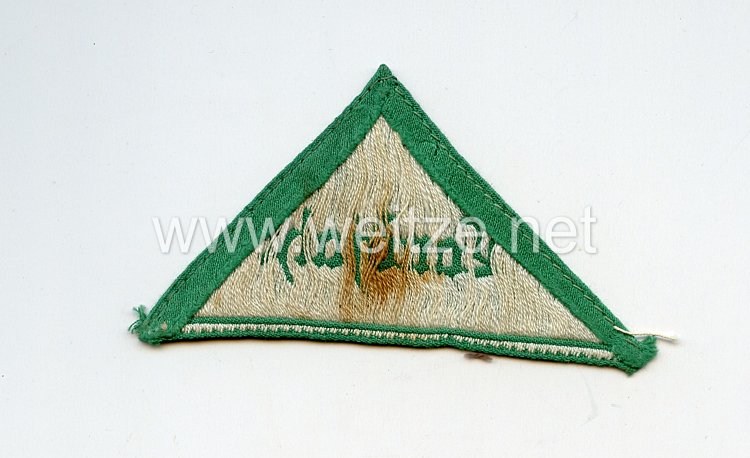
Hitler Youth (HJ) Regional Triangle “Landjahr”

white woven on green base, condition 2.
415562
170,00

Hitler Youth (HJ) Regional Triangle “Landjahr”

The Hitler Youth Area Triangle “Landjahr” represents a significant badge within the complex hierarchy and organizational structure of the Hitler Youth (Hitlerjugend, HJ) during the National Socialist regime. This particular badge, woven in white on a green background, indicated membership in a special program that deployed young people to rural areas.

The Hitler Youth was founded in 1926 and evolved after the Nazi seizure of power in 1933 into the state youth organization of the German Reich. With the Law concerning the Hitler Youth of December 1, 1936, membership became effectively mandatory, and the organization eventually encompassed nearly all German youth between the ages of 10 and 18. The HJ was divided into various territorial units, with the Gebiet (Area) representing one of the higher administrative levels.

The Landjahr Program (Land Year) was officially introduced in 1934 and had its roots in the youth movement of the Weimar Republic. The concept aimed to deploy urban youth to the countryside for one year, where they would work in agriculture while simultaneously receiving ideological training. This initiative pursued several goals: strengthening the connection between city and country, physically training youth, providing agricultural labor, and transmitting National Socialist ideology.

The Area Triangles (Gebietsdreiecke) were part of the Hitler Youth's comprehensive badge system. They were worn on the left upper arm of the uniform and served for quick identification of the wearer's organizational affiliation. Each Area had its own characteristic triangle with specific colors and patterns. The Landjahr badge with its white lettering on green background symbolized the connection to agriculture and rural work.

Participation in the Landjahr was initially voluntary but increasingly became an expected duty for many young people, especially for girls within the framework of the League of German Girls (Bund Deutscher Mädel, BDM). The youth lived in special camps or with farming families and spent their days with agricultural work, physical exercises, and political training. The program typically lasted one year and was often viewed as preparation for the Reich Labor Service or military service.

The production of such badges was subject to strict regulations. They were typically manufactured by authorized producers who held licenses from the Reich Youth Leadership (Reichsjugendführung). Quality and execution varied depending on the time of manufacture and producer. Early examples from the 1930s often show higher-quality workmanship than later wartime productions, when material shortages affected quality.

The green cloth as the foundation for the Landjahr badge was symbolically chosen. Green represented nature, agriculture, and peasant life – central elements of National Socialist “Blood and Soil” ideology (Blut-und-Boden). This ideology glorified the peasantry as the foundation of the German people and portrayed rural life as particularly valuable.

During World War II, the Landjahr program gained additional significance as agricultural production was essential for the war effort and many adult workers were serving at the front. Young people were increasingly called upon to support harvests and other agricultural work, with the program taking on an increasingly pragmatic character.

From a collector's perspective, HJ Area Triangles are today historical artifacts that document the organization and structure of National Socialist youth education. The condition of such textile badges is typically evaluated on a scale from 1 (excellent) to 5 (poor), considering factors such as color fastness, preservation of fabric structure, and completeness of weaving.

The scholarly examination of such objects serves exclusively for historical documentation and education about the National Socialist system and its methods of youth indoctrination. They help understand the comprehensive penetration of all areas of life by the NS regime and serve as warnings against totalitarian structures.

r