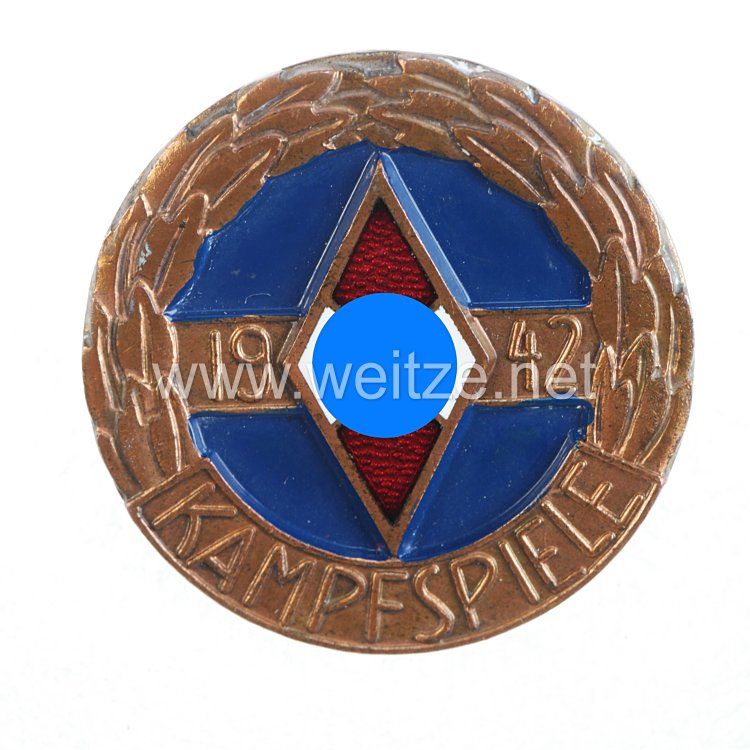
HJ - Winner's Badge of the HJ Combat Games 1942 in Bronze
The HJ Victory Badge of the Combat Games 1942 in bronze represents a significant element of the National Socialist youth organization and its comprehensive strategy for the physical and ideological education of German youth. This award was presented during the annual HJ Combat Games (Kampfspiele), which formed a central component of the Hitler Youth's paramilitary training program.
The Hitler Youth (Hitler-Jugend), officially founded in 1926 and declared the state youth organization in 1936, developed a sophisticated system of athletic competitions designed as preparation for military service. The Combat Games, first conducted in their systematic form in 1935, encompassed various disciplines including track and field, cross-country sports, small-caliber shooting, close combat, and other military sports exercises. These competitions took place at local, regional, and Reich-wide levels.
This badge from 1942 was awarded during a critical phase of World War II. By this time, the war had already lasted three years, and the Nazi leadership regarded the necessity of preparing young people for their future deployment as soldiers as increasingly urgent. The 1942 Combat Games took place under intensified wartime conditions, with the military character of the exercises being emphasized even more strongly.
The bronze version of this victory badge denotes the third-highest performance level. The three-tier system included gold for the highest achievements, silver for the second tier, and bronze for the third tier. This hierarchy reflected the National Socialist principle of performance selection and competitive spirit. Awards were made according to precisely defined guidelines laid down in the service regulations of the Reich Youth Leadership (Reichsjugendführung).
The design features of the badge are characteristic of HJ awards from this period. The central HJ emblem with the victory rune (Siegrune) in enameled execution formed the core motif, surrounded by the inscription "Kampfspiele 1942". The blue-lacquered background symbolized the colors of the HJ and created a visual contrast to the bronzed metal. With a diameter of 29.5 mm, the badge corresponded to the standardized dimensions for HJ performance badges.
The manufacture of such awards was carried out by various producers authorized by the Reich Youth Leadership. Quality and execution varied depending on the production year and manufacturer, with war-related material shortages from 1943 onwards increasingly leading to quality degradation. Badges from 1942 generally still show solid craftsmanship, as material shortages had not yet reached their full extent at this time.
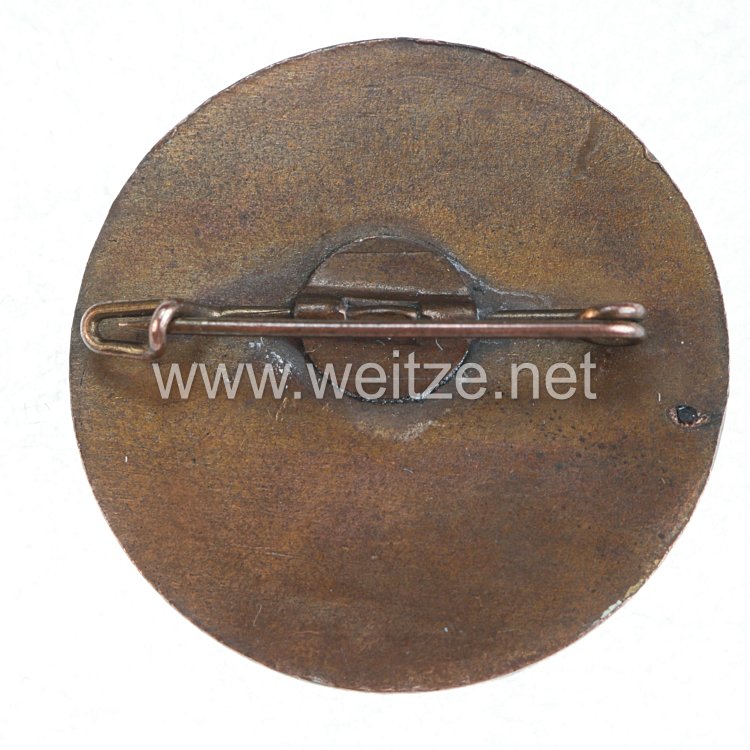
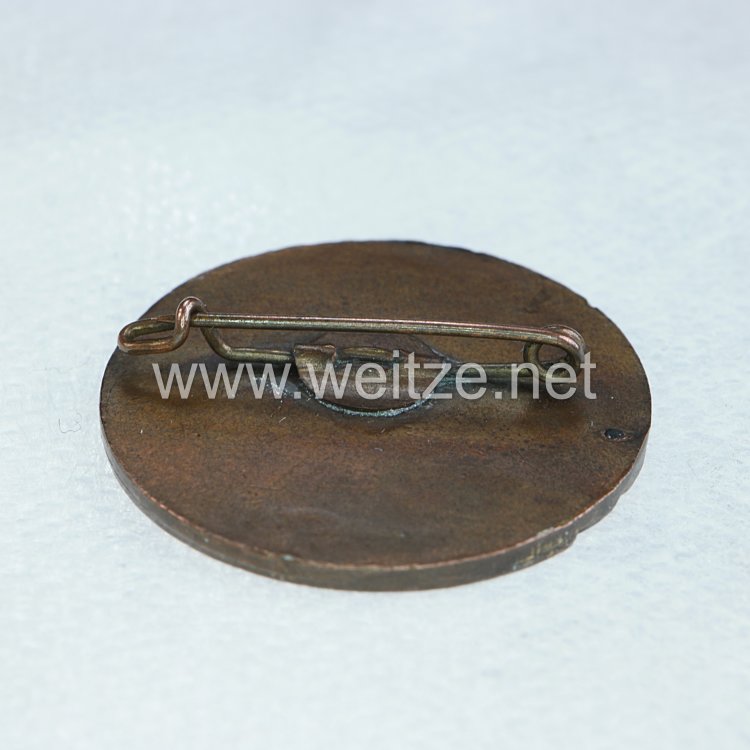
The wearing method was on civilian clothing or the HJ uniform, with precise regulations regarding the position on the garment. The reverse horizontal pin enabled secure attachment. For the wearers, the award meant not only personal recognition of athletic achievements but also proof of their "validation" in the sense of National Socialist ideology.
From today's military-historical perspective, such awards document the systematic militarization of youth in the Third Reich. The Combat Games were an integral part of a comprehensive system aimed at physically training and ideologically indoctrinating young people. The awarding of badges served as a motivational instrument and as a visible sign of hierarchy within the organization.
The collection and scholarly documentation of such objects is significant for historical research, as they represent material evidence of a dark chapter in German history. They provide insights into the everyday world of the Hitler Youth and the mechanisms of National Socialist education. At the same time, they require critical and contextualized examination that considers their role in the overall system of Nazi rule.
Understanding these artifacts within their historical context helps researchers and the public comprehend the extent to which the Nazi regime penetrated all aspects of youth life, transforming sporting activities into instruments of ideological control and military preparation. The 1942 Combat Games, occurring at a time when Germany was heavily engaged in warfare on multiple fronts, reflected the regime's increasing desperation to prepare ever-younger cohorts for military service.