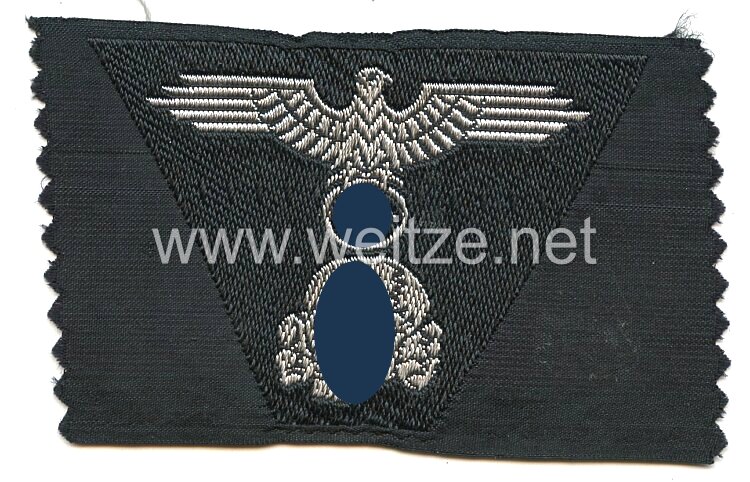
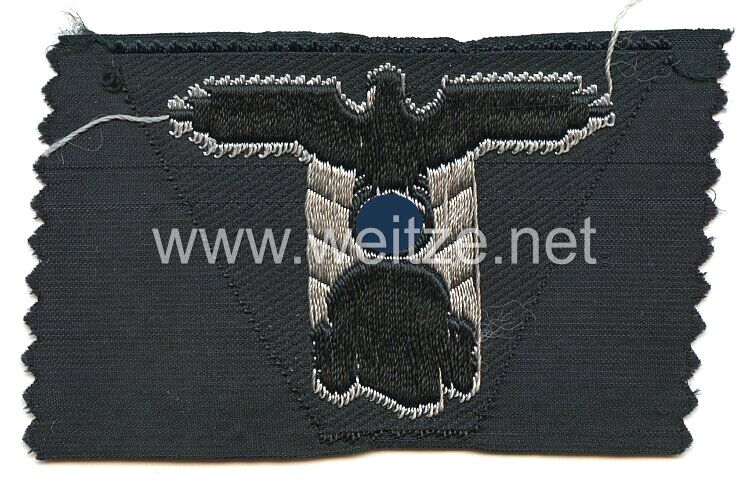
Waffen-SS Cap Trapezoid for the Black M 43 Field Cap for Panzer Crews

Bevo-woven construction. Unissued condition, condition grade 2+.
462461
600,00

Waffen-SS Cap Trapezoid for the Black M 43 Field Cap for Panzer Crews

The Waffen-SS cap trapezoid for the black M 43 field cap for tank crews represents a characteristic insignia of German armored forces during World War II. These emblems, manufactured using Bevo weaving technique, were essential components of the uniform and served to identify unit affiliation and branch of service.

The M 43 field cap was introduced in 1943 as a simplified headgear designed to supplement and partially replace previous headwear. It responded to the need for more practical and economical uniform design during the later phase of the war. A special black variant was created for tank crews, distinguishing them from the field-gray versions worn by other branches.

The cap trapezoid formed the central sovereign insignia on the front of this headgear. The Bevo weaving technique, named after the Barmen Bandweberei Ewald Vorsteher company, was an advanced weaving process that enabled the production of detailed emblems and insignia directly in textile form. This method was more production-efficient than embroidered variants while still delivering high-quality results with precise details and durable colors.

The black panzer uniform had a special tradition in the German Wehrmacht and Waffen-SS. As early as the 1930s, the black uniform was introduced for tank crews because it was more practical and made stains from oil and lubricants less visible. The color black thus became the characteristic identifying feature of armored troops.

The trapezoid itself typically displayed the national eagle with swastika, as prescribed for SS formations. The design followed strict regulations laid down in uniform specifications. The Waffen-SS version differed in details from those of the Wehrmacht, particularly in the stylization of the eagle and the arrangement of elements.

Production of these insignia was carried out by various authorized manufacturers who had to meet military quality standards. The Bevo technique enabled mass production, yet each piece retained a certain craftsmanship quality. Colors were typically silver-gray or white on a black background, creating clear contrast and ensuring visibility.

The “unworn” condition of such a historical object is remarkable, as most uniform items from this period were used intensively and often damaged or destroyed by war action. Unissued or unused insignia frequently remained in depots or with manufacturers and were either destroyed after the war's end or entered private collections.

The M 43 field cap with its characteristic trapezoid was worn throughout the remaining war years. It was part of a more comprehensive uniform reform aimed at saving materials and simplifying production without impairing military functionality. The black version for tank crews remained in use until the war's end.

From a historical perspective, such uniform items document the development of military clothing regulations and the technological capabilities of the textile industry in the 1940s. They are testimonies of a specific historical epoch and serve today for scientific research and museum documentation of this period.

The preservation of such objects in museums and scientific collections is important for historical education and research. They enable a better understanding of the material culture of World War II and the organizational structures of the armed forces of that time. At the same time, handling such objects requires critical and contextual engagement with the history of National Socialism and its crimes.

The Bevo manufacturing process represented a sophisticated approach to military insignia production, combining efficiency with quality. The technique involved using specialized jacquard looms that could weave complex patterns directly into the fabric, creating insignia that were integral to the base material rather than applied afterward. This resulted in insignia that were particularly durable and resistant to wear.

Documentation from the period indicates that strict quality controls were maintained throughout production, with specifications regarding thread count, color accuracy, and dimensional precision. These standards ensured uniformity across different production batches and manufacturers, which was essential for maintaining the standardized appearance required by military regulations.