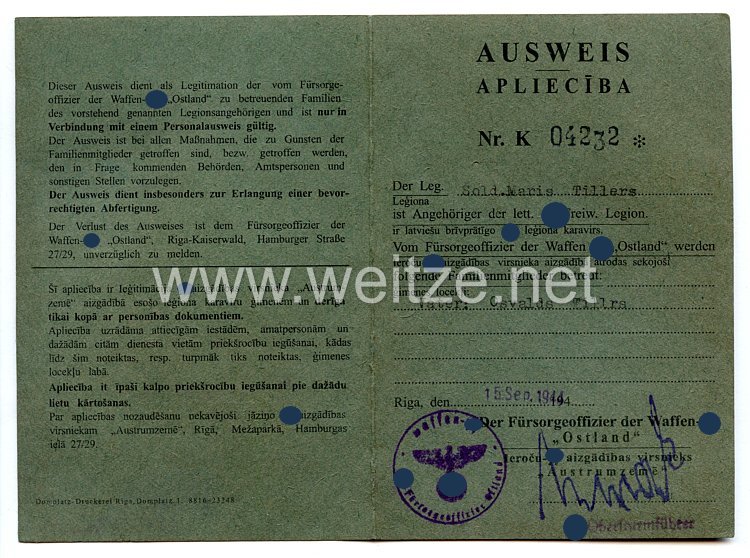
Waffen-SS - Lettische Freiwilligen-Legion - Waffen-SS Identity Card "Ostland"

for a legionnaire regarding his membership in the Latvian SS Volunteer Legion. The following family members are cared for by the Welfare Officer of the Waffen-SS "Ostland": ... Issued on September 15, 1944 in Riga, otherwise no further entries; bilingual form in Latvian and German; only lightly used.
303361
200,00

Waffen-SS - Lettische Freiwilligen-Legion - Waffen-SS Identity Card "Ostland"

This identification document issued by the Waffen-SS “Ostland” for a soldier of the Latvian Volunteer Legion represents a significant historical artifact from World War II. Issued on September 15, 1944, in Riga, this bilingual document (Latvian and German) certified a legionnaire's membership in the Latvian SS Volunteer Legion and identified his family members who were under the care of the welfare officer of the Waffen-SS “Ostland.”

The Latvian Legion, officially designated as the Latvian SS Volunteer Legion, was established in February 1943 and primarily consisted of two divisions: the 15th Waffen Grenadier Division of the SS (Latvian No. 1) and the 19th Waffen Grenadier Division of the SS (Latvian No. 2). These formations emerged in the context of the German occupation of Latvia, which had been under German control since 1941 and formed part of the Reichskommissariat Ostland.

The Reichskommissariat Ostland was established on July 17, 1941, as a civilian administrative unit for the occupied Baltic states and parts of Belarus. It comprised the General Districts of Estonia, Latvia, Lithuania, and White Ruthenia, with headquarters in Riga. The Waffen-SS “Ostland” developed its own administrative structure, which included welfare officers responsible for the social and family affairs of legionnaires.

The recruitment of Latvians into the Waffen-SS was a complex process. Initially, enlistment occurred on a “voluntary” basis, though the term “Volunteer Legion” remains historically contentious. From 1943 onwards, coercive measures were increasingly employed, and mobilization occurred partly under considerable pressure. Many Latvian men found themselves trapped between the German occupation forces and the threat of Soviet return.

The identification document described here served several important functions. Primarily, it served as proof of identity for the legionnaire and as official documentation of his membership in the Latvian SS Volunteer Legion. The registration of family members was of particular significance, as they were entitled to support services from the welfare officer. This welfare included material support, food rations, and potentially financial assistance for soldiers' families.

The issuance date of September 15, 1944, carries considerable historical significance. By this time, the German Wehrmacht was already in strategic retreat on the Eastern Front. The Red Army's Summer Offensive of 1944, Operation Bagration, had resulted in the destruction of Army Group Center. The Baltic states were directly threatened, and Latvian units were engaged in heavy defensive battles, particularly in the Courland Pocket region, where they remained encircled until the war's end in 1945.

The bilingual design of the document in Latvian and German reflects administrative practices in the Reichskommissariat Ostland. The German occupation administration used local languages in official documents to increase administrative efficiency and suggest a degree of legitimacy. These documents were produced according to standardized forms manufactured by the Waffen-SS administration.

After World War II, the fate of Latvian legionnaires became a controversial topic. During the Nuremberg Trials, the Baltic Waffen-SS units were treated differently from other SS formations. The Nuremberg Tribunals acknowledged that many members of these units had been recruited under duress and were not involved in war crimes or Holocaust actions perpetrated by other SS units.

Many former legionnaires fled westward after the war to escape Soviet captivity. Those captured by Soviet forces were frequently treated as “traitors” and deported to labor camps. In the Latvian diaspora, particularly in the United States, Canada, Great Britain, and Australia, the memory of the Legion remained a sensitive topic.

Such identification documents are now rare historical artifacts that provide important insights into the administrative structures of the Waffen-SS and the complex history of the Baltic states during World War II. They document the individual fates of people caught up in the devastating events of this period and serve as reminders of the tragic circumstances under which many Balts were trapped between competing totalitarian powers.

r