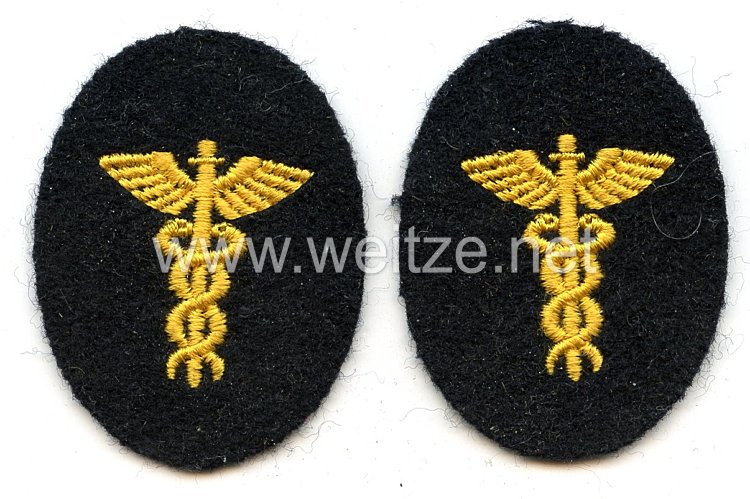
Kriegsmarine Pair of Sleeve Insignia for an Administration Officer

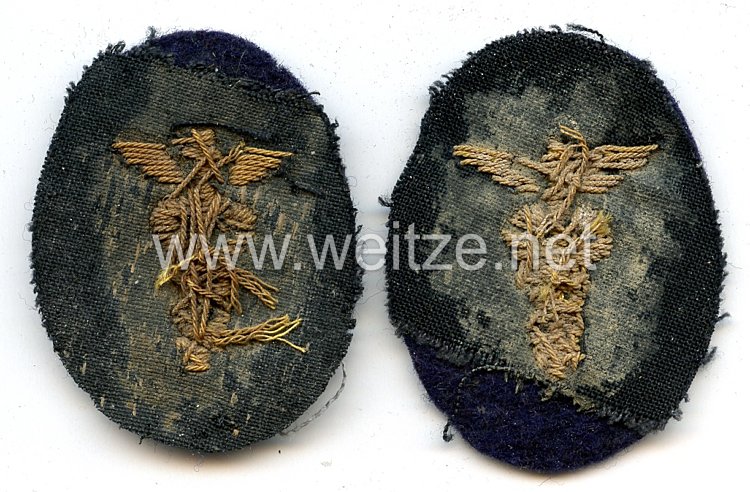
Cellon hand-embroidered version, Condition 2.
441061
55,00

Kriegsmarine Pair of Sleeve Insignia for an Administration Officer

The described sleeve insignia for Administrative Officers of the Kriegsmarine represent an important aspect of the complex rank insignia system of the German Navy during World War II. These hand-embroidered versions on a Cellon backing testify to the high level of craftsmanship employed in the production of officer insignia.

The Kriegsmarine, the official designation of the German Navy from 1935 to 1945, developed a differentiated system of career insignia to identify the various specializations within the naval forces. Administrative Officers formed an essential, though often overlooked, component of the naval organization. They were responsible for administration, supply, pay, and economic management of naval facilities and ship units.

The career insignia of Administrative Officers characteristically displayed gold or silver embroidery that varied according to rank. The insignia were worn in pairs on the dark blue uniform jackets, typically on both sleeves above the rank stripes. The design for Administrative Officers differed significantly from the insignia of other career paths such as Sea Officers, Engineers, Medical Officers, or Weapons Officers.

The use of Cellon as a backing material is of particular significance. Cellon was a thin, translucent celluloid-based material that allowed the embroidery to be applied to a stable backing that could then be sewn onto the uniform. This technique was especially common in high-quality officer versions and differed markedly from the machine-made or woven variants used for enlisted ranks.

The hand-embroidered execution suggests private procurement or production for the senior officer level. Officers of the Kriegsmarine were often required to purchase their uniforms and insignia from private tailors or specialized military outfitters. These suppliers, often traditional firms in the major naval cities such as Kiel, Wilhelmshaven, or Flensburg, offered hand-embroidered versions that were of higher quality than standard issues.

The legal basis for wearing sleeve insignia in the Kriegsmarine was regulated by various uniform regulations. The Dress Regulations for the Kriegsmarine (Anzugsordnung - ANO) specified in detail which insignia were to be worn by which ranks and career paths. These regulations were adjusted and refined several times during the war.

Administrative Officers underwent specialized training that differed from the nautical training of Sea Officers. Many came from civilian administrative professions or had completed commercial training. Their role became increasingly important as the war progressed, as the complex logistics and supply of the widely dispersed naval units required professional administration.

The hierarchy of Administrative Officers ranged from Administrative Officer Candidate through Paymaster to Fleet Intendant as the highest administrative rank. Each of these ranks was characterized by specific combinations of sleeve braids and the career insignia. The sleeve insignia remained fundamentally the same across all ranks, while the number and design of the gold braids differed.

The preservation of such sleeve insignia in good condition is remarkable, as the materials used, particularly Cellon, are susceptible to aging and deterioration. The quality rating “Condition 2” corresponds in collector terminology to a well-preserved condition with possibly slight signs of wear but without significant damage.

Today, such insignia are important study objects for uniform history and military history. They help historians and collectors better understand the organizational structure and self-conception of the Kriegsmarine. The careful documentation and preservation of such objects contributes to the preservation of historical heritage and provides future generations with material access to this chapter of history.

The existence of paired insignia, as described here, is typical for the naval practice of symmetrical uniform decoration. Both sleeves required identical insignia, which explains why these items are often found and preserved in pairs. This practice distinguished the Kriegsmarine from some other military branches where sleeve insignia might be worn on only one arm.