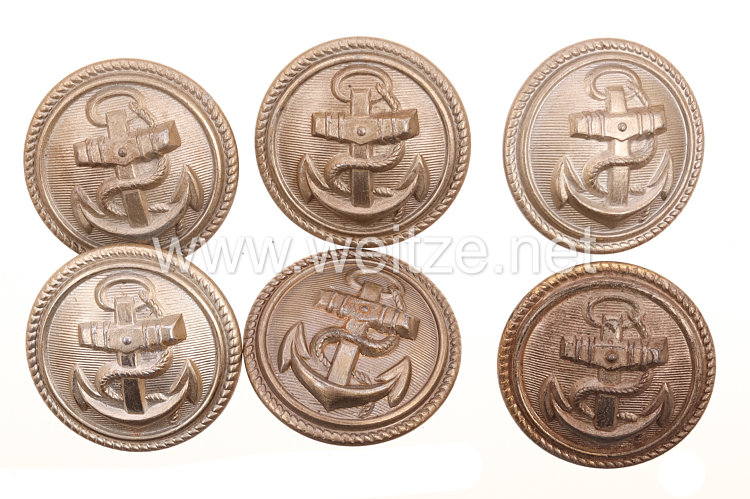
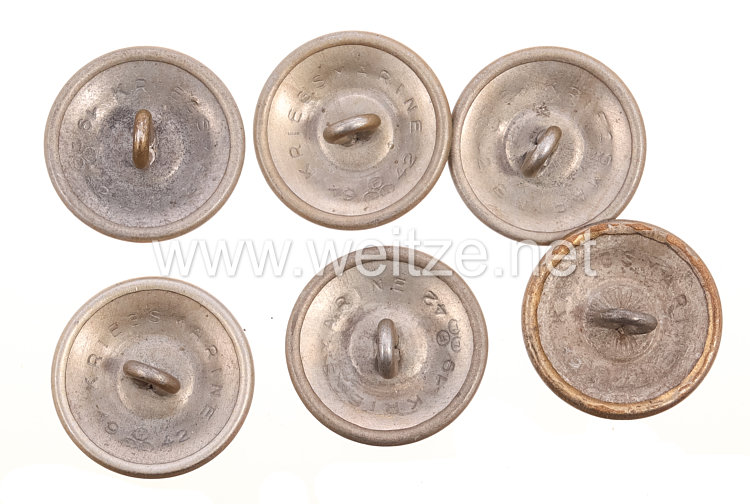
Kriegsmarine 6 Uniform Buttons
Kriegsmarine Uniform Buttons: Standardization and Symbolism of the German Naval War Fleet 1935-1945
These six uniform buttons made of fine zinc with a diameter of 25 mm represent a characteristic element of Kriegsmarine uniforms during the Third Reich period. These seemingly inconspicuous objects reveal, upon closer examination, a complex system of military dress regulations, industrial production, and National Socialist symbolism.
The Kriegsmarine and Its Uniform Regulations
The Kriegsmarine was officially founded on June 1, 1935, replacing the Reichsmarine of the Weimar Republic. This new establishment brought comprehensive reforms to uniform regulations, which were specified in the Anzugsordnung für die Kriegsmarine (A.O.K. - Dress Regulations for the Navy). These regulations controlled every detail of naval personnel appearance, including specifications for uniform buttons.
Kriegsmarine buttons differed from those of other Wehrmacht branches through their specific design. Typically, they displayed an anchor on the front, surrounded by an oak leaf wreath, and frequently bore the inscription “Kriegsmarine.” The reverse stamping with manufacturer marks was standard practice and served both quality control and traceability purposes.
Material Selection and Production
The use of fine zinc as material is particularly noteworthy and characteristic of the war economy. While brass or bronze were frequently used for uniform buttons during peacetime and the early war years, increasing resource scarcity led to greater use of zinc alloys. Zinc was more readily available than copper, which was needed for war-critical production such as ammunition casings.
Uniform button production was carried out by various civilian manufacturers contracted by the Wehrmacht. Each manufacturer had its own stamping, enabling tracking and quality assurance. The uniform production by an identical manufacturer, as with these six specimens, suggests they may have been part of a complete uniform outfit.
Usage and Rank Insignia
Buttons with a 25 mm diameter were primarily used on jacket uniforms of the Kriegsmarine. Different sizes existed for various purposes: larger buttons for jackets and coats, smaller ones for shirts and work uniforms. The position and number of buttons were strictly regulated and could vary depending on uniform type and rank.
For different ranks and career paths, slight variations existed, with officers sometimes wearing gilded or silver-plated buttons, while enlisted personnel and non-commissioned officers used standard metal buttons. The fine zinc buttons described here typically correspond to equipment for enlisted ranks and non-commissioned officers.
Historical Context and Collector Relevance
After the war ended in 1945, many Wehrmacht uniform parts, including those of the Kriegsmarine, were destroyed or stripped of their insignia. Uniform buttons are among the most frequently preserved relics of this era today, as they were often overlooked or stored separately due to their size and low individual value.
For military historical collections, such buttons are significant as they document the standardization and industrial production of military equipment. The reverse manufacturer marking often enables temporal and regional classification, as many manufacturers and their production periods are documented.
The condition grade 2 corresponds in collector terminology to very good to good condition with minimal signs of wear. This indicates that the buttons were either little worn or carefully preserved.
Significance for Uniform Studies
Research into uniform buttons may seem trivial at first glance but is an important subfield of militaria research. Buttons enable conclusions about production methods, material shortages, manufacturer networks, and the development of uniform regulations during the war. The systematic recording of manufacturer markings has led to the identification of hundreds of Wehrmacht suppliers and contributes to understanding the war economy.
These six Kriegsmarine buttons are thus not merely remnants of a uniform but historical documents of a specific epoch of German military history, illustrating the connection between military tradition, National Socialist symbolism, and wartime economic constraints.