German Confederation Court Servant's Sword for a Noble Household

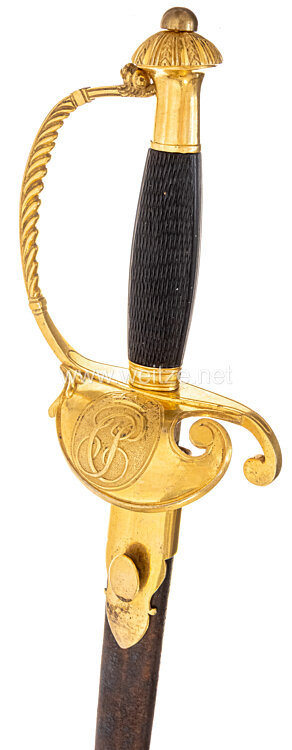
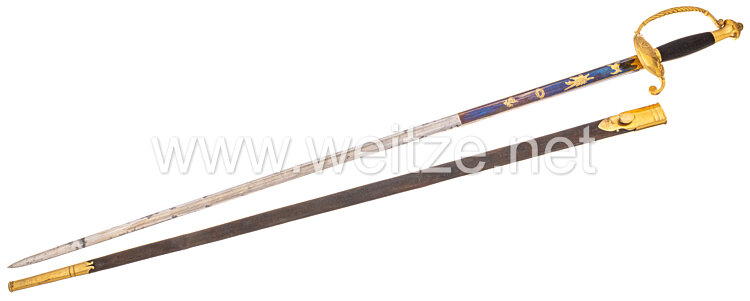
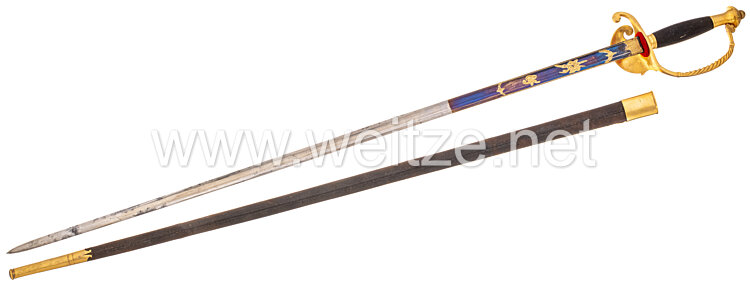
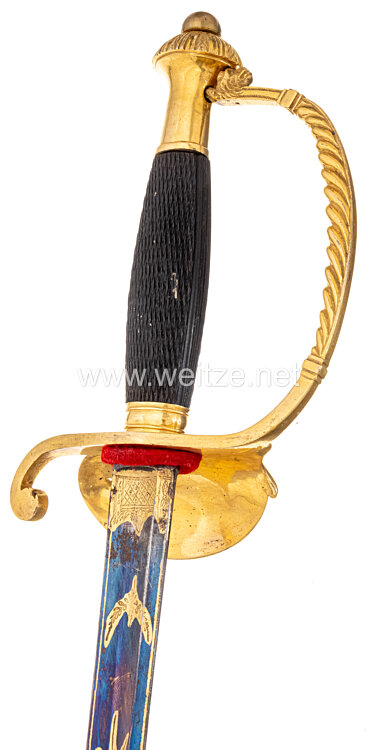
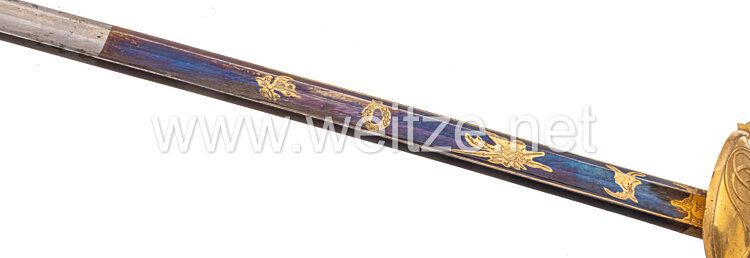
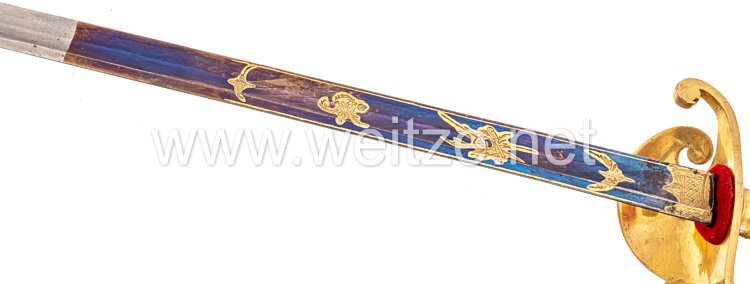
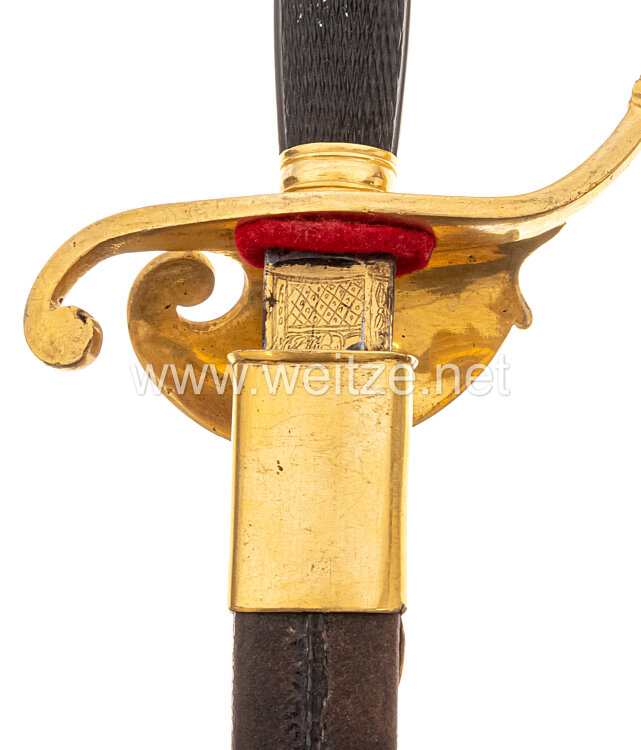
Circa 1820/30. Double-fullered blade approximately 2.2 cm wide and 84 cm long, the lower third of the blade blued and decorated on both sides with gilt engravings. Gilt-bronze hilt, partially chiseled, with a knuckle bow terminating in a lion's head and a counterguard with five-pointed crown for the untitled nobility and the cipher “CP”, black fluted grip, the knuckle bow slightly loose. Black leather scabbard with brass mounts, the scabbard slightly shrunk. Condition 2.

Overall length 99 cm.
464561
950,00

German Confederation Court Servant's Sword for a Noble Household

This court servant's sword from the era of the German Confederation (1815-1866) represents a fascinating category of ceremonial edged weapons that reflected the hierarchical structures of noble households in the early 19th century. Dating to approximately 1820/30, this example embodies the transitional period between the end of the Napoleonic era and the establishment of the restorative order following the Congress of Vienna.

Historical Context of the German Confederation

Following the Congress of Vienna in 1814/15, the German Confederation emerged as a loose confederation of 39 sovereign states. During this period, the German nobility experienced a phase of restoration in which traditional court practices and ceremonial customs were revived. Noble households employed numerous servants in various ranks, from chamberlains to simple servants. For many of these positions, specific uniforms and equipment were prescribed, including ceremonial weapons.

Function and Significance of Court Servants' Swords

Court servants' swords were not combat weapons in the true sense, but rather badges of rank and status symbols. They signified membership in a noble household and the special position of the bearer within the courtly hierarchy. The wearing of such weapons was strictly regulated and followed precise court ranking orders that varied among the different German principalities.

The importance of these ceremonial swords lay in their representative function at court festivities, official receptions, church ceremonies, and other occasions where the splendor and rank of the noble household were displayed. They were part of a comprehensive livery, often designed in the house colors of the respective noble family.

Heraldic and Symbolic Elements

The five-pointed crown on the guard identifies the commissioner as a member of the untitled nobility. In the German ranking system of the 19th century, the number of points and the form of the crown were precisely defined: counts' crowns had nine pearls, barons' crowns had seven, while the five-pointed crown was reserved for the simple nobility (von). This heraldic precision was of utmost importance, as any transgression of status-appropriate symbols was considered a serious breach of etiquette.

The cipher “CP” refers to the initials of the noble master or mistress of the household. Such personalized monograms were common and helped to clearly identify the servants' affiliation with a particular household. They are found not only on weapons but also on livery buttons, tableware, and other household items.

Technical and Artistic Features

The gilt engravings on the blued blade and the partially chased hilt demonstrate high craftsmanship. The blueing of the lower third of the blade was an elaborate process in which the blade was heated in a controlled manner to create a protective and decorative oxide layer. This technique was widespread in the early 19th century and served both aesthetic and practical purposes, as it protected the blade from corrosion.

The lion's head at the end of the knuckle bow is a classic motif symbolizing strength and courage, used in weapon decoration since the Renaissance. The black, fluted grip provided secure hold and contrasted effectively with the gilt metal parts.

The brass fittings of the leather scabbard were typical for civilian and ceremonial swords of this period. Unlike military weapons, which often had iron fittings, court swords used brass or bronze, which could be more elaborately decorated.

Social-Historical Context

The existence of such elaborately designed weapons for court servants illustrates the complex social hierarchies of the 19th century. Even simple servants in noble households participated in the system of status representation. Their external appearance, including their weapons, reflected the status and wealth of their masters.

With the progressive bourgeoisification and political upheavals of the 19th century, particularly after the Revolution of 1848 and the founding of the German Empire in 1871, such ceremonial court weapons gradually lost their significance. Nevertheless, they remained in use in conservative noble households until the end of the monarchy in 1918.

Collector's and Cultural-Historical Value

Today, court servants' swords are important cultural-historical artifacts that provide insight into the culture of representation, craftsmanship, and social organization of the German nobility in the 19th century. They document a vanished world of courtly etiquette and hierarchical order that disappeared irrevocably with the end of World War I.

r