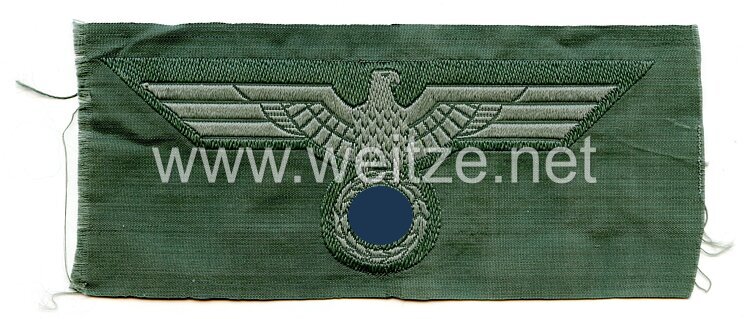
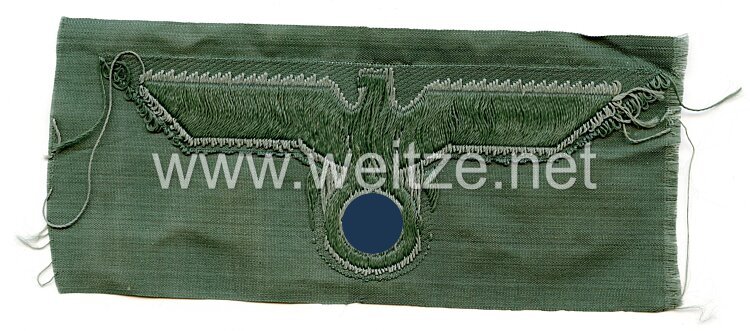
Wehrmacht Heer Breast Eagle for Enlisted Men
Condition may vary.
Price per piece: 75 Euro
The Wehrmacht Heer breast eagle for enlisted men represents a characteristic insignia of the German armed forces during World War II. This particular example shows the Bevo-woven design, which was intended for the later field tunic models M 41, M 42, and M 43.
The development of Wehrmacht breast eagles followed a long tradition of military national emblems in German military history. After the seizure of power in 1933, uniform regulations were systematically revised. The eagle as a national symbol was officially introduced for the newly created Wehrmacht on February 17, 1934. For enlisted men and non-commissioned officers of the Army, the breast eagle was worn on the right breast side of the field tunic, above the breast pocket.
The Bevo weaving technique owes its name to Bandfabrik Ewald Vorsteher from Wuppertal-Barmen, which perfected this weaving method. With this process, the insignia were woven directly in one piece, as opposed to embroidered or printed versions. The Bevo technique enabled cost-effective mass production while maintaining high detail accuracy and durability. The insignia were flat, lightweight, and could be easily sewn onto the uniform.
The eagle for enlisted men differed significantly from officer versions. While officers wore hand-embroidered or machine-embroidered eagles made of aluminum or silver thread, the enlisted men's eagles were rendered in more subdued colors. The eagle was typically woven in gray or gray-green yarn on a dark green background, which ensured good camouflage in the field.
The various field tunic models for which this eagle was intended represent the war-induced evolution of German uniforms. The Field Tunic M 41 was a simplified version of the earlier M 36 and M 40 models. The M 42 represented further simplification, with decorative elements increasingly eliminated. The Field Tunic M 43 was finally the most austere version, created under the pressure of material shortages and the need for rapid mass production.
Wearing regulations for the breast eagle were precisely defined in the Army Regulation Gazettes (Heeres-Verordnungsblätter or HVBl). The eagle had to be sewn on the right breast side, centered above the breast pocket. The distance from the top edge of the pocket was prescribed to ensure a uniform appearance. These regulations were maintained throughout the war, although practical implementation under field conditions was not always perfectly possible.
The production of Bevo insignia was carried out not only by the eponymous company but also by numerous other supplier companies throughout the German Reich. Quality could therefore vary, with early war productions generally being of higher quality than late versions from 1944-1945. Towards the end of the war, increasingly inferior materials were used, and the weaving technique was simplified.
From a collector's perspective, unworn examples like the one described are of particular interest. They show the original quality and coloring without the signs of aging from wearing, washing, or weather exposure. The stated Condition 2 means in the collector's hierarchy a very good to excellent state of preservation with possibly minimal storage traces.
The historical classification of such militaria requires sensitivity. These objects are testimonies to a dark period in German history. They have significance for military historical research, uniform studies, and understanding the material culture of World War II. Serious collectors and institutions preserve such items for educational and research purposes, always conscious of the historical context and without glorification.
The demand for authentic Wehrmacht insignia in the collector's market has unfortunately also led to numerous forgeries. Experts recognize originals by the specific weaving technique, the materials used, the coloring, and other details that are difficult to reproduce. Bevo insignia show characteristic woven edges and a specific reverse side structure.
Today, these objects serve as tangible reminders of historical events and help future generations understand the realities of warfare and totalitarian regimes. Museums, archives, and educational institutions use such artifacts to illustrate lectures, exhibitions, and publications about the Second World War. The study of military uniforms and insignia contributes to a comprehensive understanding of military organization, logistics, and the everyday life of soldiers during this period.