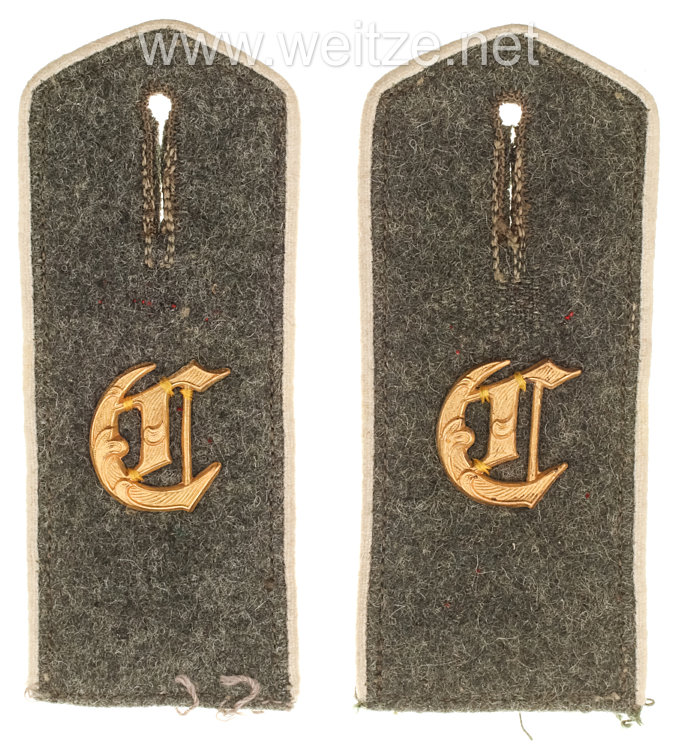
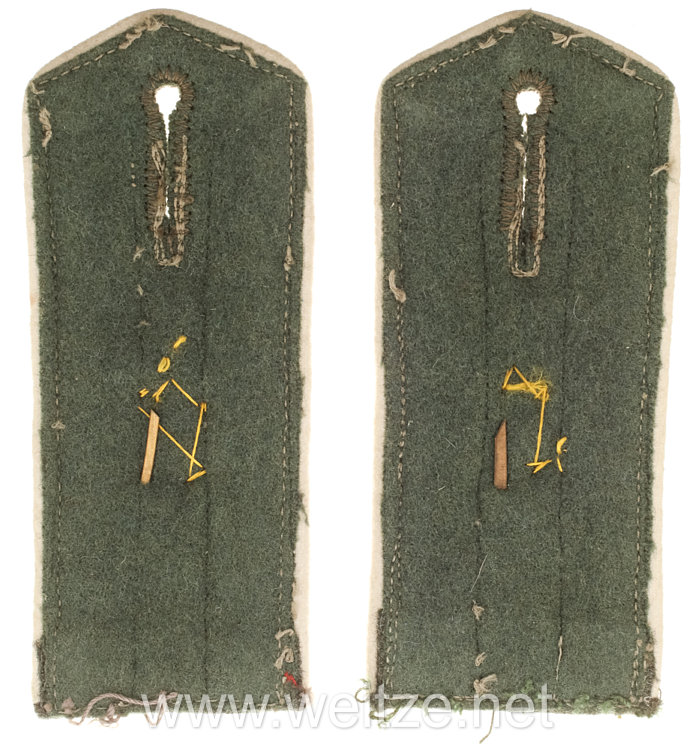
These shoulder straps of the Landwehr-Inspektion Erfurt (Erfurt Landwehr Inspection) in field-gray cloth with gilt applied letter āEā represent a significant aspect of Prussian military organization during World War I. These rank insignia, manufactured around 1917, reflect the complex administrative structure of the Prussian Landwehr, which alongside the active army and reserves formed one of the three main components of the German military.
The Landwehr was an institution with deep roots in Prussian military history. Originally created in 1813 during the Wars of Liberation against Napoleon, it was fundamentally reorganized through the army reform of 1814 and later through the military service laws of 1888 and 1913. Conscripted men first served in the active army, then in the reserves, and finally in the Landwehr, creating a tiered system of military readiness.
The Landwehr Inspections functioned as regional administrative centers responsible for organizing, mobilizing, and administering Landwehr units in their respective districts. The Landwehr-Inspektion Erfurt belonged to the corps district of the XI. Army Corps with general command in Kassel. This corps district encompassed large parts of Thuringia and northern Hesse, including the Landwehr districts of Weimar, Erfurt, Marburg, and Hersfeld. The XI. Army Corps, founded in 1866 after the Austro-Prussian War, traditionally played an important role in the Prussian and later German military structure.
The technical characteristics of these shoulder straps are typical of the late war period. The field-gray cloth had been the standard color of German field uniforms since 1907/1910, replacing the previously worn colored uniforms. The white piping identified officers of the infantry and related branches. The reseda green cloth base was the branch color associated with certain military functions and administrative units. The gilt applied letter āEā clearly identified affiliation with the Erfurt Inspection.
The construction for sewing in corresponds to regular practice for officers' shoulder straps. Unlike enlisted and non-commissioned officers' shoulder straps, which were often slipped on, officers' shoulder straps were typically sewn in permanently. This gave the uniform a more closed, neater appearance and corresponded to the higher status of officer ranks.
In the context of 1917, Germany was in the third year of World War I. The Landwehr played an increasingly important role as the original active and reserve units were weakened by ongoing combat. Landwehr officers, often older men with experience from earlier service years or younger officers with special training, assumed important duties both at the front and at home. The Landwehr Inspections were crucial for maintaining the supply of trained soldiers and organizing replacement units.
The rarity of such shoulder straps from Landwehr Inspections can be explained by several factors. First, the inspection staffs were relatively small, with only a limited number of officers. Second, many uniform items did not survive the turmoil of the war's end and the post-war period. After the Armistice of 1918 and the provisions of the Treaty of Versailles, the German military was drastically reduced, and many military insignia were destroyed or lost their official significance.
These shoulder straps are not merely military rank insignia but also historical documents providing insight into the complex organization of the German military during World War I. They represent the administrative structures necessary to mobilize, train, and manage millions of men. The precise identification through letters and colors enabled immediate recognition of an officer's affiliation, which was crucial in the complex military hierarchy.
Today, such items serve as tangible connections to a pivotal period in European history. They remind us of the vast organizational apparatus required to wage modern industrial warfare and the individuals who served within these structures. For collectors and historians, these shoulder straps from the Landwehr-Inspektion Erfurt offer a rare glimpse into the regional military administration of Imperial Germany during its final years.