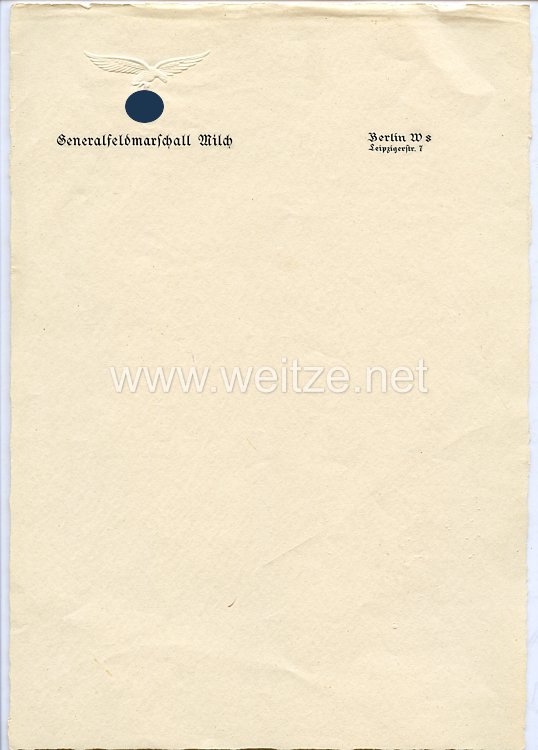
Luftwaffe - Generalfeldmarschall Erhard Milch - His Personal Stationery

with embossed Luftwaffe eagle and letterhead reading “Generalfeldmarschall Milch - Berlin W 8 Leipzigerstr.7”; unfolded with minor storage marks.
336960
150,00

Luftwaffe - Generalfeldmarschall Erhard Milch - His Personal Stationery

This letterhead belonging to Generalfeldmarschall Erhard Milch represents a remarkable testimony to the highest military leadership level of the German Luftwaffe during World War II. Such personal correspondence materials of high-ranking officers not only provide insight into the administrative practices of the Wehrmacht but also document the representational culture and hierarchical structures of the National Socialist military apparatus.

Erhard Milch (1892-1972) was among the most influential figures in Luftwaffe history. His career began during World War I as a flying officer. In the Weimar Republic, he made his name as director of Deutsche Luft Hansa and played a crucial role in the covert construction of German air forces, which was actually prohibited by the Treaty of Versailles. After the Nazi seizure of power in 1933, Milch was appointed State Secretary in the Reich Aviation Ministry and served as Hermann Göring's right-hand man in the systematic construction of the Luftwaffe.

On July 19, 1940, following successful campaigns against Poland and France, Milch was promoted to Generalfeldmarschall along with eleven other Wehrmacht generals. This wave of promotions was part of Hitler's propaganda following the Western campaign. Milch was thus one of only five Luftwaffe officers who ever achieved this highest military rank in the German Wehrmacht. The others were Hermann Göring (who later received the unique rank of Reichsmarschall), Albert Kesselring, Hugo Sperrle, and Wolfram von Richthofen.

The address indicated on the letterhead, Berlin W 8, Leipziger Straße 7, was located in the center of the governmental district of the Reich capital. Leipziger Straße was one of Berlin's most important thoroughfares and housed numerous ministries and administrative buildings. The use of this prestigious address underscores Milch's central position in the NS state. The Reich Aviation Ministry itself was located in close proximity on Wilhelmstraße.

The embossed Luftwaffe eagle on the letterhead corresponds to the official symbolism of the Wehrmacht. The Luftwaffe's national eagle showed the stylized eagle with outstretched wings, holding a swastika in its talons. The embossed design (blind embossing or with color) was a sign of special quality and exclusivity. Such letterhead was specially manufactured for high-ranking officers and was part of the official equipment associated with their respective rank.

Milch's area of responsibility was extraordinarily extensive. As Inspector General of the Luftwaffe and head of the Generalluftzeugmeister, he was largely responsible for aircraft production, technical development, and material equipment of the air forces. Particularly from 1941/42 onward, as the war situation deteriorated, Milch concentrated on increasing armaments production. He worked closely with Albert Speer and bore responsibility for the massive expansion of the aircraft industry, which also employed forced laborers and concentration camp prisoners under inhumane conditions.

A Generalfeldmarschall's correspondence encompassed a broad spectrum from military orders to administrative directives to diplomatic correspondence. The letterhead was used for official and semi-official writings. It documents the bureaucratic penetration of the NS regime, in which even everyday administrative processes were marked with military symbolism.

After the war's end, Milch was found guilty of war crimes and crimes against humanity in the Nuremberg Milch Trial (1947). The court convicted him for his responsibility for the forced labor program and medical experiments on concentration camp prisoners, sentencing him to life imprisonment. The sentence was later reduced to 15 years, and he was released early in 1954.

From a historical perspective, such objects as the present letterhead are important material witnesses of the NS period. They document administrative structures, hierarchical systems, and the daily practice of military leadership. For military-historical research, they offer authentic insights into the organizational culture of the Wehrmacht and complement written records with material evidence. At the same time, they serve as reminders of the military elite's entanglement in the crimes of the NS regime.

r