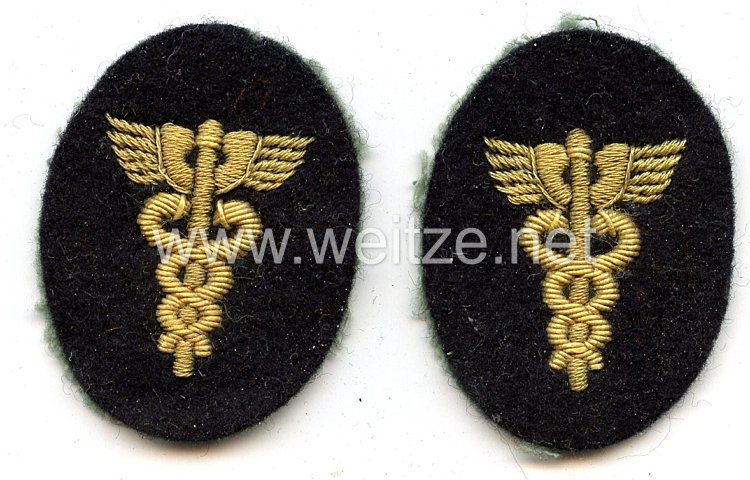
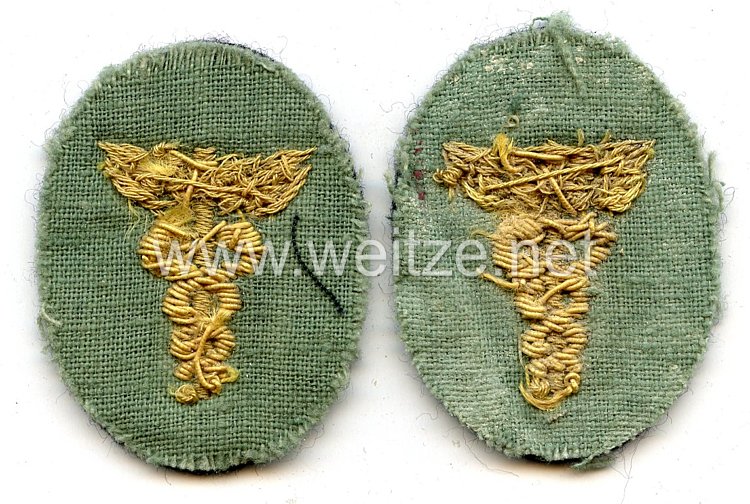
Kriegsmarine Pair of Sleeve Insignia for an Administrative Officer

Cellon hand-embroidered version, condition 2.
441060
55,00

Kriegsmarine Pair of Sleeve Insignia for an Administrative Officer

These sleeve insignia for administrative officers of the Kriegsmarine represent an important aspect of the complex rank system of the German Navy during World War II. These hand-embroidered insignia in Cellon execution demonstrate the high craftsmanship quality that was applied in the production of officer insignia of this era.

The Kriegsmarine, founded in 1935 after Nazi Germany officially renounced the provisions of the Treaty of Versailles, developed a detailed system of uniforms and rank insignia that was strongly oriented toward the traditions of the Imperial German Navy. The various officer groups were distinguished by specific colors in their sleeve insignia, with administrative officers occupying a special role within the naval organization.

Administrative officers were responsible for the logistical and administrative leadership of the Navy. Their duties included supplying ships and land facilities, managing finances, personnel administration, and coordinating material resources. These officers typically wore dark green underlay on their sleeve stripes, distinguishing them from other officer career paths. Marine engineers wore pink, medical officers dark blue, and line officers the traditional golden stripes without colored underlay.

The Cellon embroidery was a particularly high-quality form of officer insignia execution. Cellon was a cellulose-based material commonly used at the time, which had a silky sheen and was valued for its durability. Hand-embroidered versions were significantly more elaborate to produce than machine-made or woven variants and were often preferred by officers for their dress uniforms or when privately procured.

The Kriegsmarine dress regulations were detailed in the “Anzugordnung für die Kriegsmarine” (M.Dv. Nr. 110). This regulation specified exactly which uniform items were to be worn on which occasions and how rank insignia were to be attached. Sleeve insignia were worn on both sleeves of the uniform tunic and indicated the respective rank through the number of gold stripes and the arrangement of stars.

A pair of such sleeve insignia was necessary because both sleeves of the uniform tunic had to be appropriately equipped. The symmetrical placement on both sides corresponded to military tradition and uniform regulations. The insignia were usually sewn onto the uniform by the wearer or by master tailors, with the exact positioning being prescribed.

The craftsmanship quality of these insignia reflects the importance attached to external appearance in the military hierarchy. Despite the increasing war economy and material shortages in the later stages of the war, correct uniforming remained an important element of military discipline and tradition. However, as the war progressed, simplified versions or substitute materials were increasingly used.

After the end of World War II in 1945, the Kriegsmarine was dissolved, and its uniforms and insignia became historical artifacts. Today, such sleeve insignia are important study objects for military historians and uniformologists researching the complex system of military ranks and organizational structures of that time. They document not only the military hierarchy but also the craft traditions and material culture of the era.

The preservation of such historical objects is of scientific importance as they represent authentic testimonies of an important, albeit dark, period in German history. They enable researchers and interested parties to better understand and document the organizational structure and daily life in the Kriegsmarine.

These administrative officers formed the backbone of the naval supply and support system, ensuring that combat units could function effectively. Their technical expertise in logistics, finance, and administration was crucial for maintaining the operational readiness of the fleet. The distinct insignia they wore served not only as rank identification but also as recognition of their specialized professional role within the naval hierarchy.