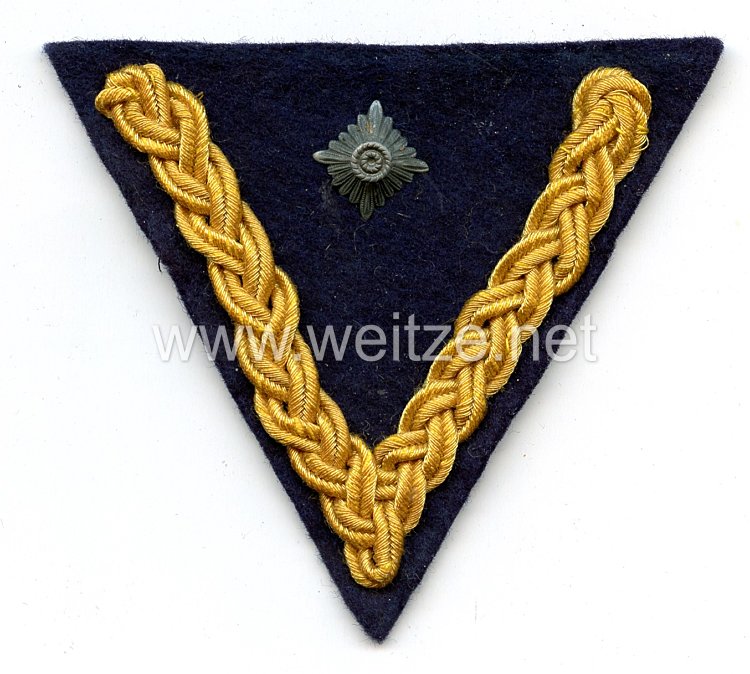
Kriegsmarine Sleeve Insignia for a Matrosenobergefreiter with More Than 6 Years of Service
The Kriegsmarine sleeve insignia for a Matrosenobergefreiter (Able Seaman Senior) with more than 6 years of service represents a significant example of the complex rank insignia system of the German Kriegsmarine during World War II. This particular celluloid (Cellon) execution for the blue uniform embodies the precise hierarchy and recognition of service time within the maritime forces of the Third Reich.
The Kriegsmarine, officially founded in 1935 as the successor to the Reichsmarine, developed a sophisticated system of rank insignia and grade markings. The rank of Matrosenobergefreiter was part of the enlisted grades and was positioned in the hierarchy between the simple Matrose Obergefreiter and the Matrosenhauptgefreiter. The designation of years of service through special badges was an essential component of the uniform regulations and served for quick identification of experience and loyal service.
The Cellon execution of these sleeve badges is of particular historical interest. Cellon was a cellulose-based material used in the manufacture of uniform insignia, particularly for the blue work and walking-out uniform of the Kriegsmarine. Unlike the embroidered badges for the parade uniform, Cellon badges offered practical advantages: they were more robust, weather-resistant, and more cost-effective to produce. The blue uniform on which these badges were worn was the standard uniform for daily service aboard ships and ashore.
The system of service time insignia in the Kriegsmarine followed precise regulations set forth in the Dress Regulations for the Kriegsmarine (M.Dv. Nr. 53). After four years of service, a sailor received a first service time badge in the form of a single chevron. After another four years, that is, upon completion of eight years of service, a second chevron was added. The badge described here for “more than 6 years of service” indicates a sailor who stood between his first service badge (after 4 years) and the second (after 8 years), or it could represent an intermediate designation.
The wearers of such badges were experienced seamen who formed the core of the Kriegsmarine. At a time when the German Navy was experiencing rapid expansion and many new recruits were being enlisted, these experienced non-commissioned officers and enlisted grades were invaluable. They often served as instructors, boatswain's mates, or in other positions requiring experience and reliability. Their service time, which dated back at least to the pre-war years or early war phase, made them important carriers of institutional knowledge and seamanship.
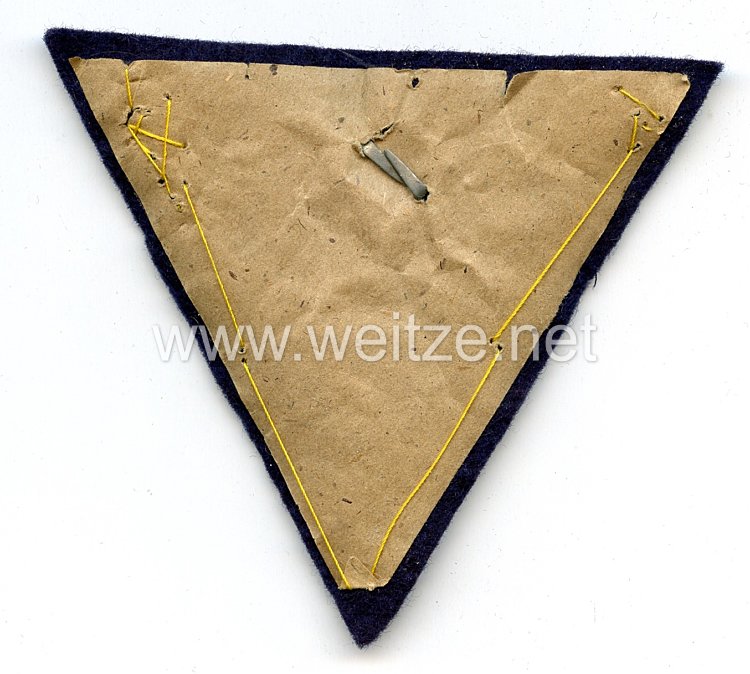
The manufacture and procurement of such badges was carried out by various manufacturers throughout the German Reich. Standardization was important, yet there were certainly variations in quality and exact execution details. Cellon badges were typically applied to a fabric backing and sewn onto the upper arm of the uniform jacket. The position was precisely prescribed: on the left upper arm, at a specified height above the elbow.
The condition grade 2 of this specific specimen indicates a well-preserved piece that has survived the decades since the war's end. Such badges are today important witnesses to history and objects of study for military historians and collectors. They enable insights into the everyday reality of the Kriegsmarine, the material economy of the war, and the organizational structures of the German armed forces.
In the context of Kriegsmarine history, these badges represent more than just rank markings. They tell of individual careers, of the professionalization of the Navy in the 1930s, of the challenges of the war years, and of daily life aboard German warships. The men who wore such badges served on U-boats, destroyers, cruisers, and battleships, in coastal batteries and naval bases from Norway to the Black Sea.
Today, such uniform items are important components of military historical collections and serve research and education about this complex and tragic period of German and European history.