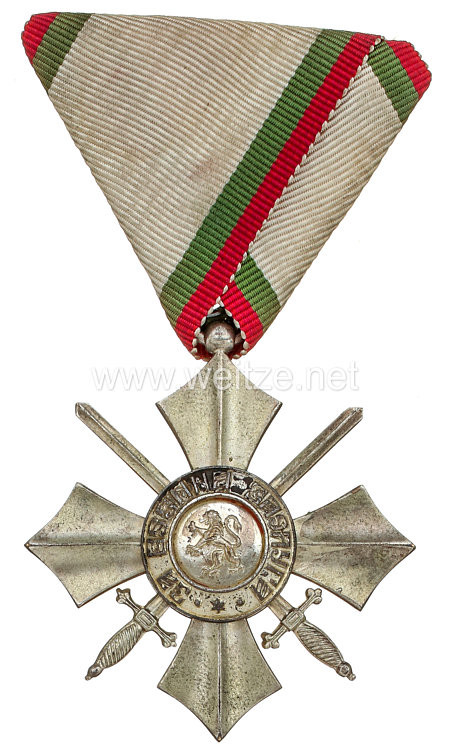
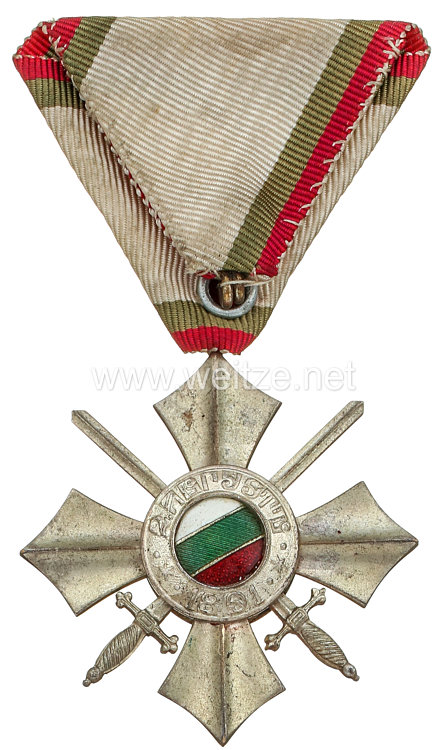
Bulgaria Order of Civil Merit 1944-1946 6th Class Silver Merit Cross with Swords

Silver-plated cross on triangular ribbon. Condition 2.
In the 1944-1946 model, the monogram on the reverse was replaced by the national colors.
353860
140,00

Bulgaria Order of Civil Merit 1944-1946 6th Class Silver Merit Cross with Swords

The Bulgarian Order of Civil Merit represents one of the most significant state decorations of the Kingdom of Bulgaria and documents the complex history of the country during World War II and the immediate post-war period. The 6th Class Silver Cross of Merit with Swords from the 1944-1946 period described here represents a particularly interesting transitional phase in Bulgarian history.

The Order of Civil Merit was originally established in the Kingdom of Bulgaria to recognize special services by civilians and military personnel. The decoration was divided into several classes, with the 6th Class representing the Silver Cross of Merit. The addition of swords indicated services rendered during military engagements or under wartime conditions.

The years 1944-1946 mark a decisive turning point in Bulgarian history. In September 1944, a government coup occurred in which the Fatherland Front seized power. Bulgaria, which had previously been allied with the Axis powers, switched sides and declared war on Germany. This dramatic political reorientation led to comprehensive changes in all state sectors, including the system of honors and awards.

The most important modification to the order during this period concerned the reverse side of the decoration. While earlier versions bore the royal monogram, this was replaced after 1944 by the Bulgarian national colors (white, green, and red). This change reflects the departure from monarchy and the turn toward a new form of state, which culminated in the proclamation of the People's Republic of Bulgaria in 1946.

The silver-plated cross itself follows the traditional design of Bulgarian orders. The use of silver-plated metal instead of solid silver was quite common during this period and reflects both the economic situation of the country after the war and the necessity to produce a larger number of decorations. The triangular ribbon is characteristic of Bulgarian order decorations and distinguishes them from the rectangular ribbons of many other European orders.

The award practice during 1944-1946 was particularly intensive. Numerous individuals received decorations for their role in the transition to the new political circumstances, for services in the fight against German troops during the final months of the war, or for the reconstruction of the country. The military variant with swords was awarded to soldiers and officers who participated in the fighting in Yugoslavia and Hungary against the retreating German forces.

The transitional period of 1944-1946 was characterized by the simultaneous existence of old and new forms of orders. While monarchist symbols were removed, the basic structure and hierarchy of the order system were initially retained. This enabled a certain continuity and kept the decorations understandable and valuable to the population.

From a collector's perspective, orders from this brief transitional phase are of particular interest. They document a historical turning point and are rarer than earlier monarchist or later communist versions due to the relative brevity of the period in which they were awarded. The authenticity of such pieces can be verified by the characteristic features of the period: the absence of the monogram, the presence of the national colors, and the specific manufacturing quality of the immediate post-war period.

The condition grade 2 indicates a well-preserved specimen showing the typical signs of wear of a worn decoration but no significant damage. This is remarkable for orders from this period, as many examples were lost or damaged during the turbulent post-war years.

Today, such decorations serve as important historical documents providing insight into the complex political transformations of Southeastern Europe in the mid-20th century. They commemorate a time of profound change and the people who were honored during this difficult transitional phase.